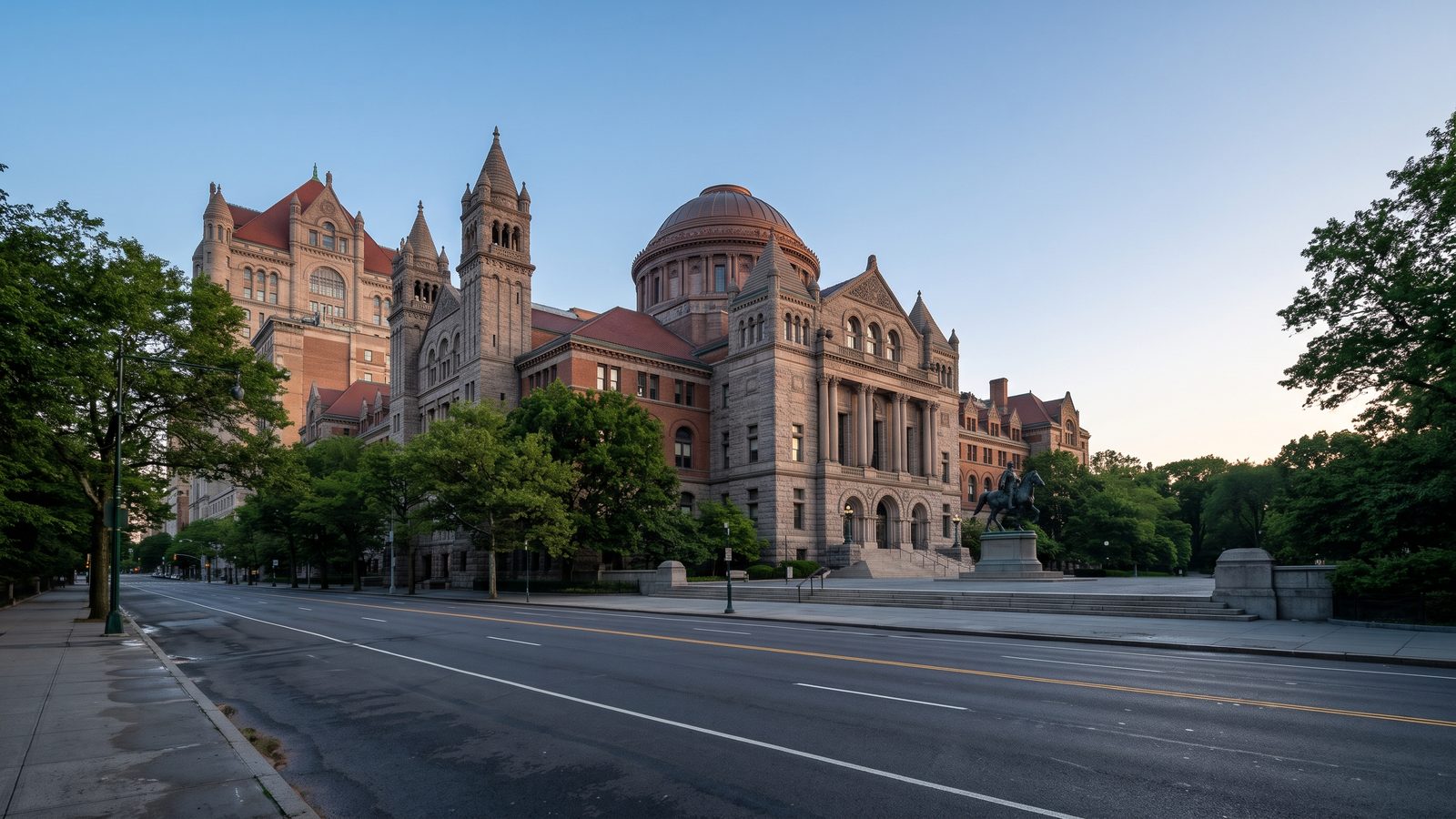
Step inside one of the world's most renowned cultural institutions and trace the story of our planet across billions of years. Located in Manhattan, the museum invites you on a voyage through deep time, showcasing everything from towering prehistoric fossils to detailed wildlife dioramas and cultural treasures. As you explore its expansive halls, you connect directly with the natural world and human history.
This self-guided audio tour highlights key halls across the complex, immersing you in the forces of evolution, exploration, and planetary science. Discover how iconic displays came to be and gain a deeper appreciation for Earth's incredible biodiversity and rich heritage at your own pace.
Listen to a sample
The opening of this tour, exactly as AllTours narrates it on site.
What you'll hear on this tour
Stop 1. Fossils of the Ancient Giants
You stand dwarfed beneath the towering fossilized skeletons of creatures that once ruled the planet. Look closely at the Triceratops skull and notice how its expansive frill served for defense or display. Nearby, you see a sleek Velociraptor, complete with feathered features that reflect modern scientific understanding rather than Hollywood myth. These painstakingly assembled fossils connect you directly to a bygone era when massive herbivores roamed ancient forests and formidable carnivores stalked their prey. As you examine the intricate detail in each bone, you feel the sheer scale of prehistory and sense an age when these remarkable giants made the Earth tremble with every step.
Stop 2. Masterpieces of the Animal Kingdom
Step into halls filled with breathtaking wildlife dioramas that showcase Earth's most adaptable creatures. You gaze at a massive African elephant with tusks that tell a story of survival, standing as a poignant reminder of modern conservation efforts. Nearby, a meticulously crafted grizzly bear diorama highlights raw power, capturing every muscle and individual strand of fur. As you explore these lifelike scenes, you uncover the remarkable evolutionary adaptations that allow mammals to flourish in extreme environments, from deep oceans to high mountain peaks. You learn how warm-blooded metabolisms, specialized diets, and insulating coats enabled these creatures to spread across every corner of the globe.
Stop 3. Crystalline Treasures of Deep Earth
Prepare to be dazzled by the raw, sparkling building blocks of our planet. You stand before deep purple amethysts formed under immense geological pressures eons ago. As you inspect a geometric quartz crystal, you admire the precise, atomic symmetry visible in every clear facet. Further along, translucent green Burmese jade reveals the extreme heat and pressure that forged it deep within the Earth, while iridescent labradorite flashes with colors reminiscent of captured moonlight. These brilliant specimens are far more than beautiful gemstones; they serve as silent, enduring storytellers, each unique crystal recording a fascinating chapter of our planet's dramatic dynamic history.
Stop 4. Voices and Vessels of Human Heritage
You venture deeper into the museum to explore the rich tapestry of human ingenuity and cultural traditions. In the Northwest Coast Hall, you stand among massive carved totem poles, where detailed figures represent ancestral lineages, history, and spiritual connections. You observe intricate beadwork adornment on Native American regalia, where every tiny, carefully placed bead narrates traditions tied to the land. Nearby, ancient pottery vessels from the American Southwest demonstrate sophisticated crafting and firing techniques passed down through generations. These masterworks offer you a window into the beliefs, social structures, and enduring heritage of diverse human societies throughout history.
Stop 5. Tracing the Tree of Life
You arrive at the center of life's grand story, where the mechanics of evolution come alive. Before you stretches a complex phylogenetic tree, illustrating how distinct species branched from common ancestors over millions of years. You examine fossilized early amphibians whose limb structures clearly capture the monumental transition from water fins to land-walking legs. Look at your own hand and compare it to a bat's wing or a whale's flipper; these shared structural blueprints demonstrate natural selection in action. Through these fossil clues and deep time, you trace how gradual genetic adaptations shaped the staggering biodiversity thriving across our planet today.
Stop 6. Relics of Historic Expeditions
You step into the world of daring explorers who ventured into uncharted territories to expand human knowledge. Here you inspect historic artifacts brought back from epic journeys across the globe, including delicate biological specimens gathered during Darwin's voyage on the HMS Beagle. You examine navigation gear used by Shackleton while enduring the harsh Antarctic ice, noticing the physical scratches and wear that speak to incredible human resilience. These instruments and preserved specimens represent courageous individuals who faced extreme hardships driven by curiosity. Through their relentless pursuit of discovery, these pioneering journeys redrew world maps and forever transformed our understanding of nature.
Planning your visit
- Best time to go
- Weekday mornings right at opening offer the quietest experience in the main halls.
- Approximate duration
- about 2 to 3 hours
- Where to start
- Central Park West entrance or the Theodore Roosevelt Rotunda
Access and conditions change seasonally — check the official site before you go.
Frequently asked questions
Is American Museum of Natural History worth visiting?
Yes, the American Museum of Natural History is world-renowned for its vast collections, iconic dinosaur halls, and historic wildlife dioramas, making it an unmissable landmark for visitors of all ages.
How long do you need at American Museum of Natural History?
Plan to spend at least 2 to 3 hours for a highlights tour, though enthusiasts can easily spend a full day exploring all four floors and dozens of exhibition halls.
When was the American Museum of Natural History founded?
The museum was founded in 1869 by a group of prominent citizens, including Theodore Roosevelt Sr., to display natural history specimens and promote scientific inquiry.
Keep exploring
Header image is an AI-generated illustration of American Museum of Natural History. AllTours.ai is an AI audio tour guide — point your camera at any landmark and hear its story.