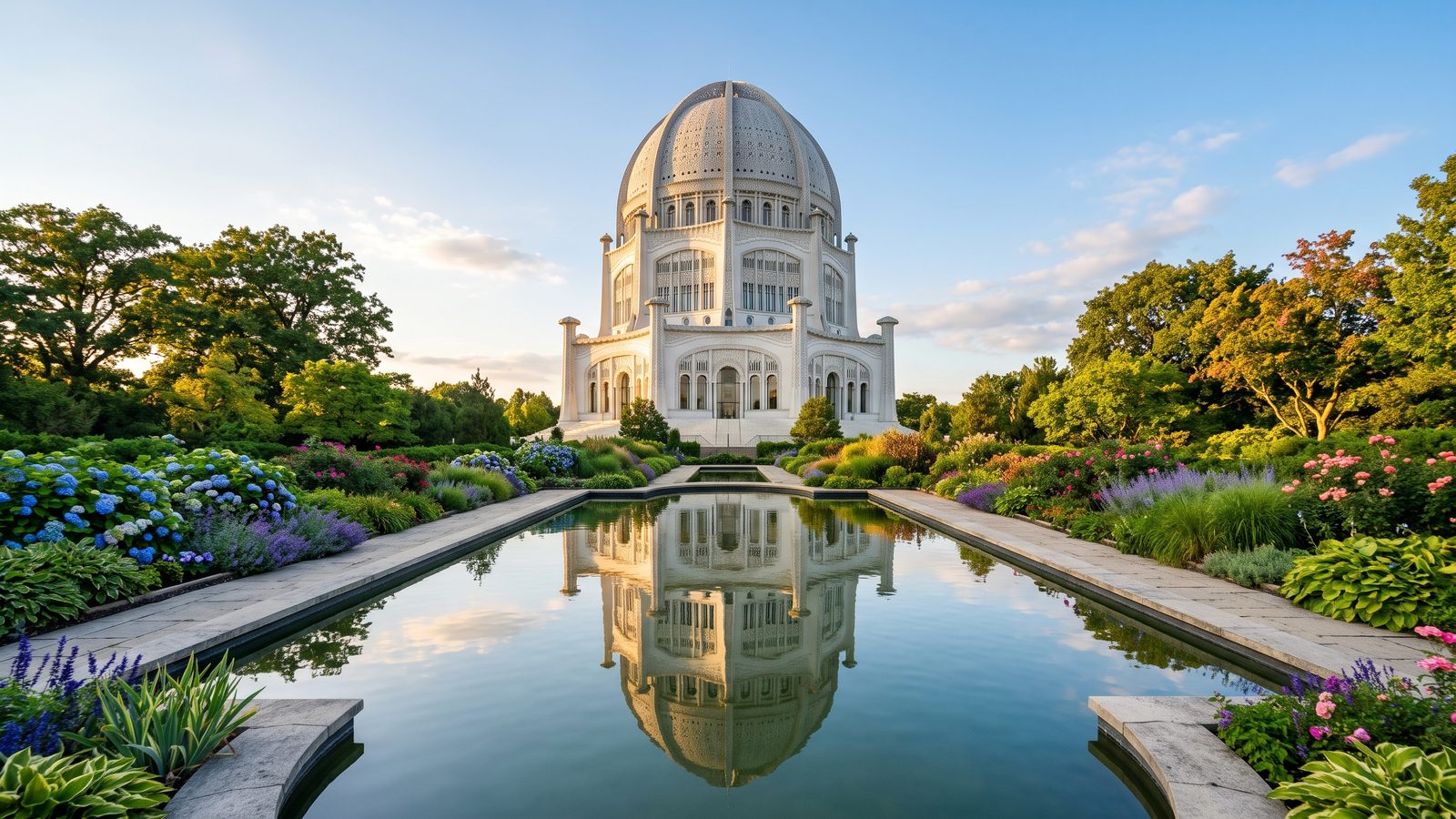
Welcome to Wilmette, Illinois, home to the extraordinary Baháʼí House of Worship. Rising above the shores of Lake Michigan, this architectural masterpiece stands as a glowing beacon of peace, interfaith harmony, and human unity. As you step onto these serene grounds, prepare to discover a sacred space built on the core principle that all religions share a fundamental spiritual origin, woven together through intricate design, geometry, and nature.
This self-guided audio tour walks you through the history, symbolism, and soothing landscape of North America's only Baháʼí temple. From its soaring lace-like dome to its reflective gardens, you will experience a tranquil oasis crafted specifically to inspire reflection, connection, and awe for every visitor.
Listen to a sample
The opening of this tour, exactly as AllTours narrates it on site.
What you'll hear on this tour
Stop 1. A Century-Long Vision of Harmony
You stand before a monument born from a vision of universal spiritual unity. Tracing its origins to early 20th-century Baháʼí principles, this land was purchased in 1908 by architect Louis Bourgeois and his wife, Juliette. Construction began in 1912 after ʻAbdu'l-Bahá visited the site and prayed for its completion. World War I, financial challenges, and the sheer complexity of its ambitious structure delayed progress for decades. After over forty years of dedicated effort from global volunteers, the temple was consecrated in 1953. As you take in its towering silhouette, you feel the enduring dedication of the artisans who built this haven.
Stop 2. Intertwined Traditions in Concrete Lace
Look up at the nine points of the dome as they transition into the starburst motif below. You are viewing a masterful synthesis of Islamic, Christian, and Buddhist geometric traditions, reflecting a universal message of unity. Observe the intricate concrete lacework of the ornamentation. Delicate details catch the sunlight to cast ethereal shadows across the facade, creating an overwhelming sense of profound peace. Hidden structural engineering supports the immense scale of the central dome, which soars high above you. As you examine every curve and facet of this edifice, you sense the intense devotion poured into its creation by craftspeople united in a singular spiritual vision.
Stop 3. Geometry of the Celestial Sphere
Observe how ninety-one radiating ribs stretch across the dome, echoing the celestial sphere where each rib symbolizes a distinct nation converging toward a single point of light. Geometric patterns inside represent the infinite complexity of the universe. Sunlight filters through expansive windows, casting dynamic illumination that shifts throughout your visit to mirror evolving spiritual truth. Wall curvatures gently lift your gaze toward the transcendent. Every element around you—from pale marble to warm wood accents—was chosen to cultivate contemplative grandeur. As you walk through, you experience an atmosphere calculated to foster quiet awe and deep connection to the divine.
Stop 4. Living Parables of the Soul
Step into the surrounding gardens, designed to reflect the spiritual journey. To the west, you find a serene Japanese garden where stones and flowing water symbolize the soul's quest for balance and tranquility. Nearby, a winding labyrinth invites you on an inward walk toward quiet reflection at its center. Look closely at the flora around you; hardy evergreens symbolize eternal life, while vibrant seasonal blooms embody Baháʼí teachings. Every pathway gently encourages you to slow your pace, turning a walk through nature into a living parable. Here, meticulously curated plants and quiet trails guide your thoughts toward peace, reflection, and unity.
Stop 5. A Sanctuary Built for Introspection
Inside these hallowed walls, you enter a space engineered specifically for quiet reflection. Listen to the unique acoustic properties as sound softens around you, inviting an immediate turning inward. Notice the recurring nine-pointed star motifs, symbolizing spiritual completion and the journey toward inner peace. Above, light diffuses through the latticed dome, offering a visual metaphor for divine illumination settling upon you. Simple, unadorned benches invite you to sit, pause, and let your thoughts unfurl naturally. Every detail, from acoustics to soft lighting, gently supports your personal moment of contemplation in this sacred hall.
Stop 6. A Beacon for Personal Discovery
Here, pilgrimage is not a rigid ritual or fixed destination, but a personal journey of inner discovery. You stand at a waypoint designed to facilitate your individual quest for connection. Imagine the countless travelers who have arrived here across decades, seeing this light-filled dome as a beacon of hope and devotion. Every step you take across these hallowed grounds marks a stride on your own spiritual path. As Baháʼí principles emphasize, the highest form of pilgrimage is service to humanity. Standing before this sacred structure, you participate in a shared human aspiration for harmony, hope, and collective spiritual purpose.
Planning your visit
- Best time to go
- Spring through autumn in late afternoon, when sunlight streams through the dome's intricate lacework and illuminates the gardens.
- Approximate duration
- about 1 hour
- Where to start
- Begin at the welcome plaza near the main garden entrance on the east side of the temple grounds.
Access and conditions change seasonally — check the official site before you go.
Frequently asked questions
Is Baháʼí House of Worship worth visiting?
Yes, it is a unique architectural masterpiece and a tranquil sanctuary of unity, featuring a magnificent 136-foot lace dome and nine peaceful surrounding gardens.
How long do you need at Baháʼí House of Worship?
Most visitors spend between 45 minutes to 1.5 hours exploring the central auditorium, taking in the architecture, and strolling through the surrounding gardens.
When was the Baháʼí House of Worship built?
Groundbreaking occurred in 1912, construction began in earnest in 1921, and after decades of dedicated effort, the temple was officially consecrated in 1953.
Keep exploring
Header image is an AI-generated illustration of Baháʼí House of Worship. AllTours.ai is an AI audio tour guide — point your camera at any landmark and hear its story.