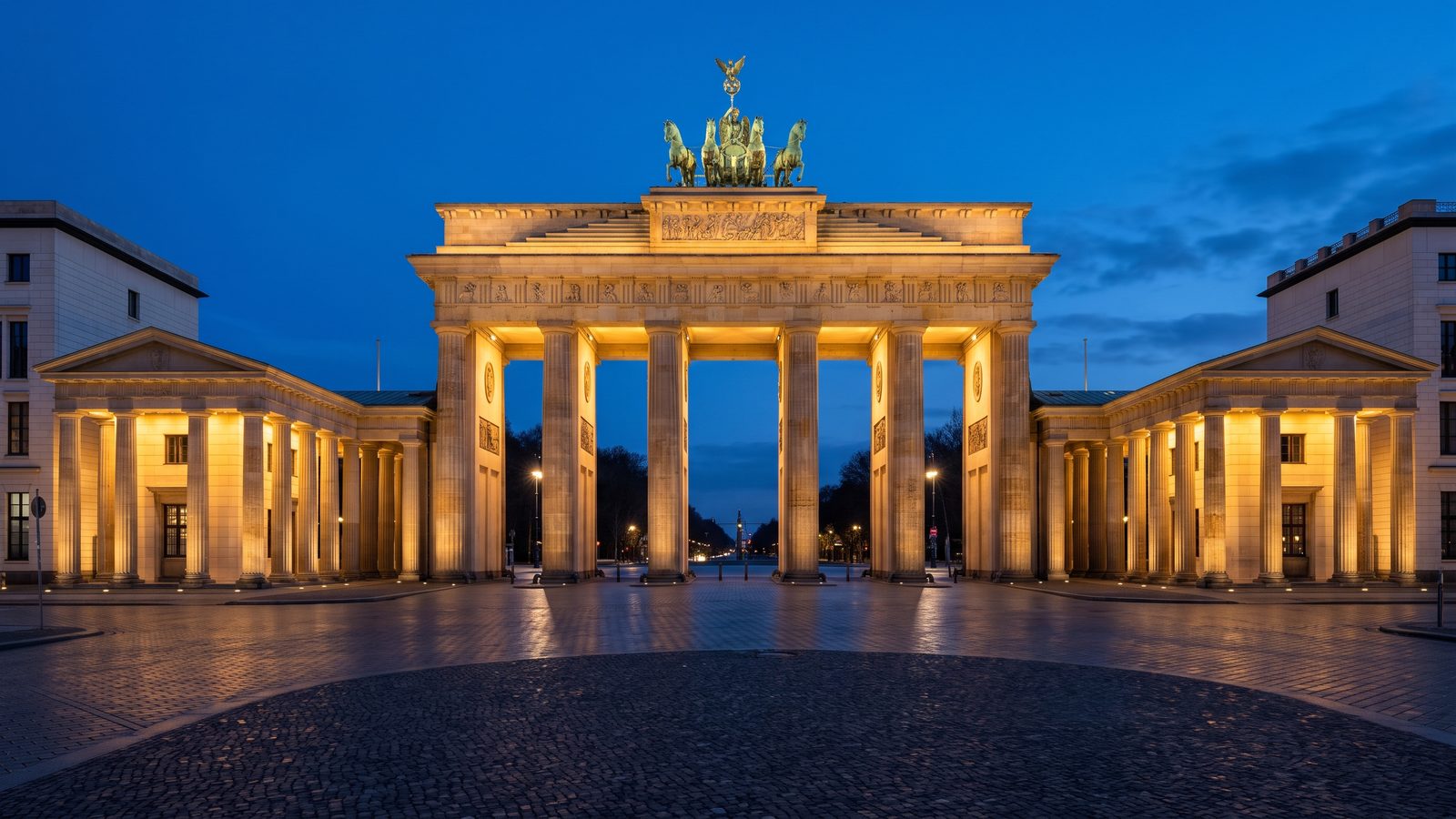
Welcome to Berlin's most iconic landmark, the magnificent Brandenburg Gate. Standing proudly at the western end of Pariser Platz, this neoclassical masterpiece has served as a witness to centuries of European history. Inspired by the Acropolis in Athens, its majestic Doric columns and crowning Quadriga chariot embody a journey through imperial glory, Cold War division, and eventual national reunification.
This self-guided audio tour reveals the dramatic stories etched into sandstone. You will explore its classical architecture, trace its transformation from a Prussian peace monument to a symbol of freedom, and discover key details that make this gate the beating heart of modern Berlin.
Listen to a sample
The opening of this tour, exactly as AllTours narrates it on site.
What you'll hear on this tour
Stop 1. Witness to Imperial Triumph and Division
You stand before a neoclassical marvel born in 1791 from Prussian ambition. Originally commissioned as a symbol of peace, this gateway holds centuries of drama within its stones. You can picture Napoleon plundering the grand Quadriga sculpture above, only for Germany to triumphantly reclaim it later. Over the decades, you trace its journey through imperial victory parades, the dark propaganda spectacles of Nazi rule, and the terrifying devastation of World War II. During the Cold War, it stands as a grim barrier dividing a city. Finally, in 1989, you feel the euphoria as the gate becomes the ultimate global symbol of freedom and German reunification.
Stop 2. The Golden Quadriga and Sandstone Reliefs
Look up toward the summit, where the magnificent Quadriga commands the sky. You see the goddess Victoria driving her chariot pulled by four powerful bronze horses. As you examine her staff, you spot the delicate Prussian eagle and the Iron Cross, symbols added to mark enduring triumph. Step closer to the central passage, standing beneath twelve colossal Doric columns. The weathered sandstone reveals layered histories written into the stone. Take a moment to gaze at the intricate mythological reliefs wrapping around the monument, where subtle carved scenes depicting Hercules and Mars reward your careful inspection.
Stop 3. Neoclassical Mastery Inspired by Athens
You are gazing upon a masterpiece of pure Neoclassical grandeur. Designed by architect Carl Gotthard Langhans, this majestic sandstone structure takes direct inspiration from the ancient Propylaea on Athens' Acropolis. Notice how twelve colossal, fluted Doric columns support the austere entablature, creating five distinct passageways. Historically, the central passageway was strictly reserved for royal ceremonial entry, reinforcing its monumental dignity. Above you rests Johann Gottfried Schadow’s integrated Quadriga sculpture. From its precise classical proportions to its grand scale, every architectural element works in harmony to convey eternal strength, balance, and civic authority in the heart of Berlin.
Stop 4. Berlin's Stage for Freedom and Celebration
Beyond its grand classical stones, you are standing in Berlin's most vibrant public forum. This open square serves as a living stage for collective expression, drawing people together across generations. As you walk across Pariser Platz, imagine the crowds gathering here for global peace rallies, political demonstrations, and spontaneous artistic performances. You can feel the real heartbeat of Berliners as they assemble to ring in New Year's Eve or voice their passionate vision for the future. The gate isn't just a static historical monument; it remains an active cultural touchstone where the spirit of unity and freedom thrives every day.
Stop 5. Capturing Light, Shadows, and Motion
Frame your shot carefully to capture this iconic landmark in its best light. If you visit during early morning, you will notice the soft sunlight sculpting the bronze Quadriga, highlighting every delicate outline. Position yourself in Pariser Platz with a wide-angle lens to capture the full monumental breadth of all twelve columns. Alternatively, zoom in close to isolate the detailed sandstone friezes and mythological reliefs. As dusk arrives, dramatic floodlights illuminate the structure. Set up a tripod for long exposures, allowing passing visitors and city lights to blur into a painterly backdrop around the steadfast form of the gate.
Stop 6. An Enduring Beacon of Hope
Stand directly beneath these soaring sandstone arches and reflect on where you are. You are looking at a profound monument to human freedom that embodies Germany's dramatic journey from harsh division to peaceful reunification. As you touch the weathered columns, feel how the enduring architecture whispers powerful stories of resilience and hope. It reminds every visitor of the extraordinary capacity of humanity to overcome barriers and choose unity over separation. This gate stands not merely as an ancient stone entrance, but as a living symbol of hope where the quiet echoes of a reunited nation resonate across time.
Planning your visit
- Best time to go
- Early morning for quiet photos and warm light on the Quadriga, or evening after dusk when floodlights illuminate the monument.
- Approximate duration
- About 30 to 45 minutes
- Where to start
- Pariser Platz, facing the eastern front of the Brandenburg Gate.
Access and conditions change seasonally — check the official site before you go.
Frequently asked questions
Is Brandenburg Gate worth visiting?
Yes, Brandenburg Gate is Berlin's most famous landmark and an essential stop. It is a stunning neoclassical architectural masterpiece and a powerful symbol of German unity and European history.
How long do you need at Brandenburg Gate?
Most visitors spend 30 to 45 minutes exploring the gate, examining the Quadriga sculpture and reliefs, taking photographs from Pariser Platz, and soaking in the historical significance.
Why was the Brandenburg Gate built?
It was commissioned by King Frederick William II of Prussia and completed in 1791 as a grand neoclassical gateway to represent peace at the end of the boulevard Unter den Linden.
Keep exploring
Header image is an AI-generated illustration of Brandenburg Gate. AllTours.ai is an AI audio tour guide — point your camera at any landmark and hear its story.