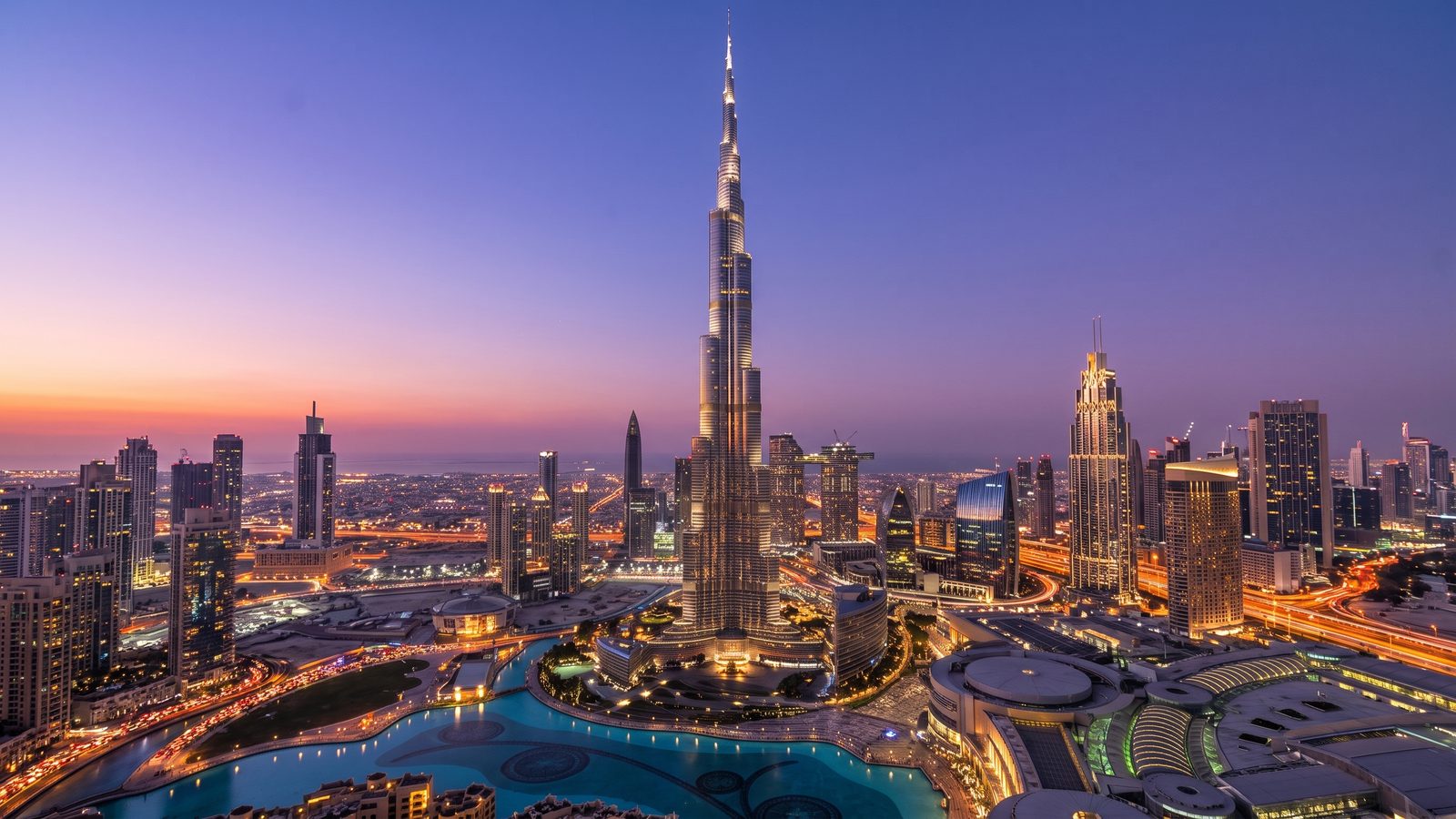
Welcome to the Burj Khalifa, the towering crown jewel of Dubai's skyline and the tallest structure on Earth. Rising 828 meters above the desert, this vertical city represents an extraordinary leap in human ambition, engineering, and architectural innovation. As you explore its base and ascend to its soaring observation decks, you will discover how desert flora inspired its iconic design and how groundbreaking technology allows it to stand tall against fierce forces.
This self-guided audio tour walks you through the tower's fascinating history, architectural genius, and luxurious interior spaces. Prepare to ride high-speed elevators and witness unbelievable vistas spanning the golden desert sands, Sheikh Zayed Road, and the shimmering waters of the Arabian Gulf.
Listen to a sample
The opening of this tour, exactly as AllTours narrates it on site.
What you'll hear on this tour
Stop 1. Standing at the Pinnacle of Observation
You rocket upward in the world's fastest double-deck elevators, rising high above Dubai toward the observation decks. Stepping onto the 124th floor at 'At the Top,' you immediately feel the sheer scale of the city below. The 360-degree panorama reveals Sheikh Zayed Road and the artificial islands blooming in the Arabian Gulf. You can peer through high-powered telescopes comparing historical Dubai with its futuristic sprawl, or step onto the outdoor terrace to feel the desert wind. Ascending to the 148th floor at 'At the Top SKY,' you reach the world's highest outdoor observation deck. Above the clouds on clear days, you see the subtle curvature of the earth.
Stop 2. Deep Foundations and Wind Resilient Design
You stand before a tower that redefines human engineering from the ground up. Beneath your feet lies an immense concrete raft nearly four meters thick, supported by 192 bored piles driven over 50 meters deep into the earth. This massive foundation stabilizes an astonishing weight of 500,000 tons. As you gaze upward, you see the Y-shaped buttressed core, an ingenious structural design that provides exceptional stability against immense wind and gravitational forces. Engineers refined its spiraling, tapering shape in wind tunnels to break up wind flow and prevent dangerous vortex shedding. High-strength concrete was even pumped to record heights exceeding 600 meters to bring this soaring structure to life.
Stop 3. Inspired by the Desert Hymenocallis Flower
Look closely at the soaring tower and notice how its design draws inspiration from the desert Hymenocallis flower. The triple-lobed, Y-shaped floor plan created by architect Adrian Smith and engineer Bill Baker of SOM is not just beautiful; it forms a buttressed core that efficiently distributes weight down to the raft foundation. As you observe the exterior, notice the spiraling setbacks that taper as the tower ascends. A shimmering curtain wall crafted from over 26,000 individual glass and steel panels reflects the brilliant desert sky. Above it all, the majestic spire pierces the clouds, serving as an essential component of the building's structural and communication infrastructure.
Stop 4. A Panoramic Tapestry of Desert and Gulf
From this unparalleled vantage point, you witness Dubai's dramatic transformation stretching toward the horizon. The striking contrast between the deep azure of the Arabian Gulf and the vast golden desert unfolds right before your eyes. Looking carefully across the water, you spot the palm-shaped fronds of Palm Jumeirah reclaiming the sea like a delicate fractal pattern. As evening approaches, the entire urban landscape shifts into a sparkling galaxy of lights along the coast. From these elevated observation decks, you literally stand above the clouds, absorbing an aerial narrative of a humble fishing village transformed into a dynamic global metropolis through sheer vision and determination.
Stop 5. An Unmatched Vertical Realm of Opulence
Beyond its staggering height, you are exploring a vertical city built around absolute indulgence and refined opulence. On the lower floors, you encounter the minimalist elegance of the Armani Hotel Dubai, personally overseen by designer Giorgio Armani with custom fabrics and dedicated lifestyle managers. Higher up, exclusive private residences offer smart home technology, bespoke finishes, and sweeping panoramic views. Residents enjoy private sky lobbies, state-of-the-art fitness facilities, and seamless access to luxury hotel services. As you take in your surroundings, you realize this tower is not merely a marvel of glass and steel, but an entire ecosystem designed for ultimate comfort, privacy, and sophisticated living.
Stop 6. Surveying a Galaxy of Steel and Glass
Looking out across the horizon, you take in the breathtaking skyline born from an audacious dream. Below you, Sheikh Zayed Road stretches out like a pulsating artery, filled with constant traffic that reflects the city's relentless energy. You can trace distinct architectural styles across the modern financial district and observe bold new developments rising from the sand. Man-made coastal features like Palm Jumeirah highlight Dubai's ambitious engineering efforts. As twilight falls, the gleaming skyscrapers transform into a glittering constellation, where urban light meets the ancient desert landscape. You gain a rare perspective on how this metropolis carefully plans and constantly pushes the boundaries of modernity.
Planning your visit
- Best time to go
- Late afternoon before sunset to experience both daytime desert vistas and the illuminated night skyline.
- Approximate duration
- About 1.5 to 2 hours
- Where to start
- Burj Khalifa main entrance at the lower ground level of The Dubai Mall.
Access and conditions change seasonally — check the official site before you go.
Frequently asked questions
Is Burj Khalifa worth visiting?
Yes, visiting the world's tallest building offers an unparalleled perspective of Dubai's rapid transformation, featuring breathtaking 360-degree views, high-speed elevators, and interactive exhibits.
How long do you need at Burj Khalifa?
Most visitors spend between 1.5 and 2 hours exploring the observation decks, taking in the panoramic views, and taking photos on the outdoor terrace.
When was the Burj Khalifa built and opened?
Construction began in 2004 during Dubai's rapid economic development, leading up to its grand opening in 2010.
Keep exploring
Header image is an AI-generated illustration of Burj Khalifa. AllTours.ai is an AI audio tour guide — point your camera at any landmark and hear its story.