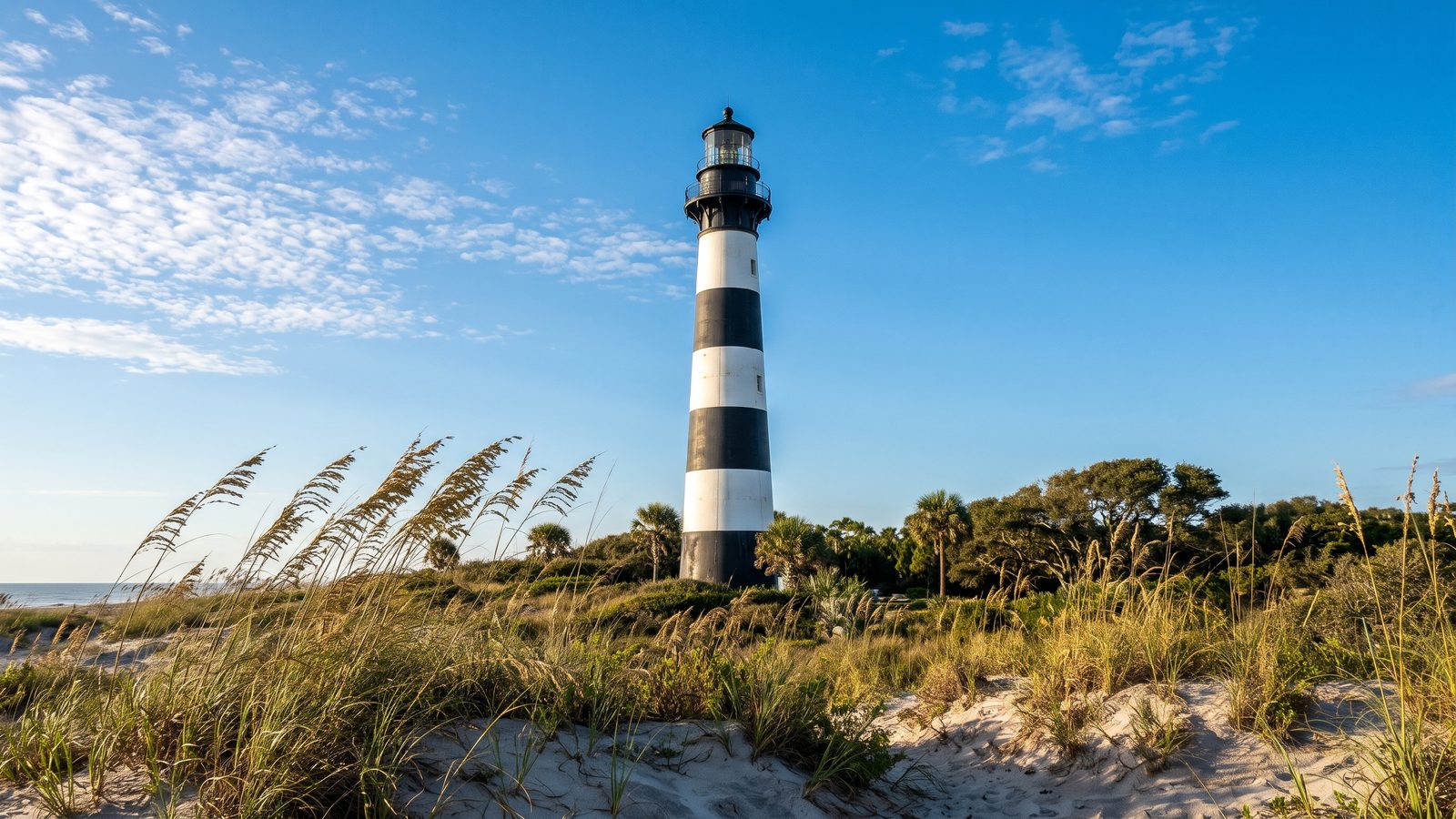
Welcome to the Cape Canaveral Lighthouse, an extraordinary beacon where 19th-century maritime history meets the frontier of modern space exploration. Standing tall on Florida's space coast, this iconic black-and-white striped cast-iron tower has guided sailors past treacherous shoals since 1894. As you walk these historic grounds, you will discover tales of Civil War conflicts, engineering triumphs over coastal erosion, and a wild landscape where sea turtles nest beside active rocket launchpads.
Through this self-guided audio tour, you will experience the sights and stories that make Cape Canaveral unique. From intricate iron stairs to panoramic views of Merritt Island's wildlife refuge, prepare to explore a place where natural beauty and cosmic ambitions collide.
What you'll hear on this tour
Stop 1. Panorama of Ocean and Space
You ascend the spiral stairs and step onto the gallery, where a breathtaking panorama unfolds beneath you. Your gaze sweeps across the vast Atlantic Ocean, where the subtle curve of the horizon reveals the Earth's vastness. Looking west, you see the lush green mosaic of the Merritt Island National Wildlife Refuge, a vibrant tapestry of marshlands and scrub. Directly north and south, the iconic silhouettes of rocket launch complexes stand against the sky. From this unique vantage point, you witness an incredible contrast where pristine coastal wilderness directly meets the cutting edge of space exploration.
Stop 2. Iron Plates and Daymark Stripes
You stand before a 19th-century marvel crafted entirely from prefabricated cast-iron plates forged in the North and bolted together on site. Inside, a cast-iron spiral staircase winds around a central support column up to the intricate copper-domed lantern room. Notice the tower's bold black and white banding; this distinct daymark allows mariners to identify this specific beacon miles away in daylight. Perched at the top, the lantern room once housed a powerful first-order Fresnel lens, while the narrow gallery walkway provided vital access for maintenance. Built deep into the earth, this robust iron structure resists fierce hurricanes and shifting sands.
Stop 3. Resilience Through Civil War and Erosion
You trace a resilient lineage beginning in 1848 with a modest 65-foot brick tower whose faint light struggled against coastal haze. Replaced in 1859 by a taller brick structure, its operation cut short when Confederate sympathizers extinguished the beacon and removed its precious lens during the Civil War. After standing dark for years, the light rekindled in 1867. However, relentless shoreline erosion soon threatened to undermine its foundation. To save the light, officials built the current prefabricated cast-iron tower further inland, meticulously assembling iron plates until it finally shone its enduring light across the Atlantic in 1894.
Stop 4. Wildlife Sanctuary on the Dunes
You feel the vibrant pulse of nature surrounding this historic tower. These sandy shores serve as vital nesting grounds where thousands of loggerhead and green sea turtles return each summer under the moonlit sky. Deep-rooted sea oats anchor the fragile dunes against coastal winds, creating a habitat where ospreys soar overhead and gentle manatees graze in nearby brackish estuaries. While the lighthouse beam once disoriented emerging turtle hatchlings, modern specialized lighting and dedicated conservation efforts now safeguard these vulnerable species, ensuring that human ingenuity and Florida's wild coastal beauty coexist along this protected barrier island.
Stop 5. From Caravel Charts to Moonshots
You stand at a historic crossroads where humanity's drive to explore spans centuries. Long before this iron tower guided maritime traffic, early Spanish navigators like Ponce de León sailed caravels along these hazardous shores, meticulously mapping uncharted lands. Over time, this dangerous cape evolved from a formidable barrier for sailing ships into a launching pad for cosmic journeys. As rockets rumble into the atmosphere just miles away, this steadfast lighthouse remains a silent witness to humanity's boldest leaps. Here, the ancient pursuit of ocean navigation seamlessly connects with our ongoing reach toward the stars.
Stop 6. Sculpted Sands and Coquina Rocks
You gaze across a dynamic barrier island constantly reshaped by Atlantic currents and shifting tides. For centuries, treacherous sandbars and shallow approaches along this shore doomed unsuspecting vessels before a permanent light pierced the dark. At low tide, you can spot dark, exposed ridges of ancient coquina rock—fossilized shell beds forming natural breakwaters against crashing waves. As part of the Canaveral National Seashore and Merritt Island National Wildlife Refuge, this coastline provides a vital sanctuary for endangered sea turtles and migratory birds, preserving a pristine wilderness alongside humanity's greatest spaceport.
Planning your visit
- Best time to go
- Mornings or late afternoons for cooler weather, optimal lighting, and better wildlife viewing opportunities.
- Approximate duration
- about 1 hour
- Where to start
- Begin at the base of the lighthouse near the visitor grounds.
Access and conditions change seasonally — check the official site before you go.
Frequently asked questions
Is Cape Canaveral Lighthouse worth visiting?
Yes, Cape Canaveral Lighthouse is well worth visiting for its unique combination of 19th-century military engineering, rich maritime history, pristine coastal wildlife, and dramatic views of nearby spaceport launch complexes.
How long do you need at Cape Canaveral Lighthouse?
Most visitors spend about 45 minutes to 1.5 hours exploring the lighthouse grounds, learning about its history, viewing the architecture, and taking photos of the surrounding coastline.
Why was the Cape Canaveral Lighthouse moved inland?
The original brick lighthouse faced severe shoreline erosion from the Atlantic Ocean. To protect the beacon, a new prefabricated cast-iron tower was constructed further inland and activated in 1894.
Keep exploring
Header image is an AI-generated illustration of Cape Canaveral Lighthouse. AllTours.ai is an AI audio tour guide — point your camera at any landmark and hear its story.