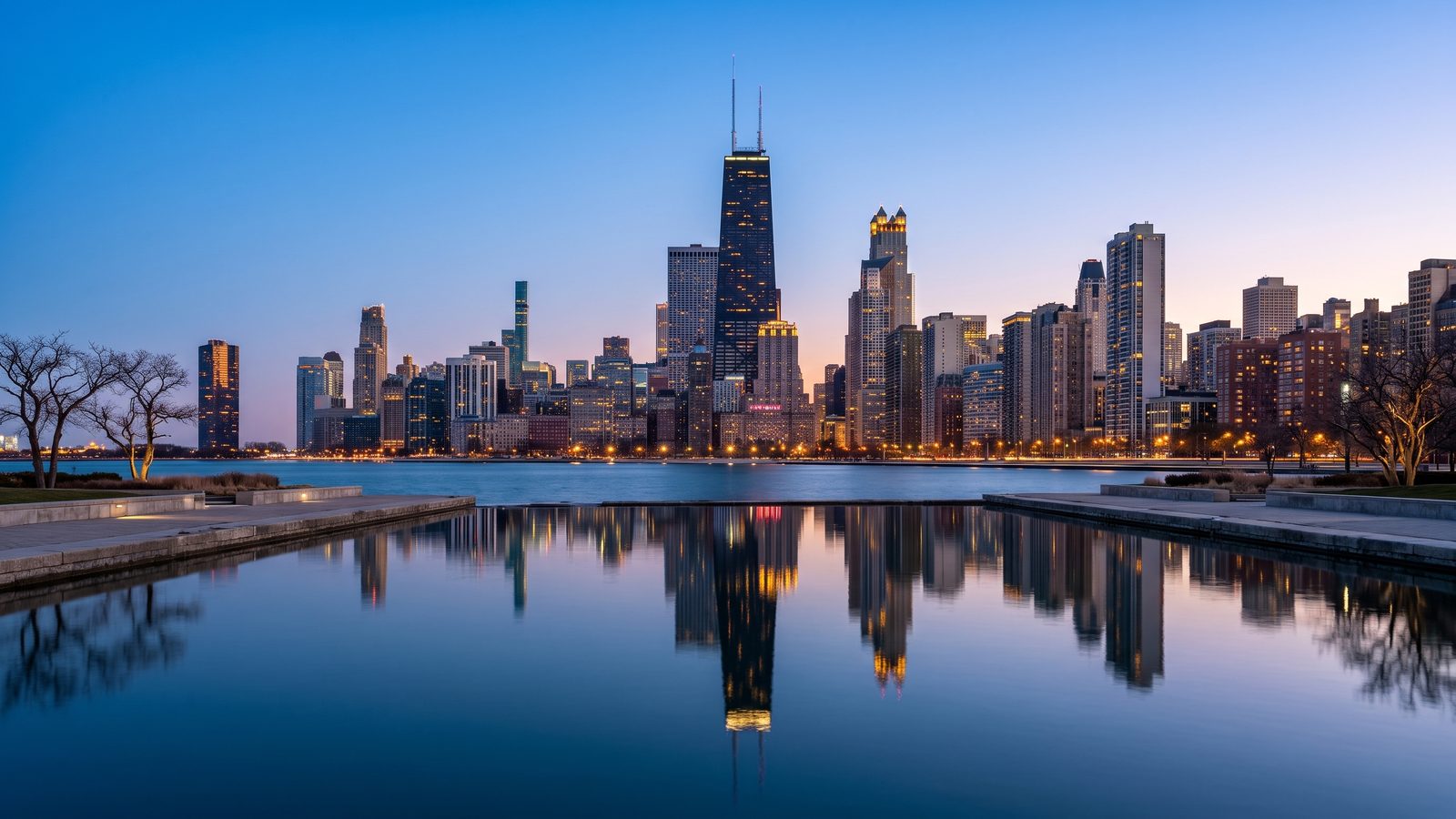
Welcome to Chicago, a city that redefined the urban landscape and invented the modern skyscraper. Following the devastating Great Fire of 1871, visionary architects turned a tragic blank slate into a playground for structural innovation. As you stand before this breathtaking spectacle of glass and steel, you are gazing upon a living museum of architectural audacity, where human ingenuity constantly reaches for the clouds along the shores of Lake Michigan.
This self-guided audio tour walks you through the history, design, and dramatic vistas of one of the world's most iconic cityscapes. From revolutionary steel frames to captivating public art, you will experience the bold spirit of a resilient city that continues to shape modern architecture.
Listen to a sample
The opening of this tour, exactly as AllTours narrates it on site.
Watch the 20-second tour
What you'll hear on this tour
Stop 1. The Birthplace of the Skyscraper
As you scan the impressive horizon, you stand at the very birthplace of the modern skyscraper. Right here in Chicago, visionary engineers pioneered steel-frame construction, liberating outer walls from bearing heavy loads and allowing buildings to soar to unprecedented heights. This breakthrough birthed the world-renowned Chicago School of architecture. Look toward the Willis Tower, where a revolutionary bundled-tube design provides exceptional stability to pierce the clouds. Nearby, the 875 North Michigan Avenue building showcases its iconic exterior X-bracing, proudly displaying its structural integrity as a bold design statement. These soaring towers remain enduring monuments to human ambition and engineering brilliance.
Stop 2. Evolution of Architectural Innovation
Observe how the Great Fire of 1871 cleared the slate for the Chicago School, where Louis Sullivan championed the principle that form follows function. You see this philosophy in early landmarks like the Rookery Building, featuring an innovative interior light court. Later, Mies van der Rohe led the Second Chicago School, introducing minimalist glass and steel curtain walls seen on the sleek Aon Center. Notice the Gothic Revival details of the Tribune Tower, the distinctive corncob shapes of the mid-century Marina City towers, and the undulating balconies of the Aqua Tower. Together, these masterpieces prove that Chicago continuously redefines urban living.
Stop 3. Engineering Marvels along the Waterfront
Turn your gaze eastward toward the vibrant waterfront, where Chicago’s relationship with nature takes center stage. In 1900, engineers achieved a massive feat by reversing the flow of the Chicago River away from Lake Michigan to safeguard the city's drinking water. Today, you can stroll along the Chicago Riverwalk, a lively promenade featuring distinct urban spaces like Marina Plaza and the tranquil Cove. Beyond the river mouth lies Navy Pier, originally built in 1916 as Municipal Pier Number Two. Having served commercial shipping and World War II naval training, Navy Pier now hosts the Centennial Wheel, offering sweeping panoramic views of the city skyline and freshwater sea.
Stop 4. A Sculptural Mirror of Modern Design
Step toward the massive, liquid-mercury-like sculpture known as Reflections, created by artist Anish Kapoor. Constructed from 168 stainless steel plates joined without visible seams, its highly polished surface acts as a dynamic, interactive canvas. As you approach, notice how the curved exterior distorts and magnifies the surrounding skyscrapers, pulling towering architecture into a fluid portrait. Walk beneath its massive arch into the concave omphalos, or navel, to experience a dizzying kaleidoscope of reflections. This brilliant feat of engineering seamlessly blends public art with urban design, inviting you to become an active participant in Chicago’s magnificent skyline.
Stop 5. Capturing Light, Glass, and Shadow
For photographers, the Chicago Skyline offers an ever-changing canvas of dramatic light and scale. You find the most magical conditions during golden hour, when setting sunlight bathes glass and steel towers in an ethereal glow. As dusk transitions to the blue hour, city lights ignite to reflect beautifully across Lake Michigan, creating a classic shot best captured from North Avenue Beach. Frame the monumental architectural canyons along the Chicago River using a wide-angle lens to highlight historic towers like the Wrigley Building. From the sweeping vistas near the Adler Planetarium to intriguing reflections, patience rewards you with unforgettable images.
Stop 6. The Grid and the Lakefront Edge
Gaze across the broader cityscape to appreciate a meticulously planned urban tapestry born after the Great Fire. Notice how the rigid grid system creates a striking visual counterpoint to the natural, organic curves of Lake Michigan. This deliberate layout forms iconic urban canyons where light and shadow play across towering facades throughout the day. Each generation of design, from early steel-framed structures to soaring glass towers, contributes to a remarkably cohesive vertical landscape. As sunlight reflects off endless windows and water, this dramatic panorama celebrates the resilient, forward-looking spirit of Chicago.
Planning your visit
- Best time to go
- Late afternoon into early evening (golden hour and blue hour) for optimal light and skyline reflections.
- Approximate duration
- About 2 hours
- Where to start
- Chicago Riverwalk or Millennium Park
Access and conditions change seasonally — check the official site before you go.
Frequently asked questions
Is Chicago Skyline worth visiting?
Yes, exploring the Chicago Skyline offers a world-class look at the birthplace of modern skyscrapers, historic engineering marvels, and breathtaking lakefront views.
How long do you need at Chicago Skyline?
Plan for about 1.5 to 2.5 hours to comfortably walk along key vantage points like the Riverwalk, Millennium Park, and the lakefront.
Why did Chicago invent the modern skyscraper?
After the Great Fire of 1871 cleared the urban core, architects pioneered steel-frame construction, allowing buildings to soar higher without load-bearing exterior walls.
Keep exploring
Header image is an AI-generated illustration of Chicago Skyline. AllTours.ai is an AI audio tour guide — point your camera at any landmark and hear its story.