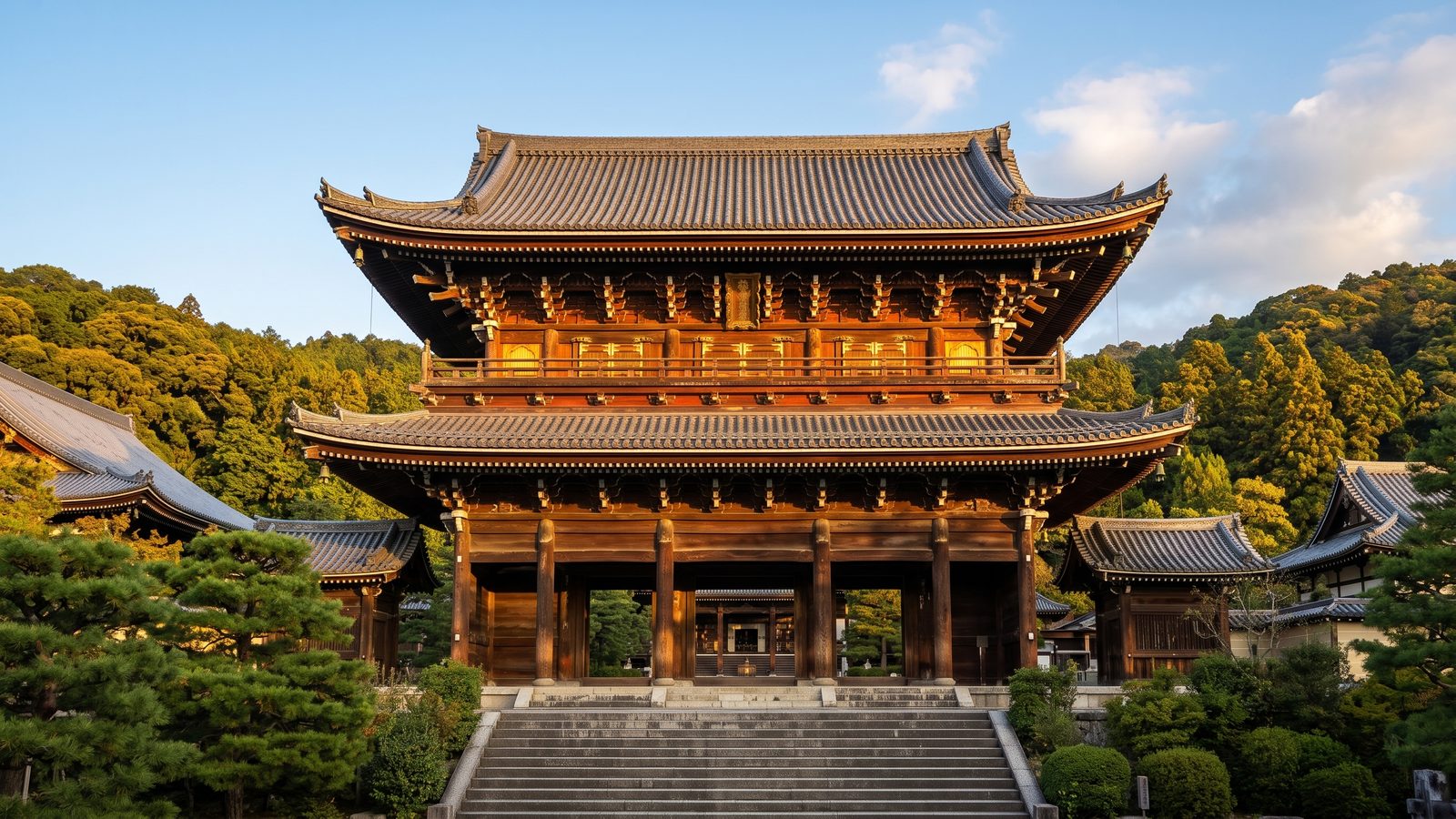
Standing as the monumental entrance to Chion-in Temple, the Sanmon Gate is Japan's tallest wooden gate. Soaring twenty-four meters high and spanning fifty meters wide, this colossal double-tiered timber structure has guarded the sacred head temple of the Jodo-shu Buddhist sect since 1619. As you approach its grand shadow, you enter an architectural marvel that seamlessly blends Edo-period power, exquisite craftsmanship, and deep spiritual significance.
This self-guided audio tour reveals the gate's hidden secrets, from interlocking joinery built without nails to high-altitude artwork and legendary guardians. Step beneath the eaves, leave the bustle of Kyoto behind, and experience a timeless portal designed to inspire awe, reverence, and spiritual clarity.
Listen to a sample
The opening of this tour, exactly as AllTours narrates it on site.
What you'll hear on this tour
Stop 1. Mastery of Nail-Free Wood Carpentry
You stand before a towering masterpiece of traditional Japanese carpentry that reaches twenty-four meters into the air. As you look up, notice how every massive timber interlocking beneath the roof forms an earthquake-resistant structure without using a single nail. Bold lines of the multi-tiered tile roof sweep against the Kyoto sky, while rich vermillion lacquer coats the massive structural frame. Complex wooden brackets support the deep eaves, showing incredible geometric skill. Even the subtle carved struts and gold accents add to its massive visual weight. You are witnessing an engineering marvel where beauty, flexibility, and colossal strength converge into a single, breathtaking sanctuary entrance.
Stop 2. Heavenly Visions and Master Carvings
Cast your eyes across the intricate details that bring this massive wooden frame to life. Notice the carved wooden panels depicting mythical creatures and celestial beings with astonishing detail. Inside the upper story, master Edo-period sculptors created serene statues of Shakyamuni Buddha and the Sixteen Arhats, capturing deep human emotion in wood. Above these sacred figures, vibrant ceiling paintings burst with mineral pigments of deep lapis lazuli, vermillion, and shimmering gold leaf. These brilliant paintings depict Buddhist cosmology and the glorious Pure Land. Every single chisel mark and brushstroke you see reflects an unparalleled devotion to beauty, transforming structural timber into a living gallery of sacred art.
Stop 3. A Shogun's Tribute Surviving Flames
You are looking at a structure commissioned in 1619 by the second shogun, Tokugawa Hidetada. He ordered this colossal gate built as a grand tribute to his father, Tokugawa Ieyasu. This monumental project declared the newly established shogunate’s supreme authority and its generous patronage of the Jodo-shu Buddhist sect. As Japan transitioned from constant civil war into an era of peace, this gate stood as a symbol of newfound stability. Remarkably, while devastating fires repeatedly swept through the surrounding temple grounds over the centuries, this massive wooden gate survived unscathed. Today, you touch a living witness to four hundred years of history.
Stop 4. Framing the Journey to Sacred Space
Notice how your perception changes as you move closer to this giant portal. From a distance, the gate appears as a serene silhouette framed against the Higashiyama hills. Yet, as you walk along the stone approach, its monumental scale grows until it dominates your entire field of view. Standing directly beneath the central archway, you look sharply upward to discover hidden joinery and colorful painted patterns tucked under the eaves. The architects intentionally designed this gate to act as a monumental frame, blocking out the modern urban world behind you and directing your spiritual focus inward toward the sacred temple grounds.
Stop 5. Threshold to the Pure Land
As you step beneath these giant timbers, you cross a symbolic threshold leading directly toward the Pure Land. You walk in the ancient footsteps of millions of pilgrims who passed through here reciting the sacred nembutsu chant in search of salvation. The massive scale intentionally awakens a sense of deep reverence, reminding you of Amitabha Buddha's vast compassion. Here, the priest Honen taught that spiritual liberation is open to all people, regardless of social rank, through simple faith and devotion. Feel the quiet atmosphere that lingers around you, echoing centuries of earnest prayers and bringing a serene stillness to your journey.
Stop 6. Unseen Guardians and Ancient Spirits
Beyond its physical timber, this colossal gate carries a living spiritual energy. Ancient tales tell that powerful nature spirits, or kami, were invoked when the gate was built, infusing its deep foundations with protective power. These unseen guardians watch over the threshold, silently reading the hearts of everyone who enters. According to legend, sincere visitors receive blessings of safe passage and mental clarity, while harmful forces are turned away from the sacred temple grounds. As you pass under the roof, observe the famous 'forgotten umbrella' left high in the rafters, and feel the gentle shift in atmosphere surrounding this ancient wooden guardian.
Planning your visit
- Best time to go
- Early morning for quiet contemplation and warm sunlight on the wooden frame, or autumn when surrounding Higashiyama foliage peaks.
- Approximate duration
- about 30 minutes
- Where to start
- At the foot of the main stone approach stairs leading up to the Sanmon Gate.
Access and conditions change seasonally — check the official site before you go.
Frequently asked questions
Is Chion-in Temple Sanmon Gate worth visiting?
Yes, it is Japan's tallest wooden gate and an iconic national treasure. Featuring intricate nail-free carpentry, grand Edo-period history, and spiritual art, it is one of Kyoto's most impressive historic landmarks.
How long do you need at Chion-in Temple Sanmon Gate?
You need about 20 to 30 minutes to admire the gate's architecture, view the eaves and joinery, take photos from different perspectives, and absorb its peaceful atmosphere.
When was the Chion-in Sanmon Gate built and who built it?
The gate was commissioned in 1619 by Tokugawa Hidetada, the second Tokugawa shogun, as a tribute to his father Tokugawa Ieyasu and a show of patronage for the Jodo-shu Buddhist sect.
Keep exploring
Header image is an AI-generated illustration of Chion-in Temple Sanmon Gate. AllTours.ai is an AI audio tour guide — point your camera at any landmark and hear its story.