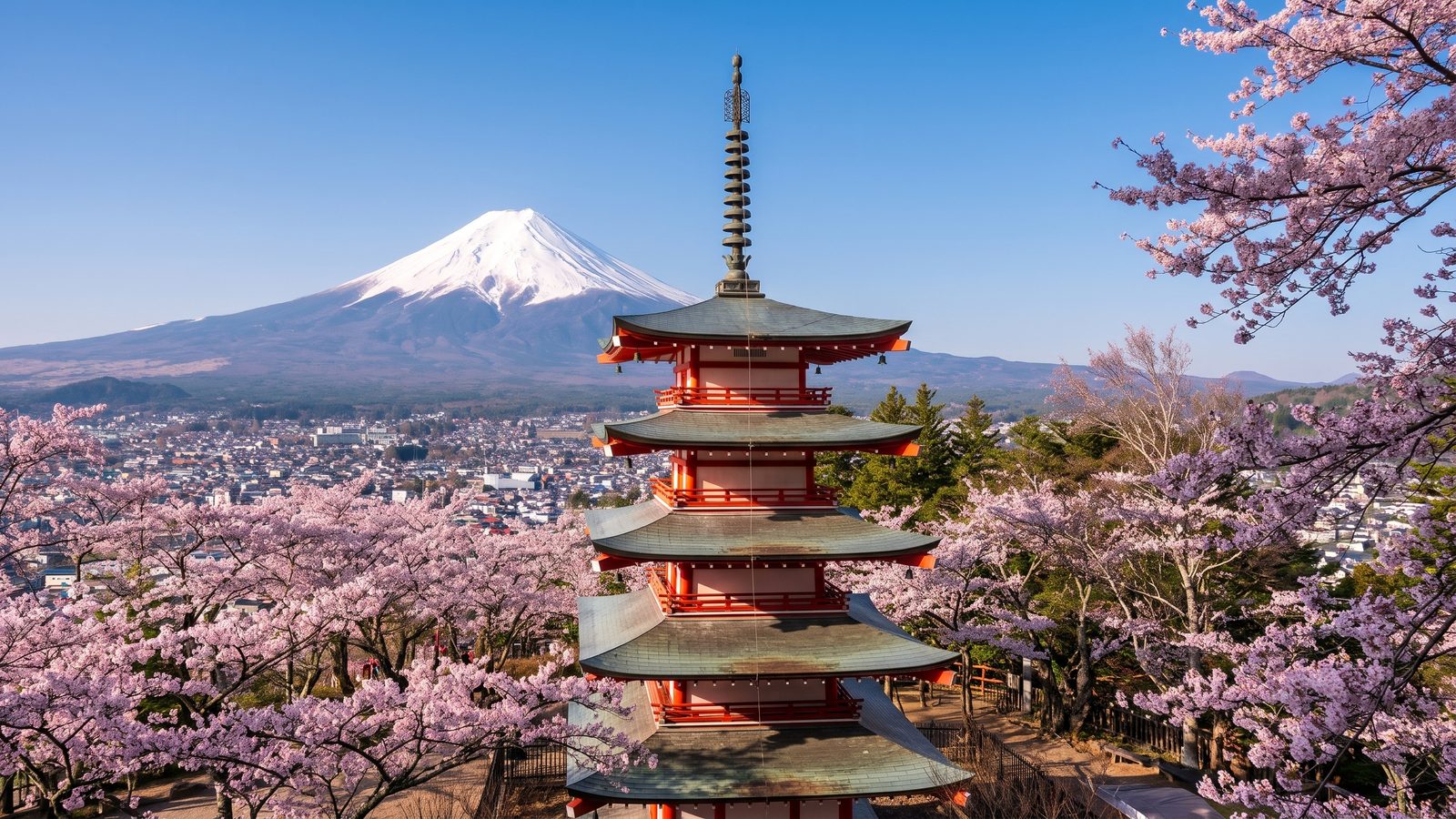
You stand before the iconic five-story Chureito Pagoda in Arakurayama Sengen Park, gazing out at the breathtaking silhouette of Mount Fuji. Built in the mid-20th century as a peace memorial, this vibrant vermilion tower seamlessly bridges deep spiritual traditions and natural splendor. As you explore the grounds of the ancient Arakura Sengen Shrine, you experience a timeless symbol of memory, peace, and Japan's sacred mountain landscape.
This self-guided audio tour leads you through the rich history, cultural symbolism, and changing seasonal scenery surrounding the pagoda. Discover how Buddhist architecture, Shinto reverent nature worship, and dramatic geological forces converge to create one of the most celebrated vistas in the world.
Listen to a sample
The opening of this tour, exactly as AllTours narrates it on site.
What you'll hear on this tour
Stop 1. The Five-Story Peace Memorial
You gaze up at the Chureito Pagoda, a brilliant vermilion beacon of remembrance rising five tiers into the sky. Built as a peace memorial to honor the citizens of Fujiyoshida who lost their lives in wars from the Sino-Japanese War through World War II, its official name translates to 'Loyalty Tower.' You trace the classic gojū-no-tō design, observing how each tier tapers upward toward an elegant bronze sōrin finial decorated with nine rings. The vibrant lacquer symbolizes vitality and protection. As you admire the sweeping eaves and delicate rooflines, you feel the solemn gravitas of a monument dedicated to global peace and collective memory.
Stop 2. Sacred Mount Fuji and Sacred Muse
Look beyond the pagoda to Mount Fuji, an active stratovolcano rising in solitary grandeur. Its perfectly symmetrical cone last erupted in 1707, leaving behind the distinct Hoei crater on its southeastern flank. For centuries, spiritual pilgrims have revered this peak as the sacred dwelling of Konohanasakuya-hime, the Shinto goddess of Mount Fuji. You stand before a natural masterpiece that inspired master artist Hokusai’s legendary woodblock prints and countless poets. Notice the snowcap crowning its volcanic peak, shifting with the seasons to reflect the fleeting nature of life. The air around you feels charged with divine energy as you contemplate this timeless symbol of Japan.
Stop 3. Harmonizing Shinto Faith and Buddhist Form
Here at Arakurayama Sengen Park, you witness a profound fusion of Shinto reverence and Buddhist remembrance. The five-story pagoda represents traditional Buddhist architecture and the five elements of the universe, standing as a tribute to the war dead. Yet it sits directly within the grounds of Arakura Sengen Shrine, rooted in Shinto traditions where sacred natural features like Mount Fuji are worshiped as divine kami. During spring, your experience aligns with hanami, the traditional practice of appreciating transient cherry blossoms. This delicate spectacle embodies mono no aware, the poignant awareness of impermanence, demonstrating how human craft respectfully honors the divine natural world.
Stop 4. An Ever-Changing Seasonal Canvas
Step back to admire the living canvas framing the iconic pagoda. The vivid vermilion structure offers a dramatic contrast against the surrounding landscape through every turn of the year. In spring, delicate pink cherry blossoms swathe the hillside in soft color. Summer brings a vibrant blanket of lush green foliage, while autumn transforms the valley into a fiery display of crimson, gold, and russet hues. Even in winter, bare tree branches etch delicate patterns against the crisp sky. As shifting light casts dramatic shadows across the terrain throughout the day, you realize no two visits to this iconic vista are ever identical.
Stop 5. Forest Slopes and Volcanic Forces
As you walk through Arakurayama Sengen Park, notice the ancient Japanese red pines and cypress trees anchoring the hillside beneath your feet. The rich volcanic soil nourishes thousands of sakura trees that frame Mount Fuji each spring in fleeting blooms. Beyond the forest, Mount Fuji’s snow-capped peak hides immense geothermal forces shaped by millennia of eruptions. You breathe in the crisp forest air, listening to the wind through the pines while watching shifting clouds swirl around Fuji’s summit. This delicate ecosystem thrives at the intersection of powerful volcanic geology and lush mountain biodiversity, offering a serene sanctuary high above the valley.
Stop 6. A Modern Tribute to Local Lives
You learn that while the surrounding shrine boasts ancient origins, the pagoda itself is a modern addition completed in 1963. It was constructed as a solemn tribute to the citizens of Fujiyoshida who sacrificed their lives in military conflicts from the Meiji Restoration through the Second World War. Standing within the historic Arakura Sengen Shrine grounds, this memorial transforms local grief into a universal message of hope. As you reflect at the base of the tower, you understand that this world-famous landmark is deeply rooted in local remembrance, carrying a quiet prayer for global peace into the future.
Planning your visit
- Best time to go
- Early morning during spring cherry blossom season (April) or autumn foliage (November) for clear views of Mount Fuji and soft lighting.
- Approximate duration
- About 1 to 1.5 hours
- Where to start
- Arakurayama Sengen Park entrance at the base of the staircase leading up to Arakura Sengen Shrine.
Access and conditions change seasonally — check the official site before you go.
Frequently asked questions
Is Chureito Pagoda worth visiting?
Yes, Chureito Pagoda offers one of Japan's most famous and iconic postcard views, combining a classic five-story vermilion pagoda with Mount Fuji perfectly framed in the background.
How long do you need at Chureito Pagoda?
Most visitors spend about 1 to 2 hours exploring Arakurayama Sengen Park, climbing the 398 steps to the main observation deck, and taking in the panoramic views.
When was Chureito Pagoda built and why?
Chureito Pagoda was constructed in 1963 as a peace memorial to honor Fujiyoshida citizens who lost their lives in wars from the Meiji Restoration through World War II.
Keep exploring
Header image is an AI-generated illustration of Chureito Pagoda. AllTours.ai is an AI audio tour guide — point your camera at any landmark and hear its story.