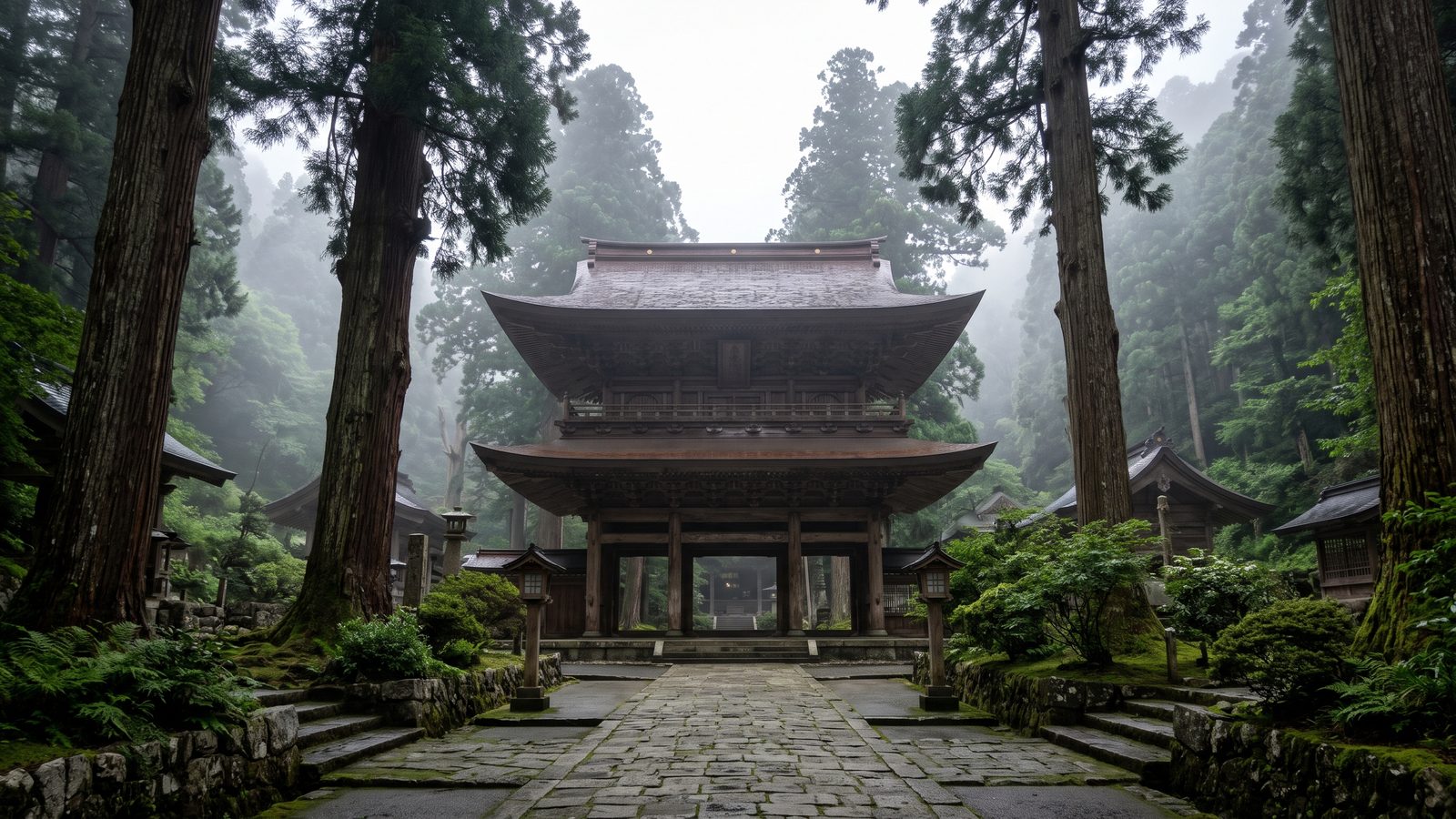
Step deep into the ancient, forested mountains of Fukui Prefecture to explore Eihei-ji Temple, a historic spiritual haven founded in 1244 by Dōgen Zenji. As the head monastery of the Sōtō Zen school, this sacred complex encompasses over seventy traditional wooden structures nestled among towering cedar trees. Through this immersive self-guided audio tour, you will experience a living tradition of meditation, monastic discipline, and profound silence.
Walk the worn stone paths and covered corridors where monks continue their centuries-old practice of zazen and mindful labor. From intricate wooden architecture to tranquil moss gardens, discover the pure essence of Zen philosophy carved into every beam and stone of this mountain sanctuary.
Listen to a sample
The opening of this tour, exactly as AllTours narrates it on site.
What you'll hear on this tour
Stop 1. The Arduous Path of Monastic Life
You observe the unsui, or cloud and water monks, whose spiritual journey begins with an arduous trial at the Tangaryo gatehouse. Here, aspiring practitioners wait outside for days, enduring harsh elements to prove their sincerity. Once accepted, their daily routine is governed by strict discipline, starting before dawn with silent zazen sitting meditation. You watch them engage in every task with total mindfulness, from eating oryoki meals in precise silence to performing physical labor known as samu. As you walk these halls, you might hear the sharp crack of the keisaku stick maintaining their focus, revealing that this intense, moment-to-moment devotion is itself the realization of Zen enlightenment.
Stop 2. Shikantaza and the Art of Sitting
You stand at the spiritual center of Eihei-ji, where meditation forms the core of daily existence. Here, practitioners engage in shikantaza, or just sitting, a tradition established by Dōgen Zenji that honors inherent enlightenment. You observe monks seated on zafu cushions with straight spines and hands folded in the cosmic mudra. Their eyes remain open in a soft downward gaze, acknowledging thoughts without attachment as they drift past like clouds. You realize this practice extends beyond the Zendo hall into kinhin, a slow walking meditation that maintains mindfulness in every step. Through the rhythmic reminders of the keisaku stick, you witness a practical path to present-moment awareness.
Stop 3. Sacred Halls of the Shichido Garan
You stand before the Shichido Garan, where seven principal halls are connected by continuous covered kairo corridors. As you look up, you notice unadorned hinoki cypress beams rising naturally without paint, reflecting the core Zen values of simplicity and authenticity. Elegant irimoya rooflines sweep gently toward the canopy, allowing the wooden structures to blend effortlessly into the surrounding cedar forest. You see how elevated foundations adapt to the steep mountain slopes, protecting the sacred halls like the Butsuden from heavy winter snows. Every joint and timber beam demonstrates a masterwork of traditional Japanese craftsmanship designed to honor nature while sustaining centuries of active spiritual practice.
Stop 4. Moss Carpets and Dry Landscapes
You step into the quiet sanctuary of Eihei-ji's gardens, where every rock and patch of moss invites deep reflection. Look down at the vibrant emerald moss spread like an ancient carpet beneath towering cedar trees. Monks carefully tend this living landscape as an act of mindfulness, seeing the moss as a symbol of timeless wisdom. Further along, you observe the karesansui dry landscape garden, where raked gravel forms gentle ocean waves and strategic stones rise as mountain islands. As you listen to the soft drip of water from a bamboo shishi-odoshi, you feel how these living art forms guide your mind into a state of profound inner peace.
Stop 5. Dōgen Zenji and Eight Centuries of Tradition
You trace the origins of Eihei-ji back to 1244, when Dōgen Zenji founded this remote sanctuary five years after returning from Song Dynasty China. He deliberately selected these isolated Echizen mountains to escape Kyoto's political distractions and establish pure Sōtō Zen practice centered on shikantaza. Despite devastating fires in 1473 and 1748 that destroyed the wooden halls, the monastic community repeatedly rebuilt each structure with unyielding devotion. By the Edo period, the shogunate formally recognized Eihei-ji as a premier training monastery. Today, as you walk these grounds, you walk through an unbroken lineage of Zen history that has survived centuries of adversity.
Stop 6. Mindful Labor and Sacred Etiquette
You feel the tranquil cultural rhythm that permeates every corner of Eihei-ji. Here, daily chores like sweeping wooden corridors or preparing meals become samu, a form of active meditation where work is offered as devotion. You observe monks partaking in shojin ryori, traditional vegetarian meals eaten in silence where every grain of rice is treasured to avoid waste. Simple actions, such as bowing or removing your shoes before stepping onto polished floors, reveal a deep etiquette of humility and respect. In the pervasive quiet of the temple, you discover how ordinary moments transform into spiritual practice through constant mindfulness and reverence for all living things.
Planning your visit
- Best time to go
- Early morning for a quieter experience and to witness morning routines, or autumn for vibrant foliage.
- Approximate duration
- About 1.5 to 2 hours
- Where to start
- At the main entrance path near the Sanmon Gate.
Access and conditions change seasonally — check the official site before you go.
Frequently asked questions
Is Eihei-ji Temple worth visiting?
Yes, Eihei-ji Temple is widely considered one of Japan's most profound spiritual sites. As the head temple of Sōtō Zen Buddhism, it offers visitors a rare look at active monastic training, magnificent wooden architecture, and pristine forest gardens far removed from typical tourist crowds.
How long do you need at Eihei-ji Temple?
Most visitors spend between 1.5 and 2 hours exploring the vast Shichido Garan hall complex, moss gardens, and covered corridors at a peaceful pace.
Who founded Eihei-ji Temple and when?
Eihei-ji Temple was established in 1244 by Dōgen Zenji, the scholar monk who brought Sōtō Zen Buddhism to Japan after studying in Song Dynasty China.
Keep exploring
Header image is an AI-generated illustration of Eihei-ji Temple. AllTours.ai is an AI audio tour guide — point your camera at any landmark and hear its story.