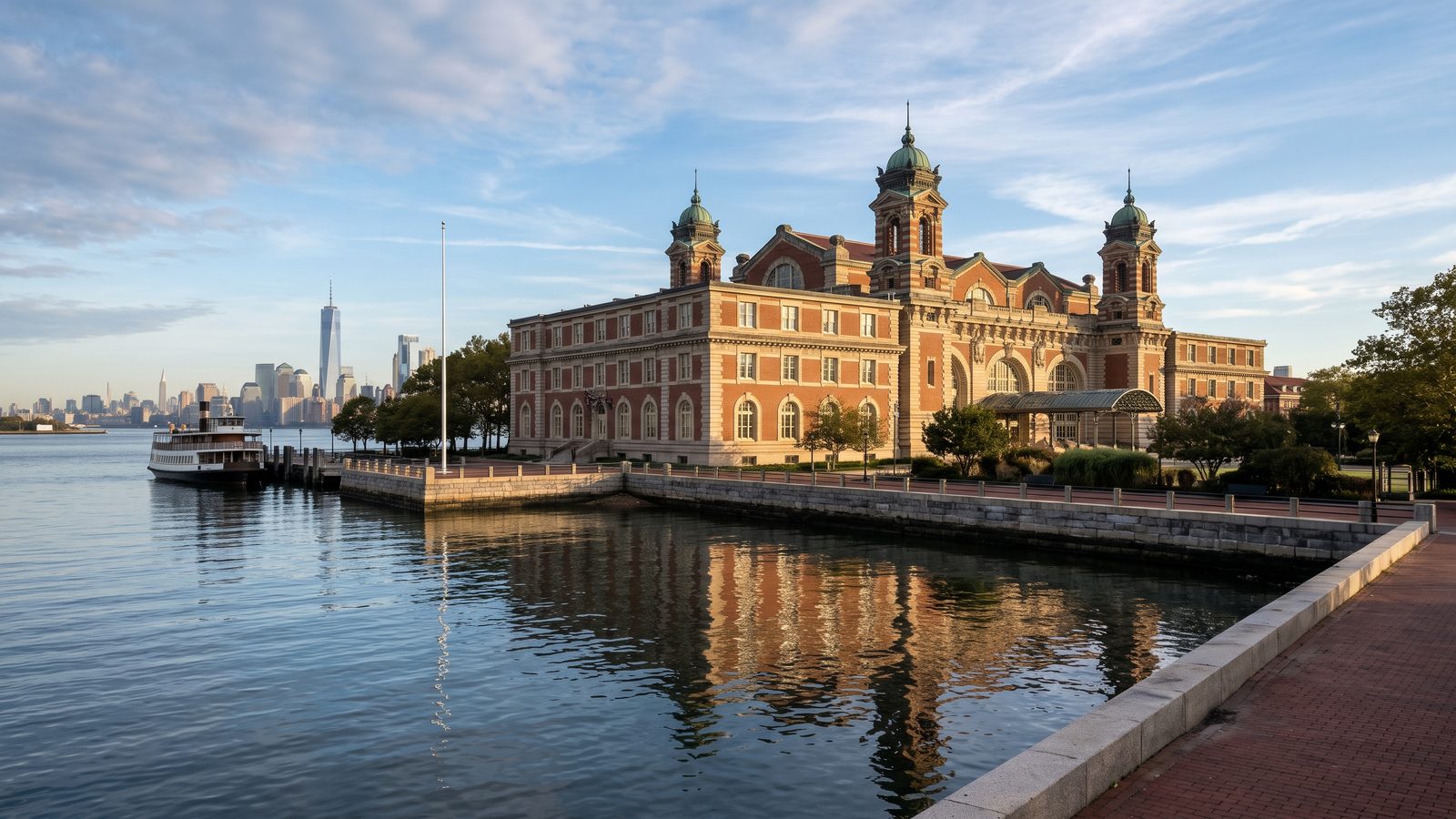
Step back into history at the Ellis Island National Museum of Immigration in New York Harbor. Between 1892 and 1954, over twelve million immigrants passed through these historic halls seeking new lives in America. With this self-guided audio tour, you will walk in their footsteps across the Great Hall, discover the striking Beaux-Arts architecture, and hear emotional stories of hope, health checks, and new beginnings.
From the tense moments of the six-second physical to emotional reunions at the Kissing Post, this tour brings the immigrant journey vividly to life. Explore structural marvels like the Guastavino vaulted ceilings and immerse yourself in the crucible of American reinvention.
Listen to a sample
The opening of this tour, exactly as AllTours narrates it on site.
What you'll hear on this tour
Stop 1. The Crucible of American Identity
You step off the ferry, your entire future hanging in the balance as you enter the busy processing hall. Doctors quickly scan you during the infamous six-second physical, marking your coat with chalk if an ailment is suspected. Next comes a rapid legal inspection questioning your name, money, and destination to ensure you can support yourself. You wait anxiously in the Great Hall among hundreds of languages and unfamiliar faces. As your family navigates the Stairs of Separation, you pray for a joyous reunion at the legendary Kissing Post outside, where your new life in America finally begins.
Stop 2. From Execution Ground to National Gateway
You stand on an island that began as a small marshy patch, once dark with public executions when known as Gibbet Island. In 1892, federal immigration processing officially opened here, but a tragic fire destroyed the original wooden structure in 1897, burning decades of irreplaceable family records. Undeterred, builders raised the grand Beaux-Arts brick station in 1900 to handle unprecedented waves of newcomers. Between 1900 and 1914, thousands of hopeful arrivals pass through these halls every single day. Though 1920s laws later turn the island into a detention center before its 1954 closure, it reemerges in 1990 as a profound national museum.
Stop 3. Grandeur Built for Millions
You gaze up at the imposing French Renaissance Revival facade, designed by architects Boring & Tilton to convey absolute permanence and civic authority. Meticulous red brickwork accented with crisp limestone trim creates a symmetrical Beaux-Arts exterior designed for maximum efficiency. Inside the Registry Room, your eye travels upward to soaring vaulted ceilings engineered with self-supporting Guastavino tiles. These thin arches provide structural integrity while diffusing soft natural light throughout the vast hall from immense windows. Every architectural choice, from robust materials to soaring vertical spaces, works to handle the overwhelming human tide passing through, reflecting the bold ambition and progress of a rising nation.
Stop 4. Arches, Plaster, and Tapestries of Hope
You notice that artistic grandeur is woven directly into the building's functional design. The soaring Guastavino arches in the Registry Room form an intricate mosaic pattern, creating an uplifting, cathedral-like atmosphere that inspires awe in arriving newcomers. Classical decorative plasterwork adorns the grand stairwells, while crafted ironwork showcases the meticulous detail of the period. As you wander through the museum spaces, contemporary installations like the Flags of America exhibit catch your attention. Here, vibrant banners represent the international origins of millions who arrived. This blend of historic architecture and modern art transforms the museum into a living expression of the global immigrant experience.
Stop 5. A First Taste of the New World
You enter the vast dining hall after an exhausting sea journey to receive your very first meal on American soil. Instead of the comforting, spiced regional dishes of your homeland, workers serve simple, hearty fare designed for efficiency, such as beef stew, fresh bread, and coffee. Federal authorities prioritize basic nutrition and easy digestion over familiar culinary traditions. Though the bland food marks a sharp cultural shock, this bustling cafeteria offers a brief respite and warmth during an overwhelming process. These initial meals mark your introduction to a new land, paving the way for diverse flavors immigrants would soon bring to America.
Stop 6. The Promise of Reinvention
As your ship sails into New York Harbor, you look out at Lady Liberty holding her glowing torch, representing the freedom you have dreamed of across oceans. For you, America is not merely a place on a map, but an audacious promise of personal reinvention. Here, your future depends on hard work rather than ancient lineage or old-world social boundaries. You imagine owning land, speaking your mind freely, and offering your children opportunities once thought impossible. You step into a grand democratic experiment, contributing your own unique heritage to a chaotic, vibrant tapestry of cultures bound together by shared hope.
Planning your visit
- Best time to go
- Early morning on weekdays, especially during spring or autumn to avoid heavy crowds on the ferry and inside the Great Hall.
- Approximate duration
- About 2 to 3 hours
- Where to start
- Inside the main building's ground-floor baggage room after landing from the ferry at Ellis Island.
Access and conditions change seasonally — check the official site before you go.
Frequently asked questions
Is Ellis Island National Museum of Immigration worth visiting?
Yes, Ellis Island is one of the most historically significant sites in the United States. Over 12 million immigrants passed through its halls, making it a deeply moving experience for history enthusiasts and family heritage seekers alike.
How long do you need at Ellis Island National Museum of Immigration?
Most visitors spend between 2 and 3 hours exploring the Great Hall, exhibits, and interactive displays, though you should budget additional time for ferry transit.
When did Ellis Island open as a federal immigration station?
Ellis Island opened as a federal processing station in 1892. Following a devastating fire in 1897, the iconic Beaux-Arts main building was constructed and opened in 1900.
Keep exploring
Header image is an AI-generated illustration of Ellis Island National Museum of Immigration. AllTours.ai is an AI audio tour guide — point your camera at any landmark and hear its story.