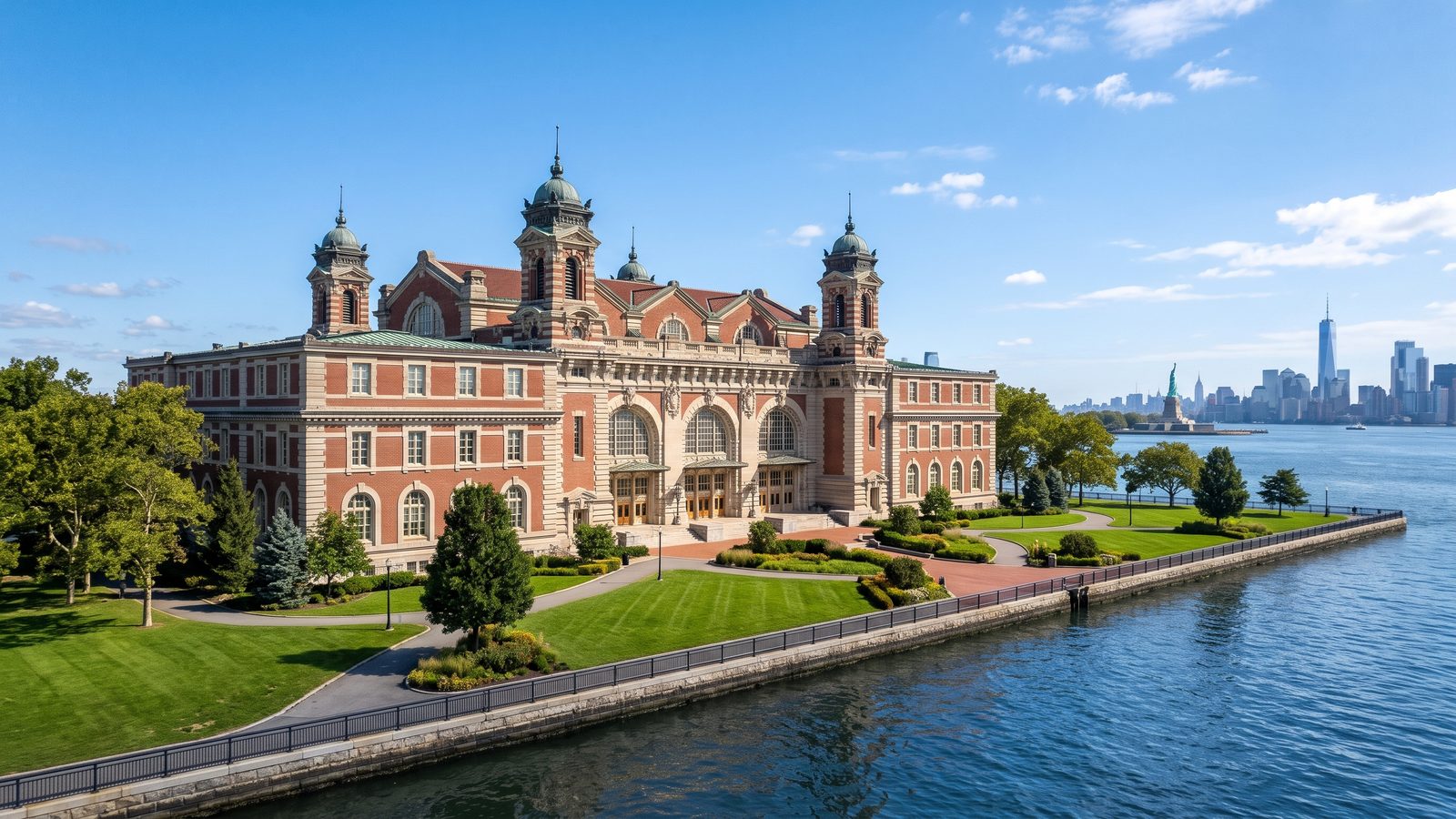
Step onto Ellis Island, the iconic gateway through which millions of hopeful newcomers entered the United States. As you walk through the historic grounds of New York Harbor, this self-guided audio experience transports you back to the turn of the twentieth century. You will explore the massive Great Hall where arrivals underwent medical and legal inspections, admire the grand French Renaissance Revival architecture, and hear the poignant stories of those seeking a new life.
Immerse yourself in preserved exhibits, historical photography, and authentic oral histories detailing the immigrant journey. From its origins as Lenape land and a military fort to a national immigration station, discover how this small island shaped the cultural and social fabric of modern America.
What you'll hear on this tour
Stop 1. The Crucible of the Great Hall
You step off the ferry, your heart pounding with hope and anxiety as you enter the cavernous Great Hall. Here, Public Health Service doctors observe your arrival, conducting the infamous six-second physical to scan for conditions like trachoma or tuberculosis. You watch anxiously as chalk marks are drawn on coat lapels—an X for a suspected mental defect or an H for a heart condition—signaling potential detention. Next, you face legal inspectors who fire questions through interpreters about your money, employment, and connections. You feel the intense pressure knowing that ninety-eight percent of arrivals pass through into America, while two percent face an agonizing return voyage across the ocean.
Stop 2. From Fort Gibson to Gateway
You stand on an island with a deep, layered history stretching far beyond its famous immigration era. Long before serving as America's gateway, the Lenape people knew this land as Kioshk, or Gull Island, before local merchant Samuel Ellis acquired it in the 1770s. You trace its transformation into Fort Gibson, a federal military post protecting New York Harbor. On January 1, 1892, the first federal immigration station opens here in wooden buildings, processing over one point five million arrivals. Tragically, a catastrophic fire in June 1897 completely destroys the original complex and five years of immigration records, leading directly to the grand, fireproof brick structure you explore today.
Stop 3. Grandeur of the Renaissance Revival
Gazing at the Main Building, you admire its grand French Renaissance Revival design, crafted by architects Boring and Tilton to project national authority. You notice the rich contrast between deep red brick and light limestone trim that softens the building's massive scale. As you step into the Registry Room, your eyes rise to vaulted ceilings featuring revolutionary fireproof Guastavino tile arches. These self-supporting tile vaults eliminate internal columns, creating a vast open space while managing acoustics for thousands of voices. You look through immense arched windows designed to flood the hall with natural light, illuminating the faces of arriving immigrants as inspectors systematically evaluate their destinies.
Stop 4. Living Archive of Human Hope
Inside the Ellis Island National Museum of Immigration, you immerse yourself in a living archive of human determination. In the 'Through America's Gate' exhibit, you view physical evidence of the rigorous screening process. You examine personal artifacts—worn suitcases, tattered clothing, and official entry documents—clutched by arrivals over a century ago. Listening closely to oral history recordings, you hear personal sagas of courage in the immigrants' own voices. You walk through the 'Peak Immigration Years' gallery to see crowded dormitory photos, and explore 'Treasures from Home' to view cherished personal items brought across the sea, preserving a profound link to the homelands they left behind.
Stop 5. Crucible of a New Identity
You stand amid the echoes of a vibrant cultural kaleidoscope where traditions, languages, and worldviews first collided with American life. You imagine the swirling sound of a hundred different tongues—Yiddish, Italian, Polish, German, and Gaelic—filling the hall. Immigrants arrive holding tight to their cultural fabric, bringing ancestral recipes, religious customs, folk songs, and family traditions into a new land. This island serves as the initial negotiation point where newcomers weigh retaining their heritage against embracing a new American identity. You witness the birth of the hyphenated American, feeling how these enduring cultures refused to be erased and instead enriched the nation with dynamic diversity.
Stop 6. Craftsmanship and Visual Narratives
Looking closely at your surroundings, you discover exquisite turn-of-the-century artistry woven into the building's design. Above you, the herringbone patterns of the Guastavino terracotta tiles form a warm, earthy mosaic, reflecting meticulous hand-craftsmanship alongside structural engineering. You observe historical photographs displayed throughout the space, recognizing them as poignant works of visual art that freeze raw emotions of hope, fear, and determination. Each carefully composed photograph documents the human narrative of arrival. Even the careful museum restoration work represents an artistic commitment, painstakingly recreating original paint finishes and authentic aesthetics so you can experience the gateway exactly as intended.
Planning your visit
- Best time to go
- Early morning on weekdays to avoid ferry crowds and peak museum hours.
- Approximate duration
- about 3 hours
- Where to start
- Ellis Island Main Building, accessible by ferry from Battery Park in New York or Liberty State Park in New Jersey.
Access and conditions change seasonally — check the official site before you go.
Frequently asked questions
Is Ellis Island worth visiting?
Yes, Ellis Island offers an essential look into American history, featuring the restored Great Hall, historic exhibits, oral history archives, and stunning architectural detail in New York Harbor.
How long do you need at Ellis Island?
Most visitors spend about 2 to 3 hours exploring the exhibits, Great Hall, and museum galleries inside the historic Main Building.
What happened to the original Ellis Island immigration building?
The original wooden immigration station opened on January 1, 1892, but was completely destroyed by a catastrophic fire in June 1897, leading to the construction of the fireproof French Renaissance Revival building seen today.
Keep exploring
Header image is an AI-generated illustration of Ellis Island. AllTours.ai is an AI audio tour guide — point your camera at any landmark and hear its story.