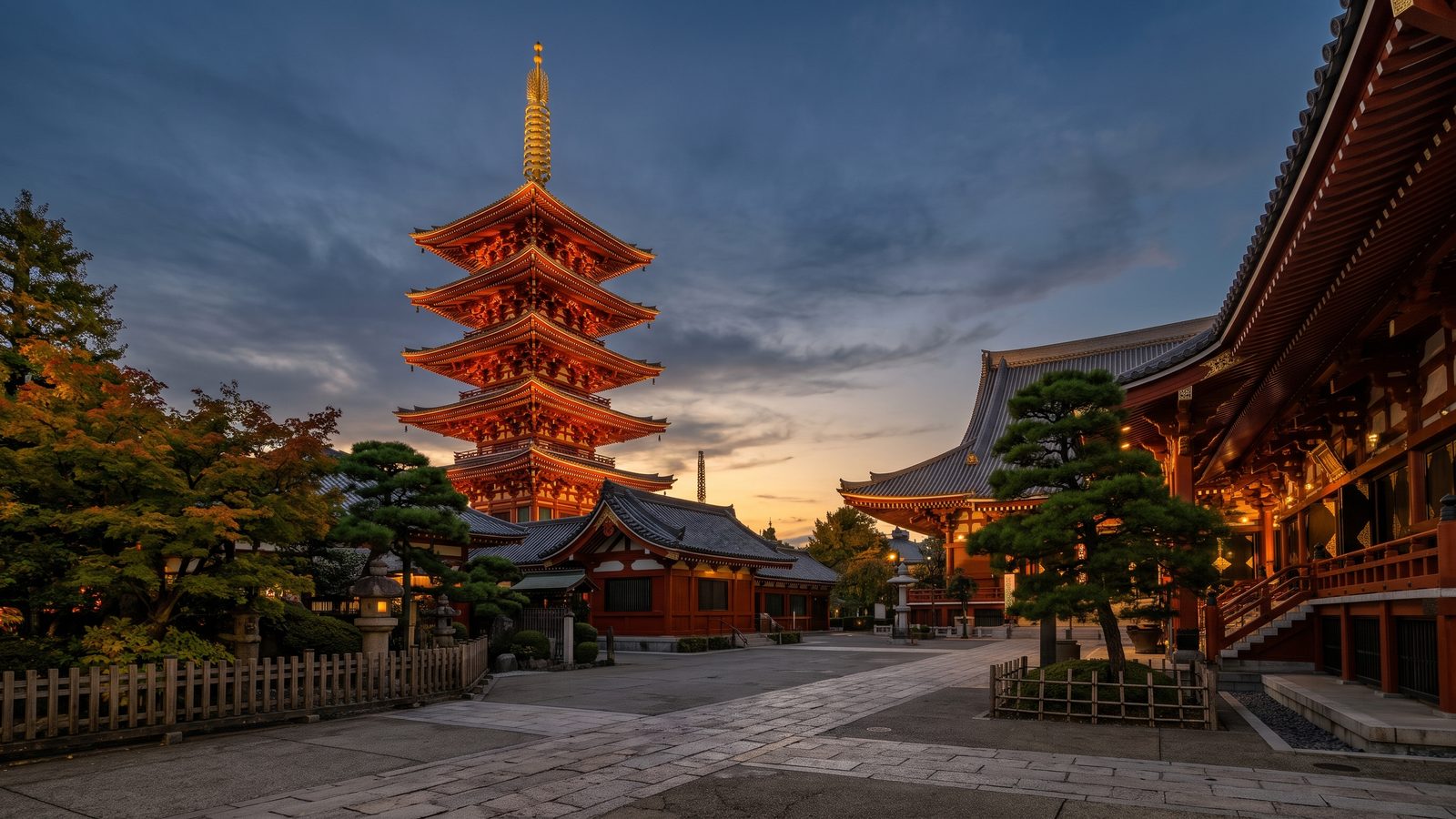
You are standing before the magnificent Five-Story Pagoda at Sensō-ji, a soaring 53-meter crimson spire that anchors Tokyo’s oldest and most sacred Buddhist temple complex. Rebuilt in 1973 following World War II, this striking landmark symbolizes unwavering spiritual resilience, carrying over a millennium of history. As you look up at its intricate red eaves, you are beholding both a marvel of ancient seismic engineering and a deeply revered cosmic shrine.
This self-guided audio tour reveals the hidden mysteries behind the pagoda's architecture, sacred relics, and cultural heritage. From Sri Lankan gifts to earthquake-resistant pendulum pillars, step closer to discover how this ancient beacon continues to inspire millions of pilgrims and visitors from around the globe.
Listen to a sample
The opening of this tour, exactly as AllTours narrates it on site.
What you'll hear on this tour
Stop 1. Mastery of Earthquakes and Wood
Look up at the pagoda's five sweeping roofs gracefully diminishing in size as they soar skyward. You are gazing at a masterclass in ancient Japanese seismic engineering. Notice the deep eaves supported by the intricate tokōyō bracket system—an interlocking network of wooden components assembled without a single nail to distribute immense weight. Hidden inside the core sits a central shinbashira pillar, functioning like a suspended pendulum that allows the structure to sway independently during tremors. Ceramic kawara roof tiles protect the vibrant vermilion framework from the elements, while atop the spire stands the sōrin finial, featuring nine rings and a sacred hōju jewel connecting earth to heaven.
Stop 2. A Phoenix Arising From the Ashes
You stand on ground that has witnessed over a thousand years of destruction and rebirth. Military commander Taira no Kinmasa first erected a pagoda here in 942 AD. After devastating fires consumed it in 1649, Shogun Tokugawa Iemitsu commissioned a grander reconstruction that endured for nearly three centuries as a symbol of Edo Prosperity. Tragedy struck again during the March 1945 Tokyo Air Raids when wartime bombings reduced the historic spire to rubble. The 53-meter structure you see today was completed in 1973, combining traditional aesthetics with modern craftsmanship to embody Tokyo's enduring spiritual heritage and invincible spirit.
Stop 3. Sacred Relics and Skyward Eaves
Marvel at how the vibrant vermilion of this 53-meter tower pierces the Tokyo sky. Beyond its visual beauty, this pagoda serves as a sacred repository holding a portion of the Buddha's ashes, gifted to the temple from Sri Lanka and enshrined on its uppermost level. As you observe the deep, upward-curving eaves, imagine their dual purpose: shielding delicate wooden lacquerwork from harsh weather and symbolic protection to ward off evil spirits. Each of the five distinct tiers represents a fundamental cosmic element, inviting you to reflect on the universe as you trace the tower from its sturdy base to its gilded tip.
Stop 4. A Cosmic Diagram in Three Dimensions
Allow yourself to absorb the quiet spiritual energy radiating from this sacred tower. Think of the structure before you as a three-dimensional mandala—a cosmic diagram guiding pilgrims toward enlightenment. The five stories represent the universe's foundational elements: earth, water, fire, wind, and the void. Inside, the enshrined ashes of the Buddha offer a focus for veneration, drawing silent prayers and incense smoke upward toward the heavens. As you look toward the crowning sōrin spire symbolizing divine wisdom, you join centuries of pilgrims who have sought solace, inner peace, and the boundless compassion of Kannon Bodhisattva here.
Stop 5. Heartbeat of Edo Tradition and Faith
Gaze upon a living symbol of Japanese cultural identity. This pagoda is far more than historical architecture; it acts as an active anchor for community life and seasonal celebrations. Each tier's representation of earth, water, fire, wind, and void reflects a holistic Buddhist philosophy deeply woven into everyday Japanese life. Families gather around this courtyard during vibrant temple festivals, carrying forward centuries-old traditions of prayers, merit-making, and gratitude. The meticulous vermilion lacquerwork and traditional joinery speak to generations of dedicated craftsmanship passed down through centuries, keeping Tokyo’s ancient cultural spirit vibrant in a modern world.
Stop 6. The Legend of the Golden Statue
Turn your attention toward the nearby Hondō main hall, the divine origin of Sensō-ji. In 628 AD, two fishing brothers, Hinokuma Hamanari and Takenari, pulled a small golden statue of Kannon Bodhisattva from the Sumida River. Though they repeatedly returned it to the water, the statue miraculously reappeared, prompting the founding of this holy sanctuary. Today, the sacred statue remains perpetually hidden from public view inside the inner sanctum to preserve its mystique and sanctity. As you stand among modern pilgrims, you can feel the unseen presence and benevolent energy that has drawn worshippers to this riverbank shrine for centuries.
Planning your visit
- Best time to go
- Early morning before 8:30 AM for peaceful photos without crowds, or evening when illuminated.
- Approximate duration
- about 30 minutes
- Where to start
- In front of the Five-Story Pagoda in the main Senso-ji temple courtyard, just west of the main hall.
Access and conditions change seasonally — check the official site before you go.
Frequently asked questions
Is Five-Story Pagoda at Senso-ji worth visiting?
Yes, the Five-Story Pagoda at Senso-ji is one of Tokyo's most iconic historic landmarks. It features rare Buddha relics from Sri Lanka, brilliant vermilion architecture, and fascinating earthquake-resistant engineering.
How long do you need at Five-Story Pagoda at Senso-ji?
You need about 20 to 30 minutes to admire the exterior architecture of the pagoda, explore its structural details, and listen to its history before visiting the adjacent Hondō main hall.
What is the history behind the Five-Story Pagoda at Senso-ji?
First built in 942 AD by military commander Taira no Kinmasa, the pagoda was rebuilt by Shogun Tokugawa Iemitsu in 1648-1650, destroyed during the 1945 air raids, and faithfully reconstructed in 1973.
Keep exploring
Header image is an AI-generated illustration of Five-Story Pagoda at Senso-ji. AllTours.ai is an AI audio tour guide — point your camera at any landmark and hear its story.