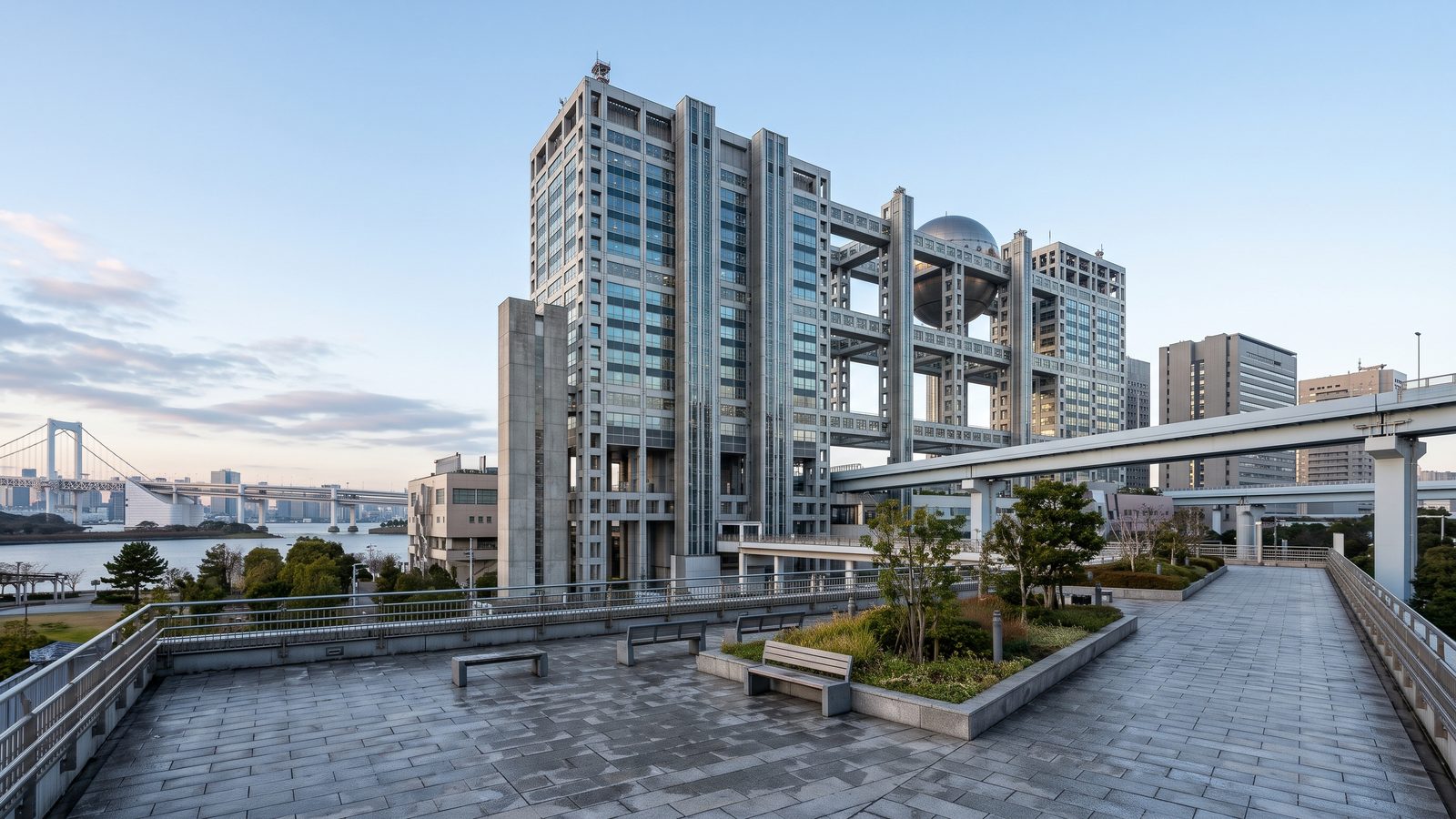
Welcome to Odaiba, home to one of Tokyo's most recognizable skyline icons: the Fuji Television Building. Designed by legendary architect Kenzo Tange and completed in the late 1990s, this daring postmodern structure stands as a monumental media fortress. As you explore this high-tech marvel, you will encounter floating sky corridors, exposed steel frameworks, and the breathtaking 1,200-ton titanium sphere suspended high above Tokyo Bay.
This self-guided audio tour reveals the inner workings of Japan's vibrant entertainment capital. Learn how legendary anime like One Piece, hit dramas, and live broadcasts are created inside, while taking in sweeping panoramic views of Tokyo's skyline from the building's futuristic observation deck.
Listen to a sample
The opening of this tour, exactly as AllTours narrates it on site.
What you'll hear on this tour
Stop 1. Floating Inside the Hachitama Sphere
You step inside the Hachitama, a colossal titanium sphere suspended 123 meters above ground. As you look out through the interior lattice work, an incredible 270-degree panorama of Tokyo Bay unfolds around you. Below, you trace the elegant arc of the Rainbow Bridge and the lively waterfront district of Odaiba. Off in the distance, the iconic silhouette of Tokyo Tower pierces the city horizon, while on exceptionally clear days, the majestic peak of Mount Fuji stands proud against the sky. As you take in this breathtaking vista, you might feel a subtle sway, a constant reminder of the 1,200-ton steel structure's daring engineering.
Stop 2. Kenzo Tange's City in the Sky
You stand before a masterpiece of postmodern futurism, envisioned by Pritzker Prize laureate Kenzo Tange. Designed as a "media fortress" rising from the bay, the building showcases a conceptual "city in the sky." You notice dynamic sky corridors bridging the two primary towers at multiple levels, creating both functional connections and dramatic visual pathways. The massive 1,200-ton Hachitama observation deck seems to defy gravity between the towers, supported by a complex network of steel trusses and cables. Exposed steel frameworks and vast glass facades intentionally highlight the building's high-tech purpose and structural transparency, all anchored by a robust earthquake-resistant engineering system.
Stop 3. The Heartbeat of Japanese Pop Culture
You walk through the birthplace of modern Japanese entertainment, where television has been redefined for decades. Inside these active studios, Fuji TV pioneered groundbreaking dramas that captivated millions, along with variety shows that became daily household staples. This hub gave rise to globally recognized anime series, helping spread Japanese pop culture far beyond the nation's borders. As you explore, you sense the creative legacy of writers, directors, and performers whose work has influenced national fashion, slang, and social trends across the archipelago. Every floor represents a chapter in Japan's modern cultural narrative, crafted through relentless technical innovation and narrative storytelling.
Stop 4. Inside the Live Broadcast Hub
You are standing near the pulsing nerve center of Japan's media operations. Inside this massive content factory, dynamic control rooms buzz with producers, directors, and technicians meticulously crafting every frame and soundbite. From this very site, live news broadcasts, hit variety programs, and daily dramas originate, requiring split-second decisions that reach millions of homes across the Japanese archipelago. You feel the palpable energy of a continuous production hub, where technical precision meets creative output. From breaking news updates to the latest anime sensations, every signal is orchestrated right here in Odaiba to capture the nation's immediate attention.
Stop 5. Odaiba's Iconic Metallic Beacon
You gaze up at the gleaming titanium skin of this iconic Odaiba landmark. The building's defining element, the Hachitama sphere, hangs dramatically 123 meters high, anchoring a design that has become a backdrop for countless TV dramas and anime. You see how the two towering structures link together through massive sky corridors, giving the entire complex the appearance of a futuristic suspended bridge over Tokyo Bay. Completed in the late 1990s under Kenzo Tange's visionary direction, the building’s shimmering metallic exterior serves as a high-tech symbol on the Tokyo skyline, capturing the adventurous spirit of modern media.
Stop 6. A Kinetic Industrial Sculpture
You observe the building's exposed steel framework, a striking example of late twentieth-century industrial design. More than a simple office complex, the structure functions like a colossal kinetic sculpture reflecting the fast-paced digital age. You notice how vast glass panels create an atmosphere of architectural transparency, symbolizing the open flow of information. Massive crisscrossing beams support the central metallic sphere, giving the impression that heavy structural elements can float freely in midair. Housing state-of-the-art studios inside, this modern monument showcases the seamless blend of structural engineering, high-definition broadcast technology, and visionary urban design.
Planning your visit
- Best time to go
- Late afternoon before sunset to catch daylight city views, sunset over Tokyo Bay, and the evening city lights.
- Approximate duration
- About 1 to 1.5 hours
- Where to start
- Outside the main plaza of the Fuji Television Building in Odaiba, facing the central towers and titanium sphere.
Access and conditions change seasonally — check the official site before you go.
Frequently asked questions
Is Fuji Television Building worth visiting?
Yes, especially for fans of Japanese television, anime like One Piece, and modern architecture. The building features Kenzo Tange's unique futuristic design and the Hachitama observation deck, offering 270-degree views of Tokyo Bay, Rainbow Bridge, and Mount Fuji.
How long do you need at Fuji Television Building?
Most visitors spend about 1 to 1.5 hours exploring the public display areas, walking through the sky corridors, and visiting the Hachitama spherical observation deck.
When was the Fuji Television Building built and who designed it?
The building was designed by Pritzker Prize-winning architect Kenzo Tange and completed in the late 1990s (1996-1997) as a cornerstone of Odaiba's futuristic redevelopment.
Keep exploring
Header image is an AI-generated illustration of Fuji Television Building. AllTours.ai is an AI audio tour guide — point your camera at any landmark and hear its story.