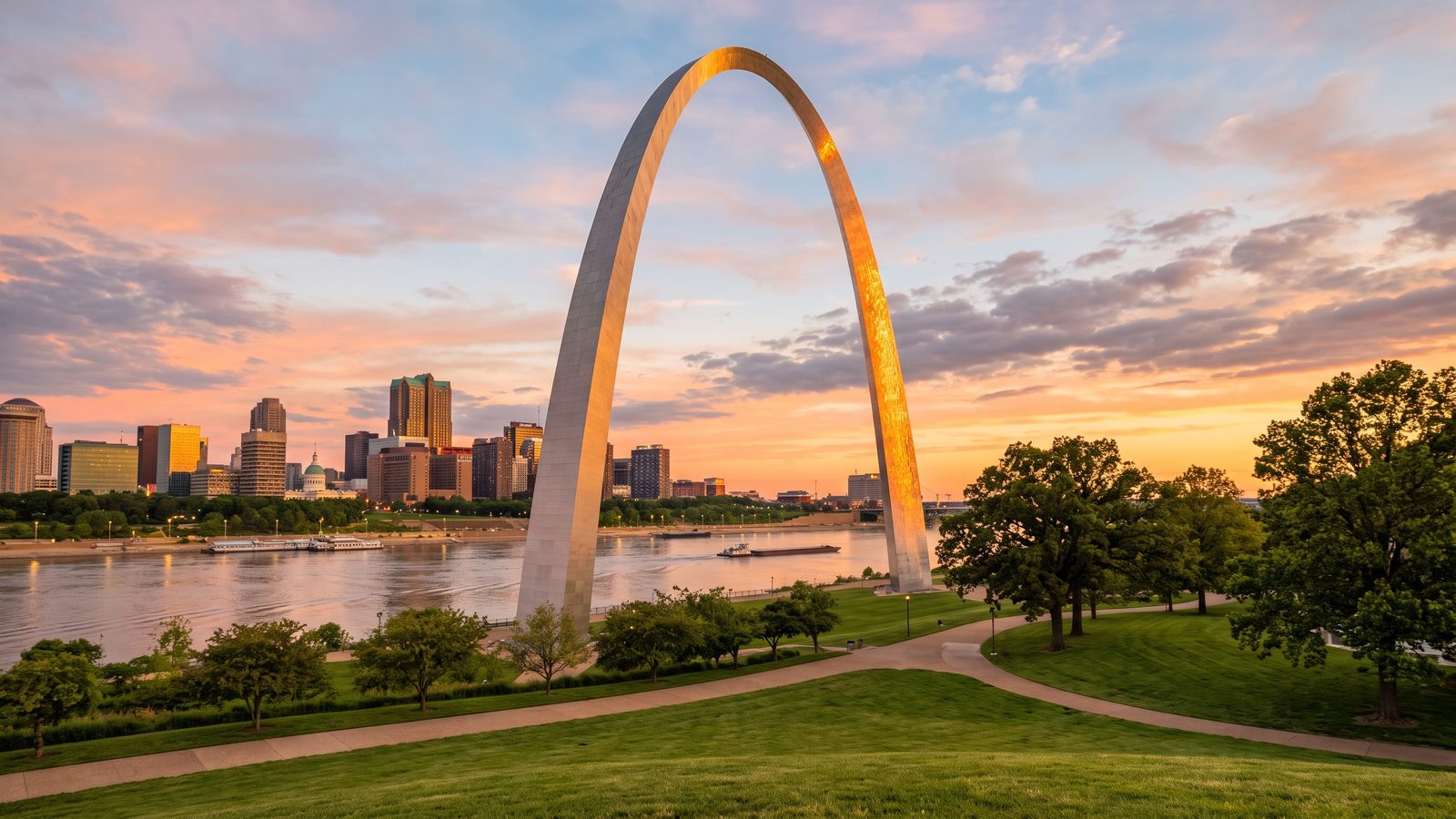
Welcome to St. Louis's iconic Gateway Arch, a soaring 630-foot stainless steel monument celebrating America's spirit of westward expansion. Designed by architect Eero Saarinen after winning a national competition in 1947, this monumental structure stands on the banks of the Mississippi River as a symbol of pioneer courage and modern ingenuity. As you walk around its sweeping base, you stand at the historical launching point of continental exploration.
This audio tour guides you through the incredible engineering, mathematical artistry, and historic legacy of the nation's tallest monument. Discover how 142 stainless steel sections come together to form a flexible catenary curve, and prepare to take in breathtaking panoramic views of the river and the St. Louis skyline.
Listen to a sample
The opening of this tour, exactly as AllTours narrates it on site.
What you'll hear on this tour
Stop 1. Conquering Steel and Gravity
You stand beneath a 630-foot monument forged from over 900 tons of gleaming stainless steel. As you look up, you observe how each soaring leg forms a hollow triangle tapering gracefully toward the sky. Imagine the audacity required to construct this geometric masterpiece in the mid-20th century. Workers used a revolutionary internal tram system to winch towering steel sections into place bit by meticulous bit. This structure is not just about height; it represents post-war American innovation in structural design and materials science, engineered to withstand immense environmental forces while maintaining its precise, sweeping form.
Stop 2. The Audacity of the Catenary Curve
You gaze upward at a groundbreaking realization of modern physics: a sleek catenary curve rising high above the Mississippi River. Architect Eero Saarinen designs this structure to appear effortlessly thin, yet it possesses immense structural integrity. Look closely at the stainless steel skin, composed of 142 distinct sections. This outer layer actively distributes structural loads, allowing the Arch to sway slightly during high winds without sacrificing stability. As you stand at the base, notice how the legs widen significantly to anchor the monument. You experience a striking visual contrast between grounded strength and airy, soaring ambition.
Stop 3. Ground Zero for Westward Ambition
You stand on the historic riverfront ground that once served as the vibrant starting point for pioneer expeditions following the Louisiana Purchase. In the late 1940s, a national competition draws over 170 architectural proposals for this prime location along the Mississippi River. You learn how Eero Saarinen’s bold, catenary design wins over judges by capturing the daring spirit of reaching into uncharted territories. The resulting monument commemorates the explorers and fortune seekers who launched their dreams right from this spot. Its mid-century construction represents a landmark engineering journey built to honor an era of boundless national adventure.
Stop 4. Panoramas of a Changing Nation
You look out across a landscape where centuries of American history unfold before your eyes. Looking north, you sense the lingering legacy of Lewis and Clark departing into uncharted wilderness. Below you, the mighty Mississippi River flows steadily, carrying memories of steamboats and vital trade routes that built a nation. To the south, the city of St. Louis stretches into the distance, its evolving skyline reflecting human growth and innovation. As light shifts throughout the day—from soft morning radiance to brilliant fiery sunsets—you witness a living canvas bridging historic journeys with the modern horizon.
Stop 5. Mathematical Elegance in Polished Steel
You appreciate the intellectual beauty of Saarinen's concept, which turns pure mathematics into visual art. The design takes the catenary curve—the natural shape a hanging chain forms—and inverts it into a permanent steel sculpture. Notice how the gleaming stainless steel skin reflects and distorts ambient light, changing dynamically as you walk around the plaza. Even the internal tram system operates as a hidden vein, blending mechanical utility with artistic intrigue. Saarinen integrates structural science, material reflection, and interior movement to turn a structural monument into an ever-shifting, harmonious work of public art.
Stop 6. The Launchpad of Continental Dreams
You stand at the edge of the American continent, right where historical journeys into the unknown began. This monument embodies the courage of early expeditions venturing into uncharted lands with only a compass and curiosity. You occupy the very genesis point where figures like Lewis and Clark launched their monumental expedition across the vast western frontier. The soaring Arch serves as a permanent declaration of discovery, honoring the human drive to cross horizons and map unknown territories. As you look out from this spot, you connect directly with that unyielding spirit of adventure.
Planning your visit
- Best time to go
- Early morning or late afternoon for smaller crowds and spectacular lighting along the Mississippi River.
- Approximate duration
- About 1 to 2 hours
- Where to start
- Gateway Arch National Park Grounds, near the riverfront entrance
Access and conditions change seasonally — check the official site before you go.
Frequently asked questions
Is Gateway Arch worth visiting?
Yes, the Gateway Arch is a premier national park site offering world-class modern architecture, rich American history, and unmatched panoramic views of the Mississippi River and St. Louis skyline.
How long do you need at Gateway Arch?
Most visitors spend between 1 and 2 hours exploring the Arch grounds, admiring the architecture, taking in the river views, and experiencing the self-guided tour stops.
Who designed the Gateway Arch and when was it built?
Architect Eero Saarinen won the design competition in 1947 with his catenary arch concept. Construction was completed in 1965.
Keep exploring
Header image is an AI-generated illustration of Gateway Arch. AllTours.ai is an AI audio tour guide — point your camera at any landmark and hear its story.