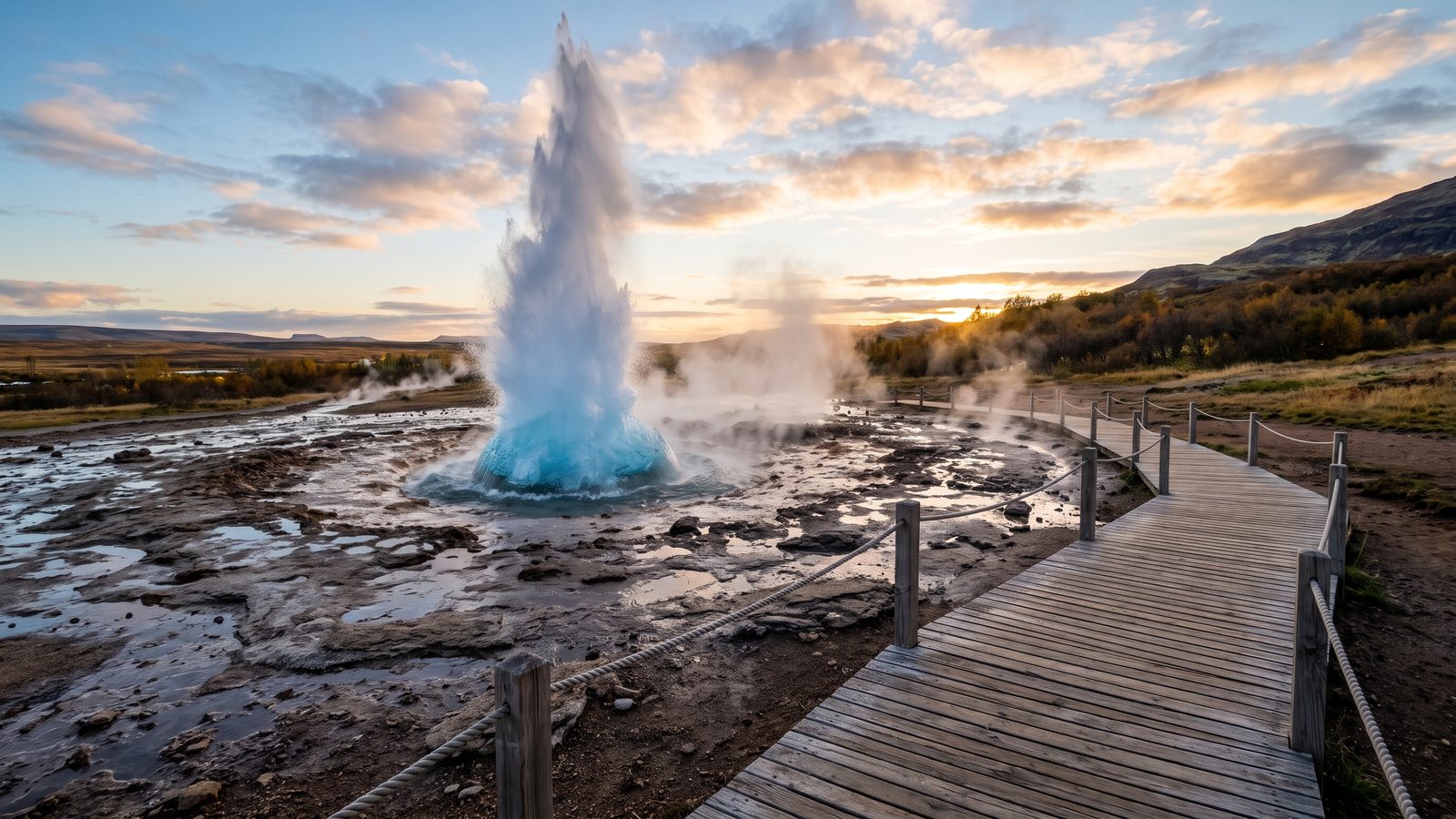
Welcome to Haukadalur valley in Southern Region, Iceland, home to the world-famous Geysir Geothermal Area. As you step onto the wooden pathways guiding you through this active landscape, you enter a real-life natural theater of intense underground heat. Steam rises from vibrant, bubbling mud pots, while the surrounding earth glows with rich mineral hues, offering an unforgettable showcase of raw planetary forces along the iconic Golden Circle.
Here, you can witness the energetic Strokkur erupt every few minutes, blasting scalding water high into the sky. You will also learn how ancient settlers, pioneering naturalists, and subterranean plumbing systems combined to make this bubbling valley one of the most remarkable, historically renowned natural wonders on Earth.
Listen to a sample
The opening of this tour, exactly as AllTours narrates it on site.
What you'll hear on this tour
Stop 1. The Mechanics of Explosive Steam
You stand above a delicate underground pressure vessel where cold groundwater percolates deep into ancient rock fissures. Beneath your feet, magma-heated bedrock superheats this trapped water far past its normal boiling point. Immense pressure keeps the fluid liquid until expanding steam bubbles force water upward, instantly relieving the weight above. This critical drop triggers an explosive phase transition, flashing superheated liquid into violent steam that propels a colossal water column skyward. As you gaze into the vent, observe how the water subtly domes and swells just before erupting. Remember that you are witnessing an exceptionally rare phenomenon, where precise heat, water, and mineral-lined conduits converge to create nature's grandest spectacle.
Stop 2. Capturing Strokkur's Sapphire Dome
To capture the raw force of Strokkur through your camera lens, you must become a student of the geyser's subtle preamble. Watch for the sudden retraction of water and the formation of a vibrant, sapphire-blue dome—your undeniable signal to press the shutter. Set your camera to a rapid shutter speed of 1/1000th of a second to freeze every crystalline droplet against the Icelandic sky, or switch to 1/250th to capture dynamic motion blur. Position yourself carefully to allow golden hour light to backlight the towering steam plume into a glowing cloud. Keep your lens cloth ready, as geothermal mist is relentless in this intense landscape.
Stop 3. Colors of the Subterranean Engine
You walk directly above the Mid-Atlantic Ridge, where diverging tectonic plates channel intense mantle heat to superheat deep volcanic groundwater. As this mineral-rich water surges upward under extreme pressure, it deposits exquisite silica sinter terraces along the active pool rims. Look closely at the vivid ochre, orange, and green hues painting the landscape; these striking colors are formed by thermophilic microorganisms thriving in extreme temperatures. Nearby, acidic mud pots boil violently as sulfurous gases dissolve the surrounding rock into thick, viscous clay, releasing a heavy mineral scent. Beneath this fragile crust, water is kept liquid at over 120 degrees Celsius, preparing for its chaotic release into the air.
Stop 4. Centuries of Spectacle and Study
You walk in the footsteps of ancient islanders and early travelers who marvelled at the Great Geysir, active since at least 1294. During its peak in the 18th century, eruption columns routinely soared sixty meters high, inspiring visitors to wait patient weeks for a single display. From the late 17th century, this colossal wonder attracted international naturalists eager to uncover Earth's secrets. In the early 20th century, curious onlookers even dug artificial channels to force powerful blasts, though this harmful practice was eventually halted. Today, you explore a carefully protected landscape, safeguarding the ancient, tumultuous heritage of the spring that gave every geyser on Earth its name.
Stop 5. Silica Seals and Bubble Pistons
You are observing a massive geothermal heat engine driven by Iceland's shallow mantle plume. As groundwater percolates through volcanic rock, chemical reactions with minerals like olivine enrich the liquid with dissolved amorphous silica. This mineral precipitates inside the subterranean throat, coating the walls with an impervious layer of geyserite that seals internal fissures. This watertight lining allows immense pressure to build, raising the boiling point deep underground. When the first rising steam bubbles act like pistons, they lift the upper water column and trigger a rapid drop in pressure. This positive feedback loop accelerates the boiling process, resulting in the explosive jet you see before you.
Stop 6. In the Footsteps of Norse Settlers
You stand on ground first documented by early Norse settlers, who recorded the marvel of this Great Spring in medieval sagas. Imagine the arduous journey these explorers faced, trekking weeks across treacherous rivers and volcanic deserts to reach this remote, steaming valley. By the 18th century, Enlightenment naturalists like Sir Joseph Banks ventured here to conduct the very first scientific observations of the mysterious eruptions. As you follow their historical trail, reflect on how their meticulous mapping, pressure measurements, and daring hypotheses in an uncharted world laid the groundwork for modern geological science. Their spirit of discovery still echoes across this ancient geothermal field today.
Planning your visit
- Best time to go
- Early morning or late afternoon to avoid peak Golden Circle tour bus crowds and catch optimal lighting.
- Approximate duration
- about 1 to 1.5 hours
- Where to start
- Geysir Center visitor parking area, near the main wooden pathway leading into the lower geothermal field.
Access and conditions change seasonally — check the official site before you go.
Frequently asked questions
Is Geysir Geothermal Area worth visiting?
Yes, it is one of Iceland's most iconic Golden Circle destinations, offering visitors the chance to watch Strokkur erupt 15 to 20 meters into the air every 4 to 10 minutes alongside vivid steaming mud pots and rare geothermal features.
How long do you need at Geysir Geothermal Area?
Most visitors spend about 1 to 1.5 hours exploring the area, which provides ample time to walk the marked pathways, observe several Strokkur eruptions, and photograph the colorful mineral terracing.
What is the history of the Great Geysir?
Active since at least 1294, the Great Geysir is the spring that gave its name to all geysers worldwide. Its eruptions peaked in the 18th century at sixty meters high, attracting early Norse chroniclers, Enlightenment naturalists, and modern visitors alike.
Keep exploring
Header image is an AI-generated illustration of Geysir Geothermal Area. AllTours.ai is an AI audio tour guide — point your camera at any landmark and hear its story.