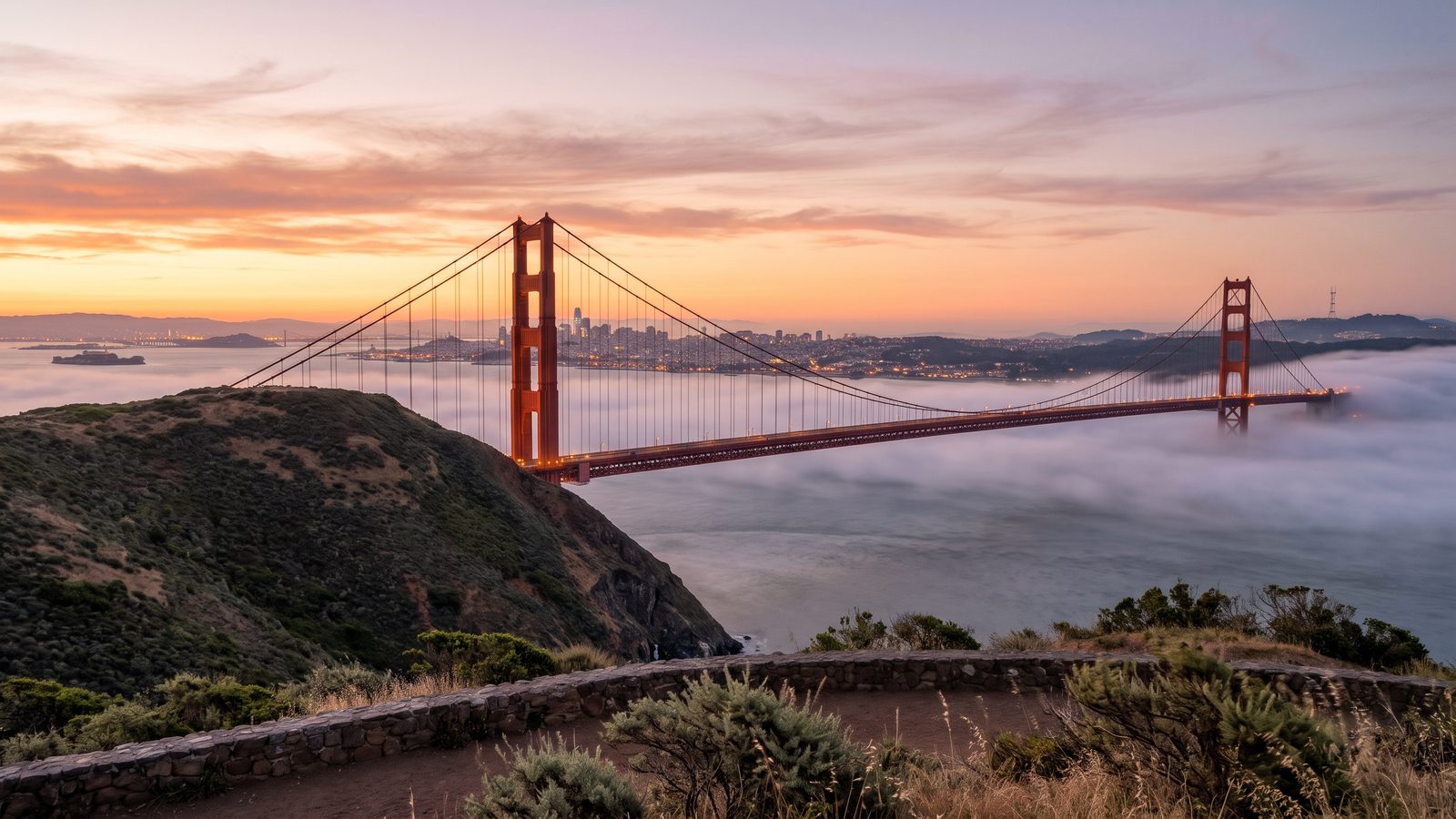
Welcome to the Golden Gate Bridge, a vibrant symbol of San Francisco and an iconic marvel of modern engineering. As you walk or cycle across its vast span, feel the invigorating Pacific breeze and take in panoramic vistas of the city skyline, Alcatraz Island, and the swirling waters below. Whether shrouded in mystical fog or glowing in California sunlight, this bridge promises an unforgettable journey through coastal scenery.
Uncover the daring feats of engineering that brought this legendary Art Deco structure to life during the Great Depression. From historic safety nets to the signature International Orange paint, your self-guided tour reveals the human ambition, resilience, and artistry behind one of the world's most recognizable landmarks.
Listen to a sample
The opening of this tour, exactly as AllTours narrates it on site.
What you'll hear on this tour
Stop 1. Masterpiece of Art Deco Engineering
Stand before two colossal towers soaring 746 feet above the turbulent straits. As you gaze along the 4,200-foot main span, appreciate the monumental challenge engineers faced battling relentless tides and fierce coastal winds. To anchor the bridge, workers spun nearly 80,000 miles of steel wire strand by strand over six months. Observe the elegant Art Deco detailing and striking International Orange coating, chosen specifically for visibility in dense fog and salt air. Beneath your feet, you can feel subtle vibrations—a designed flexibility allowing this magnificent suspension bridge to withstand powerful seismic forces in an earthquake-prone region.
Stop 2. A Feat Born from Ambition
Imagine 1917, when Chief Engineer Joseph Strauss proposed a bridge across these treacherous straits amidst widespread skepticism. Driven by a desire for economic expansion during the Great Depression, construction finally began in 1933. Against all odds, workers completed the ambitious project in just four years by 1937, coming in under budget at $35 million. As you walk the span, reflect on the human cost and courage involved in its creation. A safety net strung beneath the bridge saved nineteen workers during construction, giving rise to the famous 'Halfway to Hell Club' and adding a deeply poignant chapter to this iconic landmark's history.
Stop 3. Capturing the Perfect Light
Frame your shot as light transforms the bridge throughout the day. In the morning, soft mist wraps the steel frame in an ethereal shroud, diffusing sunlight into delicate glows. Midday sunlight brings out the brilliant International Orange hue, creating a striking contrast against cerulean skies. As evening arrives, capture dramatic silhouettes against fiery sunset skies. Zoom in on the riveted steel towers to highlight meticulous craftsmanship, or use the sweeping curves of the suspension cables to lead the eye. Whether shooting from Fort Point directly below or the Marin Headlands high above, you find endless creative angles where art and nature meet.
Stop 4. The Ancient Estuary Below
Look down at the expansive waters of San Francisco Bay, a dynamic geological marvel formed as an ancient river valley drowned under rising post-glacial sea levels. Long before ships arrived, the indigenous Ohlone people fished and harvested shellfish in these rich estuarine waters. Later, these very currents served as the vital gateway for the California Gold Rush, bringing dreamers from around the globe. Today, this body of water forms the largest estuary on the Americas' Pacific coast, supporting harbor seals, porpoises, and millions of migratory birds along the Pacific Flyway. Feel the powerful tidal currents shaping this living, resilient marine ecosystem.
Stop 5. Steel, Dreams, and Human Connections
Consider the vast journey each piece of steel undertook to form this colossal span. Manufactured in Pennsylvania and New Jersey, massive steel beams traveled thousands of miles across the continent by rail and sea before brave crews hoisted them high above the churning water. Today, the bridge remains a living conduit of human journeys. Every day, thousands of vehicles, cyclists, and pedestrians cross this passage, each carrying personal stories of exploration and hope. As you feel the subtle rhythmic vibrations beneath your feet, remember that this bridge connects far more than two shorelines—it links countless individual paths and enduring aspirations.
Stop 6. San Francisco’s Vibrant Skyline
Look out toward the iconic skyline of San Francisco, a city celebrated for its progressive spirit and rich cultural tapestry. From your viewpoint, you can appreciate the architectural harmony between historic Victorian homes and modern skyscrapers. Echoes of Gold Rush fortunes blend seamlessly with legacies of the 1960s counterculture movement and the modern tech boom that transformed the region into a global innovation hub. Beyond the downtown towers lie famous neighborhoods like Haight-Ashbury and the Mission District, each offering distinct artistic and culinary charm. Watch as soft fog rolls across the hills, casting a uniquely romantic blanket over this ever-evolving city.
Planning your visit
- Best time to go
- Mornings or late afternoons on weekdays to avoid heavy foot traffic and catch dramatic light or mist.
- Approximate duration
- About 1 to 2 hours
- Where to start
- Golden Gate Bridge Welcome Center on the San Francisco south plaza.
Access and conditions change seasonally — check the official site before you go.
Frequently asked questions
Is Golden Gate Bridge worth visiting?
Yes, visiting the Golden Gate Bridge is an unmissable San Francisco experience. Walking or cycling across offers stunning views of the Pacific Ocean, Alcatraz, and the city skyline alongside remarkable Art Deco engineering.
How long do you need at Golden Gate Bridge?
Most visitors spend 1 to 2 hours exploring the Golden Gate Bridge. This provides ample time to walk along a portion of the span, take photographs from various viewpoints, and browse the plaza area.
When was the Golden Gate Bridge built and who designed it?
Construction began in 1933 under Chief Engineer Joseph Strauss and was completed in 1937, taking four years and coming in under budget at $35 million.
Keep exploring
Header image is an AI-generated illustration of Golden Gate Bridge. AllTours.ai is an AI audio tour guide — point your camera at any landmark and hear its story.