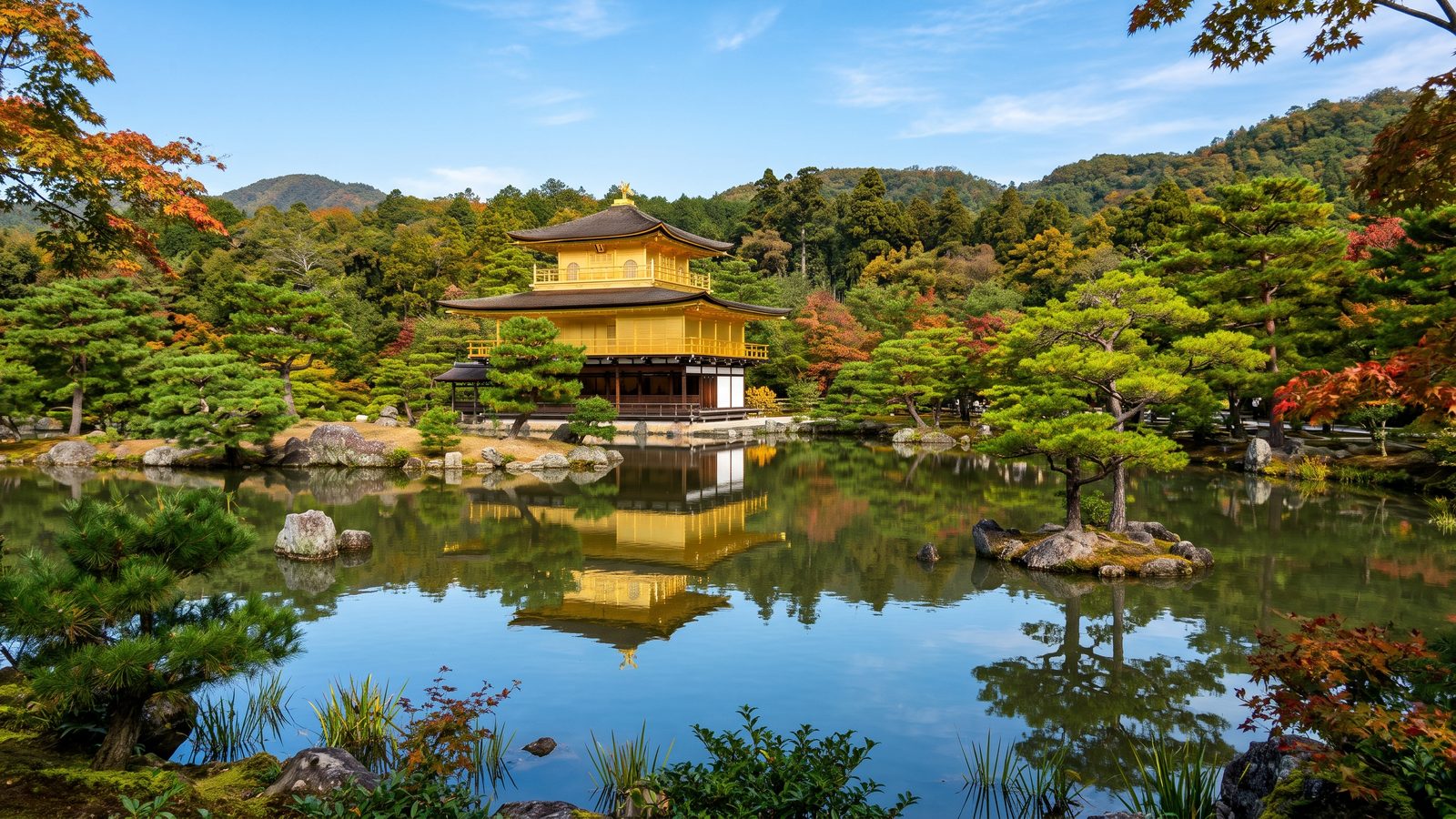
Welcome to Kinkaku-ji, Kyoto's famed Golden Pavilion, where pure Zen aesthetics meet samurai history. Originally built in 1397 as a lavish retirement villa for Shogun Ashikaga Yoshimitsu, this gilded masterpiece was transformed into a Rinzai Zen Buddhist temple following his death. Floating dramatically over the tranquil Mirror Pond, the pavilion's shimmering top floors capture the ultimate harmony between human craftsmanship and the beauty of nature.
On this audio tour, you will explore the rich architectural styles, turbulent history, and symbolic gardens of Rokuon-ji. As you walk the winding pathways around the pond, immerse yourself in the philosophical reflections, subtle Zen details, and centuries-old stories that make this world-famous landmark truly unforgettable.
Listen to a sample
The opening of this tour, exactly as AllTours narrates it on site.
What you'll hear on this tour
Stop 1. Kyoto's Gilded Sanctuary
You stand before Kinkaku-ji, the famous Golden Pavilion, gazing at its dazzling gold-leaf exterior shimmering across Kyōko-chi, the Mirror Pond. Originally constructed in the late fourteenth century as a luxurious retirement villa for Shogun Ashikaga Yoshimitsu, it transformed into a Zen Buddhist temple after his passing. Although a tragic arson destroyed the original temple in 1950, this faithful 1955 reconstruction preserves its timeless resilience and spiritual elegance. As you look up, notice the magnificent bronze phoenix perching atop the roof, guarding this paradise on Earth. You are watching a centuries-old vision of Zen beauty reflected in the water, inviting peaceful contemplation as you begin your walk.
Stop 2. Three Styles Stacked in Gold
As you examine the three-story structure, you notice how each floor represents a distinct architectural era. The ground floor, Hōssui-in, displays Heian aristocratic Shinden-zukuri style with open natural wood, white walls, and a veranda reaching over the pond. Moving your eyes upward to the second floor, Chōon-dō, you see the Buke-zukuri style of samurai residences, featuring enclosed wooden shutters and a refined balcony. Finally, the top floor, Kukkyō-chō, showcases pure Chinese Zen temple architecture, completely covered in shimmering gold leaf. Adorned with delicate bell-shaped windows and topped with the symbolic bronze phoenix, the pavilion seamlessly blends courtly, martial, and spiritual aesthetics into a single harmonized masterwork.
Stop 3. From Shogun's Villa to Resilient Temple
You are tracing the footsteps of Shogun Ashikaga Yoshimitsu, who created Kitayama-dai in 1397 as a grand villa to showcase Kitayama culture and entertain elite guests like Emperor Go-Komatsu. Following Yoshimitsu's death in 1408, it became Rokuon-ji, a Rinzai Zen temple. You learn that while it remarkably survived the devastating fifteenth-century Ōnin War that burned much of Kyoto, a tragic act of arson by a troubled monk destroyed the original structure in 1950. Today, you admire a meticulous 1955 reconstruction that faithfully reproduces the Muromachi-period design, standing as an enduring symbol of Kyoto's spiritual heritage and remarkable cultural resilience.
Stop 4. The Art of Borrowed Scenery
Step along the path and observe how the landscape framing the Golden Pavilion is meticulously designed to expand your vision. You see Kyōko-chi, the Mirror Pond, doubling the bright gold structure upon its calm surface while miniature islands like Ashihara-jima dot the water. Looking past the garden boundaries, you notice the technique of shakkei, or borrowed scenery, which incorporates the distant Kitayama mountains directly into the background composition. You also spot the ancient pine tree, Rikusho-no-Matsu, sculpted over centuries into a striking shape. Whether framed by spring blossoms, autumn maples, or winter snow, every vantage point creates a perfectly balanced visual painting.
Stop 5. Zen Aesthetics and Golden Purification
Here, you discover how Zen Buddhism shapes every aesthetic choice around you. Far from mere ostentation, the luminous gold leaf symbolizes purification from worldly defilements and represents a vision of Buddhist paradise. This harmony gave birth to Kitayama culture, blending courtly elegance with samurai vigor. As you pass near the humble Sekka-tei tea house on the grounds, imagine the quiet rituals of matcha tea preparation reflecting core Zen principles of harmony, respect, purity, and tranquility. You are witnessing a living canvas where art, nature, and spirituality unite, inspiring generations of poets, artists, and writers seeking quiet enlightenment in Kyoto.
Stop 6. Sailing Through a Paradise Garden
Walk slowly through this traditional Muromachi-period stroll garden, designed to guide your senses through symbolic landscapes. In the calm waters of the Mirror Pond, you observe carefully arranged islands like Hōrai-jima, representing the island of immortals, and Kame-jima, shaped like a turtle to symbolize longevity. Along the pathway, you encounter the remarkable Rikushu-no-Matsu, an ancient pine tree expertly pruned over six hundred years to resemble a sailing boat heading into the pond. Every stone, mossy path, and tucked-away tea house encourages quiet reflection, inviting you to discover new artistic vistas and deep tranquility with every step you take.
Planning your visit
- Best time to go
- Early morning right at opening or late afternoon when sunlight highlights the top floors and casts rich reflections on the pond.
- Approximate duration
- About 45 minutes to 1 hour
- Where to start
- In front of Kyōko-chi (Mirror Pond) with a direct view of the Golden Pavilion.
Access and conditions change seasonally — check the official site before you go.
Frequently asked questions
Is Golden Pavilion worth visiting?
Yes, Golden Pavilion (Kinkaku-ji) is one of Kyoto's most iconic UNESCO World Heritage sites, world-renowned for its top two floors covered in real gold leaf and its serene garden surroundings.
How long do you need at Golden Pavilion?
Most visitors spend around 45 to 60 minutes walking the scenic stroll garden loop, admiring the pavilion from across the pond, and exploring the temple grounds.
Why was Golden Pavilion rebuilt in 1955?
The original pavilion was tragically destroyed by arson in 1950 when set fire by a novice monk. The structure seen today was meticulously reconstructed in 1955 to replicate its original Muromachi-period design.
Keep exploring
Header image is an AI-generated illustration of Golden Pavilion. AllTours.ai is an AI audio tour guide — point your camera at any landmark and hear its story.