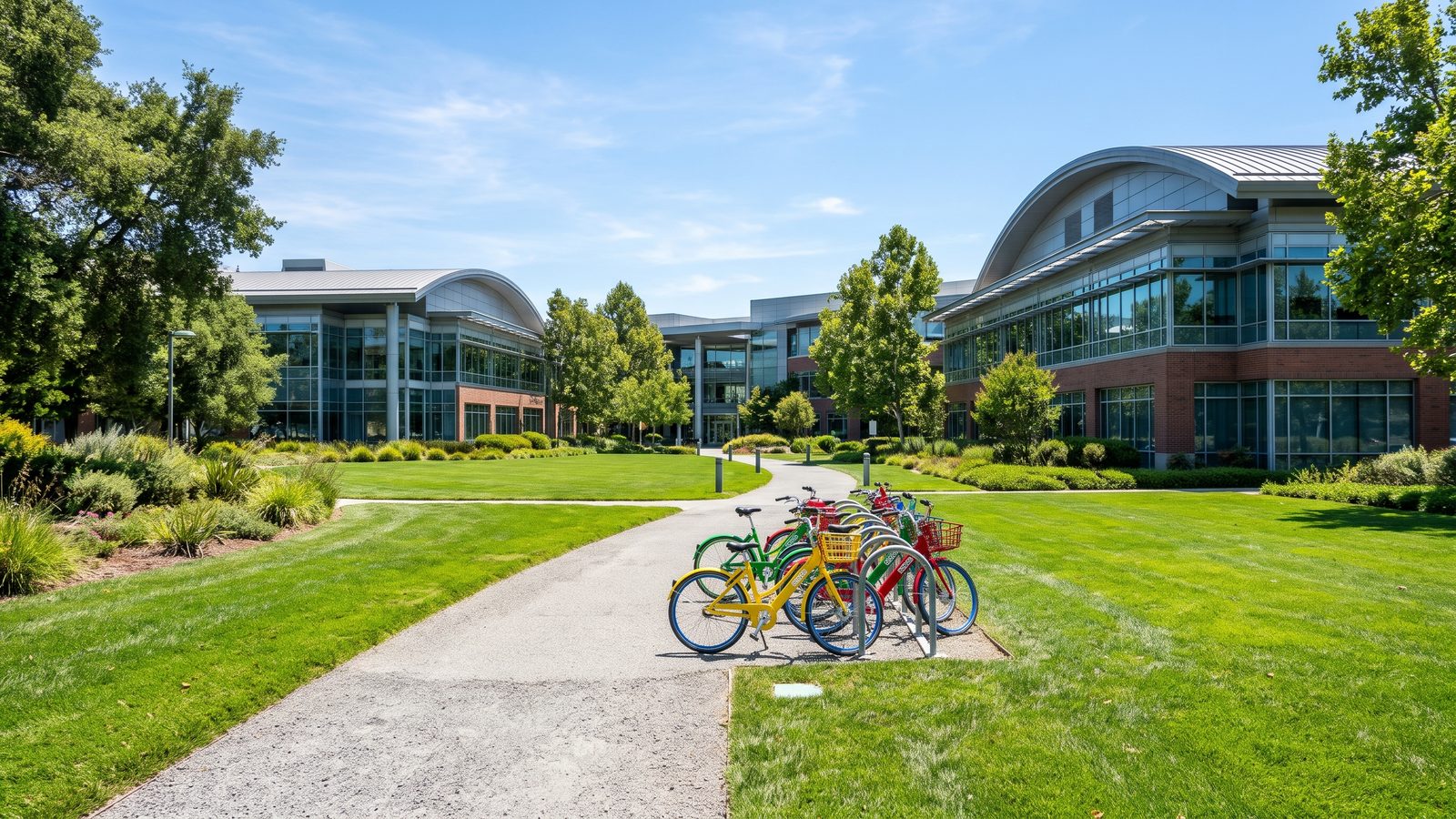
You step onto 1600 Amphitheatre Parkway in Mountain View, California, entering the beating heart of modern digital innovation. Built on the former Silicon Graphics campus and acquired by Google in 2004, the Googleplex reflects the ambitious architectural vision of founders Larry Page and Sergey Brin. As you explore this sprawling corporate headquarters, you encounter colorful primary-hued bicycles, playful lawn art installations, and inviting green spaces designed to spark world-changing ideas.
This self-guided audio tour reveals the unique culture, engineering prowess, and history behind the tech giant. From the legendary 20% time policy to moonshot innovations and microscopic silicon circuits, you experience a self-contained village where work meets play and groundbreaking ideas continuously redefine global connectivity.
Listen to a sample
The opening of this tour, exactly as AllTours narrates it on site.
What you'll hear on this tour
Stop 1. The Epicenter of Modern Tech
You stand at the heart of the iconic Googleplex headquarters, a living ecosystem where innovation thrives. Originally home to Silicon Graphics before Google acquired and transformed the property in 2004, this campus reflects founders Larry Page and Sergey Brin's vision for serendipitous collaboration. As you walk past traditional office designs, you notice vibrant Google-colored bikes scattered across the pathways, encouraging flexible exploration. Look out for unexpected art installations, including the famous T-Rex skeleton named Stan, which serves as a playful reminder to never let technology become extinct. Every green courtyard and outdoor dining space here works together to keep world-class minds inspired and engaged.
Stop 2. Moonshots and Radical Ideas
You immerse yourself in the culture of radical thinking that defines Google's approach to progress. Here, legendary policies like "20% time" allow engineers to spend one-fifth of their work week pursuing personal passion projects—an idea that directly birthed transformative tools like Gmail and AdSense. As you walk through these open spaces, you appreciate the audacious "moonshot" mentality championed by Google X, where teams tackle seemingly impossible challenges like self-driving cars and stratospheric internet balloons. The architecture purposefully triggers chance encounters, reminding you that iteration, rapid prototyping, and embracing failure are essential stepping stones toward building the technological future.
Stop 3. A Village Built for Creativity
You explore a sprawling self-contained village designed specifically to blend work, rest, and creative play. Primary-colored bikes offer free-flowing transportation between buildings, while expansive green lawns host outdoor meetings and impromptu recreational sports. As you observe newer campus additions like Bay View, you notice biophilic architecture that connects indoor workspaces with natural light and surrounding outdoor environments. Micro-kitchens, themed courtyards, and interactive art installations line your route, creating a distinct anti-corporate environment. Every amenity, from gourmet dining to quiet relaxation areas, aims to minimize external distractions so teams can focus entirely on solving complex global problems together.
Stop 4. Architecting Solutions for Billions
You walk through the engineering core where teams tackle computational challenges on an unprecedented global scale. Around every corner, whiteboards and quick huddles reveal a culture powered by rapid prototyping, custom hardware development, and data-driven decisions. Engineers here do not merely write code; they design proprietary networking protocols and invent new programming languages like Go to support billions of daily users. You observe an environment balancing individual autonomy with intense collaboration, where algorithms powering search rankings, artificial intelligence, and autonomous driving undergo constant refinement. This relentless pursuit of computational efficiency forms the digital infrastructure that drives modern connectivity across the planet.
Stop 5. Inside the Engine of Tomorrow
You step into a living laboratory where cutting-edge software and hardware take shape side by side. Machine learning algorithms actively evolve here, refining everything from predictive Google Search tools to natural language comprehension in personal assistants. As you navigate the campus grounds, you sense the intense focus required to develop neural networks for autonomous vehicles, medical diagnostic tools, and quantum computing breakthroughs. Teams collaborate on global data center architectures, energy-efficient infrastructure, and new hardware prototypes like Pixel devices. Every innovation emerging from these buildings pushes computational boundaries, transforming complex lines of code into seamless daily experiences for billions worldwide.
Stop 6. From Earthly Sand to Microchips
You reflect on the microscopic material foundation powering this entire technological realm: pure silicon. Transformed from ordinary sand into flawless, highly purified wafers, this earth element becomes the physical medium for billions of microscopic transistors. As you contemplate the invisible logic gates beneath every digital search query, you appreciate silicon's unique semiconducting properties that control microscopic electrical currents with nanometer precision. Engineered into intricate microchips, these silent engines drive advanced AI models, global server networks, and complex software systems across Google's massive infrastructure, proving how human ingenuity can turn abundant physical elements into the fundamental brains of the digital age.
Planning your visit
- Best time to go
- Weekday mornings or early afternoons offer the liveliest atmosphere on campus paths, though weekends provide quieter walking conditions.
- Approximate duration
- about 1 to 1.5 hours
- Where to start
- 1600 Amphitheatre Parkway, Mountain View, California
Access and conditions change seasonally — check the official site before you go.
Frequently asked questions
Is Googleplex worth visiting?
Yes, visiting the Googleplex offers tech enthusiasts and curious travelers a fascinating look at Silicon Valley culture, iconic Android lawn statues, primary-colored Google bikes, and modern biophilic architecture.
How long do you need at Googleplex?
Most visitors spend around 1 to 2 hours strolling the outdoor campus grounds, viewing the artwork and outdoor plazas, and exploring the self-guided walking routes.
What is the history of the Googleplex campus?
Originally built as the headquarters for Silicon Graphics, the property at 1600 Amphitheatre Parkway was acquired and transformed by Google in 2004 under founders Larry Page and Sergey Brin.
Keep exploring
Header image is an AI-generated illustration of Googleplex. AllTours.ai is an AI audio tour guide — point your camera at any landmark and hear its story.