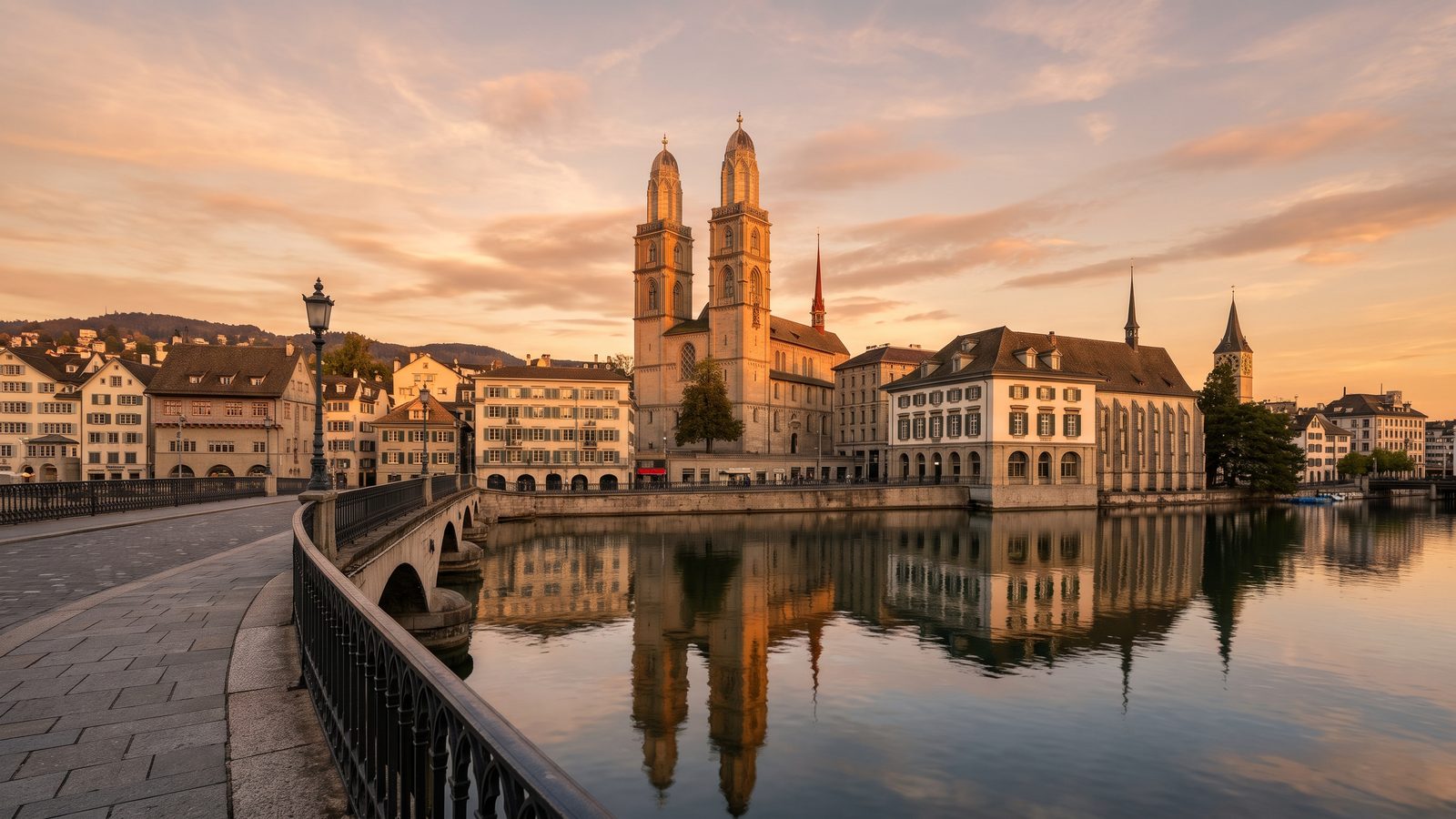
Stand on the Münsterbrücke and look up at the Grossmünster, the twin-towered Romanesque cathedral that defines Zurich's skyline. Built over the burial site of Zurich's patron saints, Felix and Regula, this sacred site carries centuries of history. From legends of Charlemagne to the fierce religious debates of the Swiss Reformation, the cathedral remains the powerful spiritual heart of the city.
On this self-guided audio tour, you will trace the church's evolution through Romanesque stonework, modern stained glass, and historic bridges. Explore how Huldrych Zwingli transformed Zurich and see how centuries of architecture, faith, and culture intertw along the banks of the Limmat River.
Listen to a sample
The opening of this tour, exactly as AllTours narrates it on site.
What you'll hear on this tour
Stop 1. Crucible of the Swiss Reformation
You stand before an edifice rooted in legend and revolution. Tradition holds that Charlemagne himself founded the church, with formal construction beginning around 1100 over the graves of Zurich's patron saints, Felix and Regula. As you trace its sandstone facade, imagine the dramatic turmoil of the 16th century. Here, reformer Huldrych Zwingli preached his revolutionary 67 Articles starting in 1520, igniting the Swiss Reformation. His fiery sermons transformed not only Zurich's spiritual landscape, but also reshaped the religious and political destiny of Switzerland forever.
Stop 2. Romanesque Roots and Baroque Crown
Look up at the Grossmünster's signature twin towers, where centuries of architectural styles meet. You notice the sturdy 12th-century Romanesque base, built from massive sandstone blocks that reflect enduring medieval craftsmanship. As your gaze climbs higher, subtle Gothic details appear within the window tracery. Look at the very top to see the distinctive 18th-century Baroque caps, added after a devastating fire destroyed the original spires. This harmonious blend of Romanesque strength, Gothic elegance, and Baroque flair creates one of the most recognizable horizons in all of Switzerland.
Stop 3. Stained Glass and Spiritual Legacy
You enter a cultural space shaped by deep religious reform and modern artistic vision. Zwingli's preaching forged a Protestant culture defined by austerity and intellectual rigor, altering Zurich's civic identity. Yet, as you look around today, you witness how modern art gracefully integrates into this sacred space. Marvel at the vibrant chancel windows created by Augusto Giacometti, alongside the striking contemporary glass narratives designed by Sigmar Polke. These modern additions bring rich color and light into the historic interior, proving that Grossmünster continues to be a living, evolving cultural canvas.
Stop 4. Crossing the Historic Münsterbrücke
Step onto the Münsterbrücke, the elegant stone bridge spanning the river. Completed in 1838, this historic crossing replaced earlier wooden structures, permanently joining Zurich's historic halves into a unified city. As you walk across its sturdy granite arches, a masterpiece of 19th-century engineering, think of the endless generations who have crossed before you. From bustling medieval market vendors to solemn civic processions, this vital artery offers you the absolute best viewpoint to take in both the Grossmünster and the bustling life along the riverbanks.
Stop 5. The Crystal Waters of the Limmat
Look down at the clear, shimmering waters of the Limmat River flowing beneath you. Feeding directly from Lake Zurich, this pristine glacial meltwater served as Zurich's original highway, powering early trade and local industries. As you watch the current move gently past ancient stone walls, you can appreciate the remarkable clarity of the water, reflecting Switzerland's dedicated environmental care. The river has nurtured the city since its founding, providing a cool, soothing backdrop to centuries of urban growth while seamlessly framing the great Romanesque cathedral towering above.
Stop 6. Zurich's Layered Old Town Skyline
Take a moment to absorb the panoramic view surrounding you. From this vantage point, Zurich reveals its multi-layered history etched directly into the skyline. The Limmat River acts as a sparkling frame for the Grossmünster's twin towers, which punctuate the sky with timeless dignity. You observe a harmonious blend of medieval stone, historic guild houses, and refined architecture lining the Old Town streets. As sunlight reflects off the water, this stunning cityscape presents a visual narrative of Zurich's steady evolution from a river settlement into a world-class city.
Planning your visit
- Best time to go
- Morning or late afternoon for gentle sunlight on the sandstone facade and lighter foot traffic on Münsterbrücke.
- Approximate duration
- about 45 minutes
- Where to start
- Münsterbrücke, facing the Grossmünster twin towers.
Access and conditions change seasonally — check the official site before you go.
Frequently asked questions
Is Grossmünster worth visiting?
Yes, Grossmünster is one of Zurich's most recognizable landmarks. It offers profound historical significance as the birthplace of the Swiss Reformation under Huldrych Zwingli, alongside striking Romanesque architecture and modern stained glass artwork.
How long do you need at Grossmünster?
A typical visit takes around 30 to 45 minutes to explore the exterior, cross Münsterbrücke for photos, and admire the interior architecture and stained glass windows.
What is the history of Grossmünster?
According to legend, Charlemagne founded the church after his horse knelt at the graves of Zurich's patron saints, Felix and Regula. Construction of the present Romanesque building began around 1100, and in the 1520s, Huldrych Zwingli launched the Swiss Reformation from its pulpit.
Keep exploring
Header image is an AI-generated illustration of Grossmünster. AllTours.ai is an AI audio tour guide — point your camera at any landmark and hear its story.