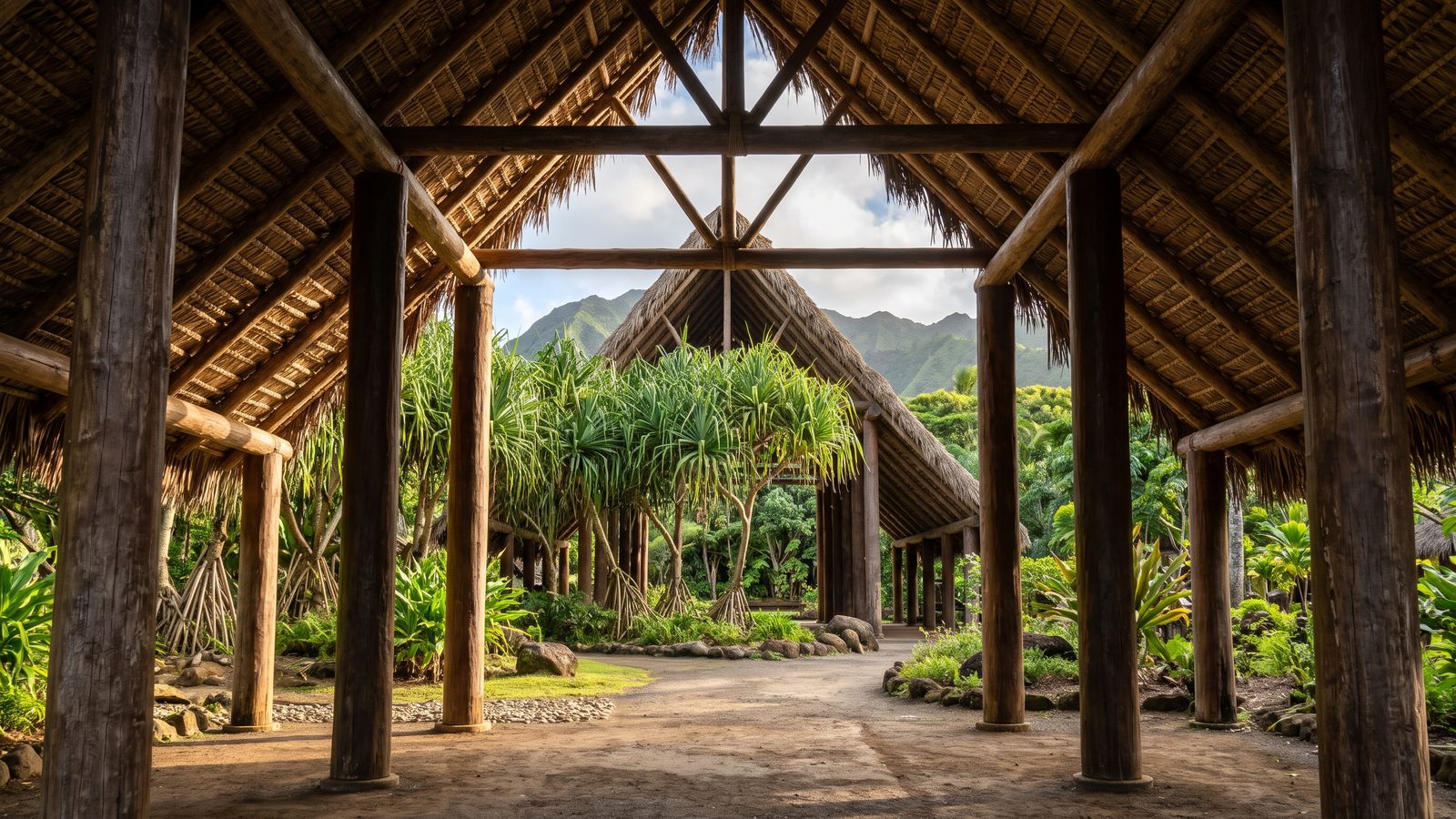
Welcome to Hale Halawai, the traditional House of the Chief situated within the Polynesian Cultural Center in Laie, Hawaii. As a central gathering space, this open-air structure reflects centuries of island governance, community unity, and artistic craftsmanship. Through this self-guided audio tour, you will discover how Polynesian voyagers, master builders, and chief leaders created a vibrant social culture that endures on these coastal grounds today.
Step beneath the high thatched roof and take in the natural scents, handcrafted woodwork, and woven fiber lashings. As you explore each feature, you will gain a deeper understanding of the traditions, natural materials, and ancestral stories that shape daily life across the Pacific islands.
What you'll hear on this tour
Stop 1. The Chief's Gathering Space
As you stand inside Hale Halawai, you step into the traditional House of the Chief, the vibrant heart of Polynesian social life. You notice how the open structure invites community and kinship, serving as a sanctuary where elders pass down sacred chants and ancestral genealogies. Here, chiefs preside not as absolute rulers, but as guardians of tradition and facilitators of communal harmony. As you look at the intricately woven walls, each strand symbolizes a family lineage binding the society together. You can feel the weight of generations who gathered in places like this to resolve disputes, share knowledge, and nurture the collective spirit of their people.
Stop 2. Mastery of Native Lashings and Thatch
Look up at the soaring timbers above you and notice a remarkable detail: there are no metal nails holding this building together. Instead, master builders bound the structural beams using sennit cord, a durable rope meticulously woven from dried coconut fibers. You observe the steep pitch of the thatched roof, engineered specifically to shed heavy tropical rainstorms while keeping the interior dry. The thatch layer, crafted from dried pandanus leaves, provides natural insulation against the sun. As warm ocean winds pass through the open walls, you feel the natural ventilation created by the wide eaves, showcasing an intimate understanding of island materials and architecture.
Stop 3. Sacred Carvings and Decorative Tapa
Turn your gaze to the walls and structural posts to witness the visual language of Polynesian artistry. You see intricate geometric patterns woven into traditional tapa cloth, where every motif tells a story of ancestral spirits or land abundance. Carved wooden figures stand as powerful embodiments of revered ancestors and deities rather than simple decorations. As you admire the smooth, polished finish of the heavy beams, remember that craftsmen shaped this wood using hand-forged tools like adzes and awls, which were prized works of art themselves. Every surface reflects a seamless blend of functional engineering and spiritual expression passed down through generations.
Stop 4. Immersed in Island Traditions
Reach out and feel the cool, smooth surface of the central wooden post beneath your fingers. You trace the hand-carved symbols detailing a chief's ancestral lineage and deep connection to the land. As you imagine sitting on woven floor mats, you can almost hear the rhythmic chanting of ancient legends echoing through the hall. Imagine distinguished guests arriving, welcomed by the rustle of ceremonial tapa garments, traditional greetings, and shell ornaments. This sacred hall served as the stage for island life's most significant moments, filling the air with the aroma of tropical blossoms and the shared joy of communal celebration.
Stop 5. Flora, Water, and Coastal Bounty
Step toward the perimeter and pause to take in the natural surroundings. You feel a gentle breeze moving through nearby hala trees, recognizable by their distinctive forked trunks adapted for coastal survival. Nearby, you see vibrant green taro patches nourished by freshwater channels designed to sustain tropical plant life. The sweet perfume of plumeria and blooming hibiscus fills the air, blossoms utilized in traditional lei making and herbal medicine. Underfoot and around the hall, pandanus leaves supply both resilient weaving mats and essential nourishment. Every natural element around Hale Halawai highlights the deep harmony between island inhabitants and their environment.
Stop 6. Centuries of Voyaging and Governance
Stand quietly and reflect on the deep historical roots of this ground. Long before modern visitors arrived, ancient voyagers navigated thousands of miles across vast ocean currents using only the stars to discover these islands. You are standing on ground where chiefs and community elders historically met to establish complex systems of resource management and social order. When 19th-century missionaries arrived, they encountered a sophisticated society steeped in oral histories and sacred ceremonies. Though constructed in modern times, Hale Halawai stands firmly on that ancient cultural foundation, serving as a lasting testament to the enduring resilience and heritage of Polynesian communities.
Planning your visit
- Best time to go
- Afternoon during operating hours, when sunlight illuminates the thatched interior and open-air breezes keep the hall comfortable.
- Approximate duration
- About 30 to 45 minutes
- Where to start
- Begin at the front entrance of Hale Halawai within the Polynesian Cultural Center grounds in Laie.
Access and conditions change seasonally — check the official site before you go.
Frequently asked questions
Is Hale Halawai at Polynesian Cultural Center worth visiting?
Yes, Hale Halawai is worth visiting for anyone interested in authentic Polynesian architecture, traditional chief gathering customs, and hand-carved artwork set within the Polynesian Cultural Center.
How long do you need at Hale Halawai at Polynesian Cultural Center?
You need about 30 to 45 minutes to explore the architectural details, admire the tapa art and wood carvings, and listen to the audio narration.
What is the historical significance of Hale Halawai?
Hale Halawai represents the traditional House of the Chief, a historical gathering place where Polynesian leaders held council, resolved disputes, passed down oral histories, and maintained social harmony.
Keep exploring
Header image is an AI-generated illustration of Hale Halawai at Polynesian Cultural Center. AllTours.ai is an AI audio tour guide — point your camera at any landmark and hear its story.