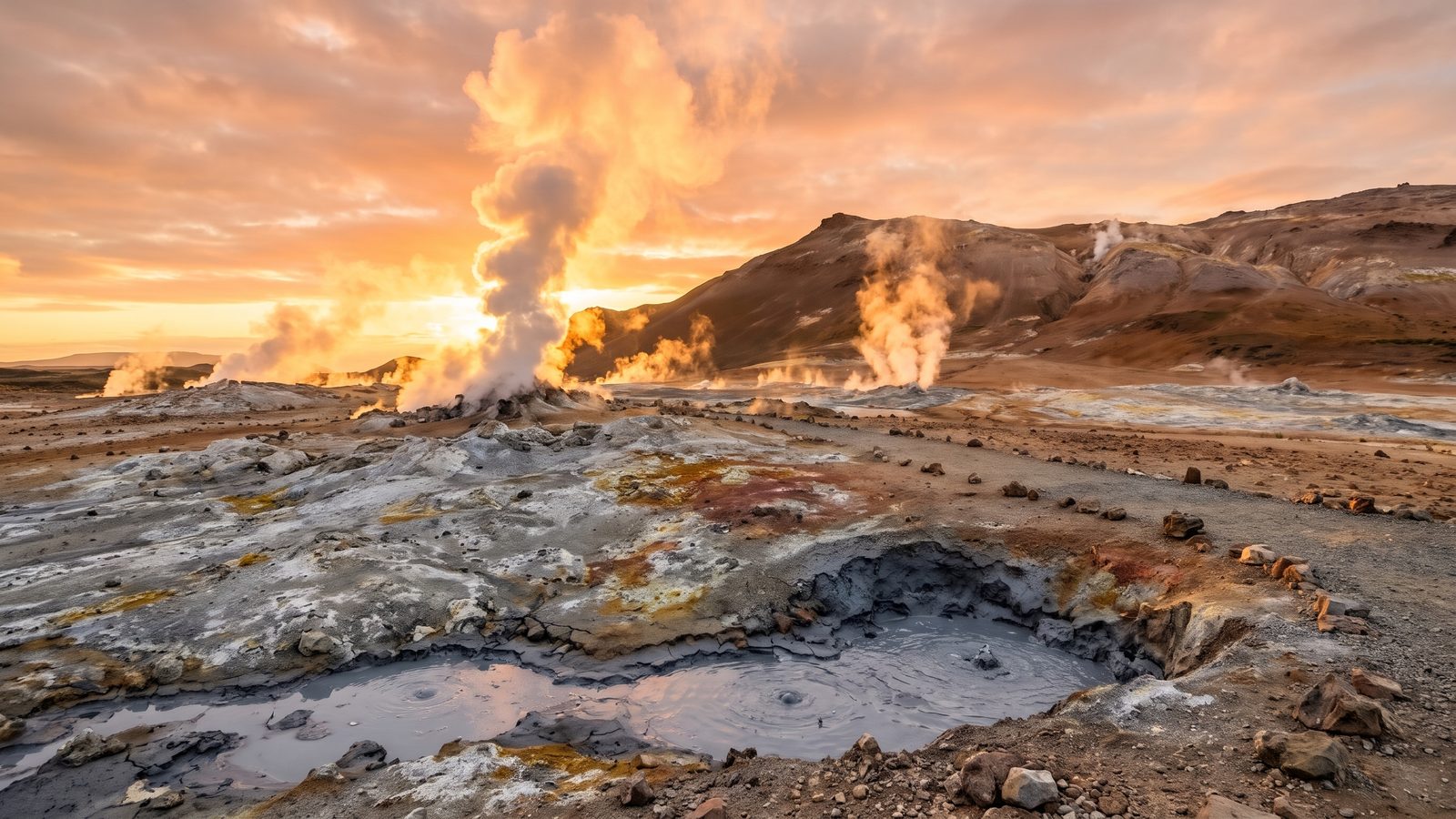
Step onto the otherworldly terrain of Hverir, a dynamic geothermal wonderland nestled in Northeastern Iceland near Reykjahlíð. Here, the raw power of the Earth vents through roaring fumaroles, colorful mineral deposits, and violent mud pots reaching temperatures over 100 degrees Celsius. As you walk along marked safety paths, your audio guide reveals the subterranean forces shaping this vibrant, sulfur-scented landscape situated directly on the Mid-Atlantic Ridge.
Experience a landscape where geology and biology collide. From extreme thermophilic life painting the ground yellow to early pioneering scientific expeditions mapping volcanic vents, this self-guided tour brings every hiss, bubble, and mineral streak into sharp focus as you explore Iceland's fiery subterranean heart.
Listen to a sample
The opening of this tour, exactly as AllTours narrates it on site.
What you'll hear on this tour
Stop 1. The Earth's Underground Plumbing System
Feel the Earth breathe beneath your feet as you stand above a shallow magma chamber. The intense subterranean heat superheats groundwater, which reacts with volcanic rock to produce powerful sulfuric acid. This acid actively dissolves the hard rock, breaking it down into the thick gray clay churning in the mud pots before you. As superheated steam and volcanic gases escape into the open air, vibrant yellow and orange sulfur minerals precipitate onto the surface. You are standing in the middle of active hydrothermal alteration, watching raw planetary forces strip away ancient rock and continually reshape this desolate, otherworldly landscape.
Stop 2. Roaring Vents and Gurgling Cauldrons
Listen to the constant hiss of steam escaping through high-pressure fumaroles, exhalation from the planet's fiery core. Right beside you, mud pots boil and gurgle like ancient cauldrons, continuously releasing subterranean pressure in thick, sulfuric bursts. The dramatic plumes of vapor drifting across the ground carry mineral-rich gases that stain the surrounding hillsides in vivid shades of white, red, and yellow. These striking visual elements are living manifestations of volcanic activity. As superheated water and steam transform the Earth's crust in real time, you witness the raw energy of Iceland's restless subterranean systems operating just below the surface.
Stop 3. Extreme Microbes and Hydrothermal Eruptions
Notice the pungent, egg-like odor of hydrogen sulfide gas in the air around you. Specialized anaerobic microorganisms thrive in these harsh, oxygen-starved conditions, using chemical energy from volcanic gases to survive and create these vibrant ochre sulfur fields. The gray mud pots, reaching temperatures near 100 degrees Celsius, demonstrate hydrothermal eruptions on a micro-scale. Trapped steam and gases build immense underground pressure until they explosively breach the surface, violently churning the silica-rich mud into gloopy masses. You are observing a specialized living ecosystem paired with continuous geological reactions, revealing how life adapts to extreme volcanic environments.
Stop 4. Life Thriving in Extreme Heat
Look closely at the ground beneath your boots, an incredibly young geological landscape undergoing constant reformation by subterranean energy. What appears to be barren, inhospitable rock is actually a dynamic biological laboratory. The vibrant yellow streaks painted across the earth are created by thermophiles—specialized heat-loving bacteria that flourish in hot, mineral-rich conditions. Their metabolic processes directly convert sulfur and other minerals into these brilliant colors. Rather than an empty wasteland, you are witnessing life’s extraordinary ability to find a foothold and thrive amid intense volcanic heat, adapting perfectly to one of the planet's most extreme environments.
Stop 5. A Canvas Carved by Volcanic Energy
Scan the horizon of this vast, untamed terrain sculpted by Iceland's location atop the Mid-Atlantic Ridge. Feel the warmth radiating directly from the earth, driven by millennia of subterranean activity. Superheated water leaches minerals from deep volcanic rock, painting the ground in striking hues of bright yellow, earthy ochre, and deep red. Every color represents a specific chemical reaction occurring right beneath the surface. Rising steam plumes constantly carve new formations into the landscape as subterranean pressure releases into the atmosphere. You are looking at a living canvas, a stark portal into the powerful processes actively creating our planet.
Stop 6. Pioneering the Frontiers of Volcanology
Imagine standing on this volatile ground centuries ago, alongside the early geologists who first ventured here to unlock the Earth's secrets. Armed with only rudimentary tools, these brave explorers meticulously mapped steaming fumaroles, collected hazardous sulfur samples from active vents, and deployed primitive seismic instruments to monitor deep magma movements. Their pioneering work transformed wild curiosity into scientific understanding, laying the foundation for modern volcanology. As you walk these marked paths today, you follow in the footsteps of researchers whose arduous observations helped decipher the complex language of volcanic activity and changed how we comprehend our planet's restless interior.
Planning your visit
- Best time to go
- Early morning or late afternoon during summer for fewer crowds and softer light across the steam clouds.
- Approximate duration
- About 45 minutes to 1 hour
- Where to start
- The main parking area at the Hverir geothermal site, just off Route 1 near Reykjahlíð.
Access and conditions change seasonally — check the official site before you go.
Frequently asked questions
Is Hverir worth visiting?
Yes, Hverir is one of Iceland's most accessible and dramatic geothermal areas, featuring boiling mud pots, steaming fumaroles, and brightly colored mineral fields right near Route 1.
How long do you need at Hverir?
Most visitors spend between 30 and 60 minutes exploring the marked pathways and viewing the geothermal phenomena.
How was the Hverir geothermal area formed?
Hverir was formed by intense volcanic activity linked to shallow magma chambers near the Krafla volcanic system along the Mid-Atlantic Ridge, superheating groundwater and driving chemical mineral deposits to the surface.
Keep exploring
Header image is an AI-generated illustration of Hverir. AllTours.ai is an AI audio tour guide — point your camera at any landmark and hear its story.