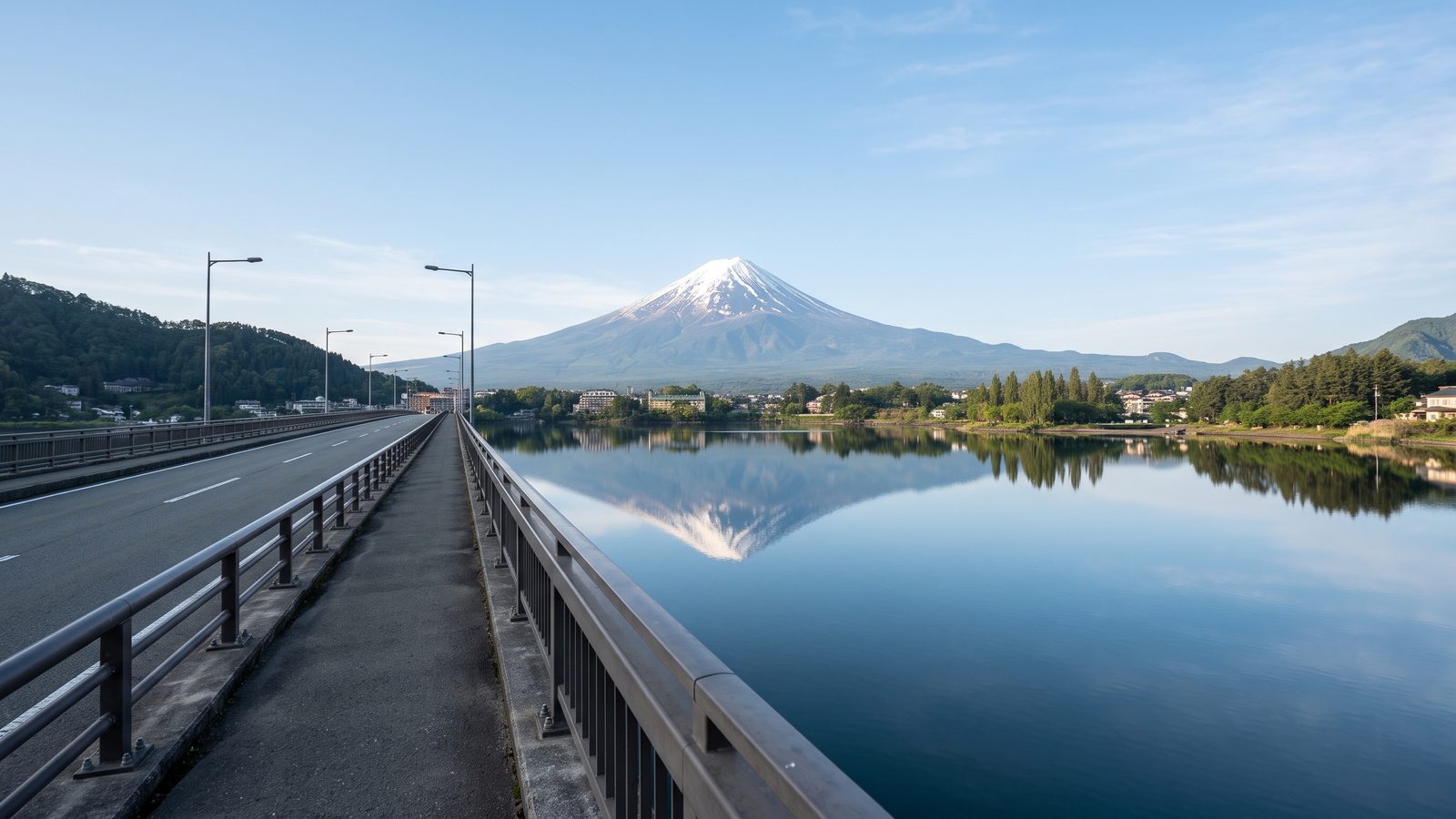
Welcome to Kawaguchiko Ohashi Bridge, an elegant crossing spanning the sparkling waters of Lake Kawaguchiko in Fujikawaguchiko. Completed in 1959, this bridge transformed local travel and opened up the scenic northern shore. As you walk along its pedestrian path, you take in panoramic views of sacred Mount Fuji, dramatic mountain ranges, and vibrant seasonal landscapes ranging from spring cherry blossoms to rich autumn maples.
This self-guided audio tour reveals the deep volcanic history of the basin, local fishing traditions, and natural highlights surrounding Fuji-san. Put on your headphones and step onto the bridge for an unforgettable walk across Yamanashi's iconic lake.
What you'll hear on this tour
Stop 1. The Lifeline Across the Water
As you step onto Kawaguchiko Ohashi Bridge, you feel its pivotal role as a vital artery connecting the region. Completed in 1959, this elegant structure replaced tedious boat crossings and long detours around Lake Kawaguchiko, transforming the northern shore into a lively hub of tourism and culture. Notice the graceful curve of its steel girders, engineered to withstand regional seismic activity while harmonizing with the landscape. Locals recall how the bridge modernized daily life, easing school commutes and produce transport. Today, as you walk across, the elevated vantage point provides sweeping panoramas of the lake that you simply cannot capture from the shoreline.
Stop 2. The Reflection of Sacred Fuji
Look out across Lake Kawaguchiko to see Mount Fuji standing majestic against the sky. On calm days, you witness Sakasa Fuji, the famous inverted reflection of the snow-capped peak mirrored on the water's surface, a sight revered by artists for centuries. Light shifts throughout the day, from soft morning mists to fiery sunset oranges across the slopes. Along the northern bank near Oishi Park, seasonal beauty unfolds in full color—cherry blossoms frame Fuji in spring, purple lavender blooms in summer, and fiery maples blaze in autumn. Even in winter, crisp air reveals every ridge of the iconic mountain.
Stop 3. Volcanic Origins and Sacred Peaks
Gaze up at Mount Fuji's symmetrical stratovolcano cone, shaped by ancient eruptions including its last major blast in 1707. For centuries, pilgrims and yamabushi mountain ascetics trekked these rugged slopes on spiritual journeys. From your view on the bridge, you see Fuji's snow-capped northern face contrasted against green lower forests. Surrounding the basin, the ancient Misaka Mountains form a protective crescent, framing Fuji to create Japan's most celebrated vista. As you feel the crisp air, you connect with the ancient volcanic energy that continues to define this sacred landscape.
Stop 4. Depths Born of Fire and Snow
Pause and look down into Lake Kawaguchiko, born when ancient lava flows dammed local rivers to create this vast basin. Reaching depths of 14.6 meters, it is the second largest of the Fuji Five Lakes. Pure subterranean springs and snowmelt feed its crystal-clear waters, supporting rich populations of wakasagi smelt and carp that have sustained local fishing for generations. Legends tell of a benevolent dragon spirit watching over the deep waters. Beneath the surface, geothermal activity warms nearby hot springs, reminding you of the profound volcanic forces still at work beneath this quiet landscape.
Stop 5. A Tapestry of Seasonal Blossoms
As you admire the lake edge, notice how vibrant flora changes with each passing season. In spring, delicate cherry blossoms line the shore while bright pink shibazakura moss phlox covers fields near Fuji. Summer brings sweet-smelling purple lavender to Oishi and Yagizaki Parks during the local herb festival, where artisans craft floral treats. By autumn, bright cosmos flowers bloom against the falling leaves. No matter what time of year you visit, this ever-changing floral landscape creates a vivid frame around the sacred silhouette of Mount Fuji.
Stop 6. Forest Trails and Subterranean Ice
Look beyond the shoreline to the vast outdoor adventures surrounding the lake. Nearby lies Aokigahara Jukai, the Sea of Trees, a primeval forest grown over ancient lava beds where dense canopies create silence. Beneath the forest floor, natural wonders like the Fugaku Wind Cave and Narusawa Ice Cave house year-round ice pillars and unique volcanic rock formations. Out on the water, rowboats and paddleboards glide across quiet bays, while cycling paths circle the lake past hidden shrines, inviting you to explore Yamanashi's rich natural environment at your own pace.
Planning your visit
- Best time to go
- Early morning for still waters and clear Mount Fuji reflections, or late afternoon for golden hour views.
- Approximate duration
- About 45 minutes
- Where to start
- South pedestrian entrance of Kawaguchiko Ohashi Bridge along the lake shore.
Access and conditions change seasonally — check the official site before you go.
Frequently asked questions
Is Kawaguchiko Ohashi Bridge worth visiting?
Yes. Walking across the bridge gives you elevated, unobstructed views of Lake Kawaguchiko and Mount Fuji that you cannot get from the shoreline.
How long do you need at Kawaguchiko Ohashi Bridge?
Plan for 30 to 45 minutes to walk across the bridge, listen to the audio stories, and take photos.
When was Kawaguchiko Ohashi Bridge built?
The bridge was completed in 1959 to connect the southern and northern shores of Lake Kawaguchiko, dramatically improving regional transportation and tourism.
Keep exploring
Header image is an AI-generated illustration of Kawaguchiko Ohashi Bridge. AllTours.ai is an AI audio tour guide — point your camera at any landmark and hear its story.