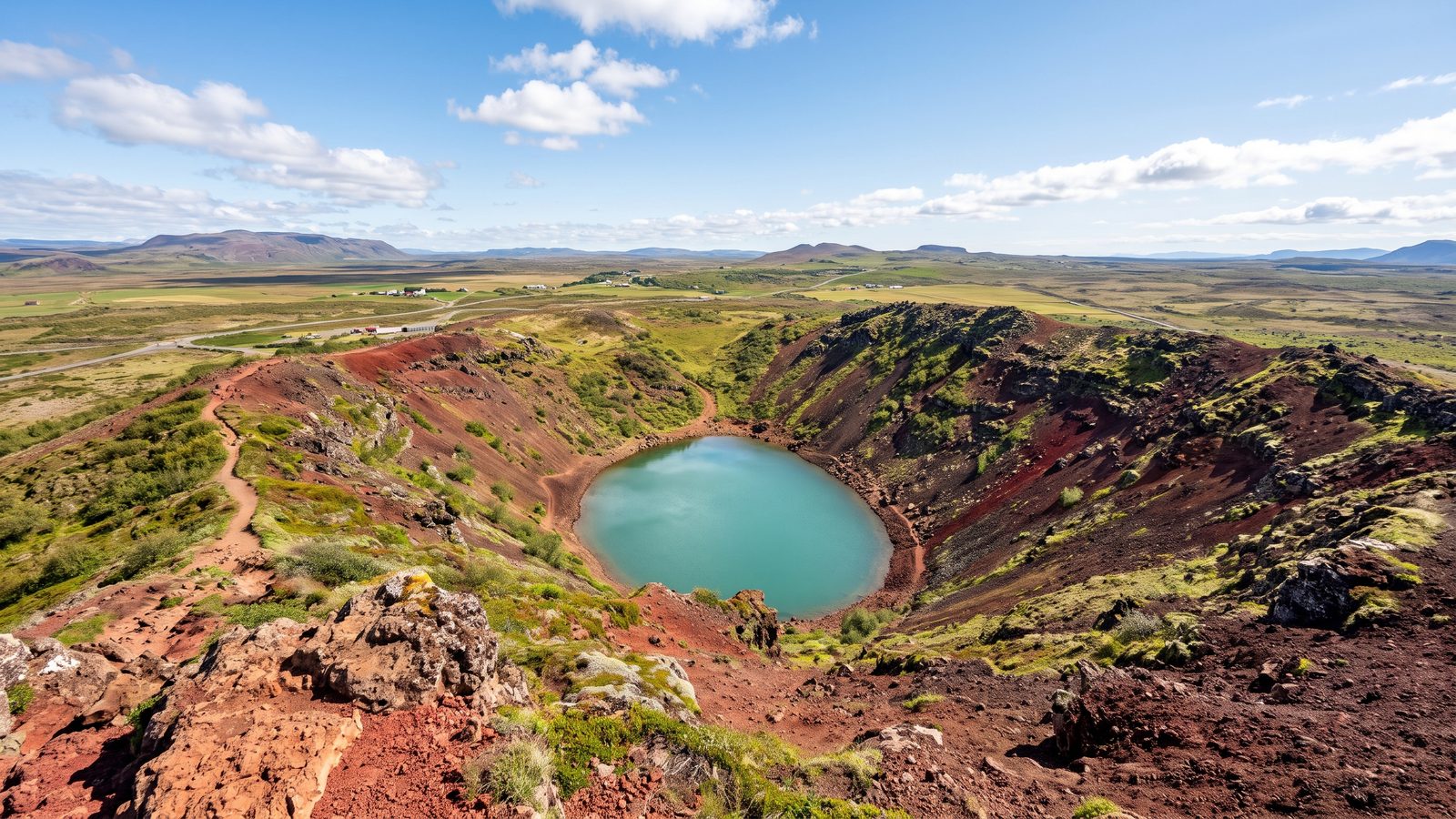
Welcome to Kerið Volcanic Crater, one of Southern Iceland's most captivating geological wonders. Situated in the Grímsnes region along the popular Golden Circle route, this 6,500-year-old crater bowl features fiery red volcanic slopes, lush mosses, and an extraordinary aquamarine lake resting at its base. Experience the dramatic contrasts of dark lava, iron-rich rock, and glowing water as you explore both the crater rim and the lake shore below.
This self-guided audio tour reveals the violent volcanic origins, unique mineral makeup, and delicate plant life of Kerið. With step-by-step guidance around the loop trail and down to the water's edge, you will discover the geological forces that carved this striking volcanic amphitheater.
Listen to a sample
The opening of this tour, exactly as AllTours narrates it on site.
What you'll hear on this tour
Stop 1. A Caldera Carved by Collapse
You stand at the edge of Kerið, looking into a caldera formed roughly 6,500 years ago during a fissure eruption in the Grímsnes volcanic area. Rather than a massive explosive peak, this collapse crater was created when the underlying magma chamber emptied itself, causing the roof above to cave in. You can see the result in this perfectly elliptical cross-section of ancient volcanic history. As you observe the steep slopes, notice the striking, fiery red volcanic rock. This intense coloring comes from iron-rich magma that oxidized over thousands of years. As you gaze into this natural bowl, you witness a remarkable textbook example of Iceland's effusive volcanic processes.
Stop 2. The Glowing Aquamarine Jewel
Look down at the base of the caldera where a liquid jewel shines in vibrant aquamarine. This shallow basin ranges between 7 and 14 meters deep, casting an ethereal, milky blue-green glow. As sunlight enters the clear water, it interacts with suspended minerals like silica and sulfur that leach directly from the surrounding volcanic rock. You are observing a self-contained body of water fed by snowmelt and rainwater accumulation. Its remarkable clarity and vivid luminescence create a striking visual centerpiece within the dark, ancient crater walls. From here, you can truly appreciate how sunlight and natural mineral deposits combine to produce Kerið's most famous, glowing spectacle.
Stop 3. Red Rock and Ancient Magma
As you explore Kerið's geological features, you are examining a prime example of a maar volcano created roughly 6,500 years ago. This formation occurred when rising, superheated magma encountered subterranean groundwater, triggering a massive steam blast that carved out a wide depression instead of building a cone. As you scan the crater walls, notice the vibrant, Martian reddish-orange hue of oxidized iron in the rhyolitic rock. Groundwater slowly seeps through these porous rocks into the bottom of the depression, carrying dissolved minerals that give the crater lake its brilliant aquamarine color. You are looking directly into a geological window that showcases Iceland's dynamic earth-sculpting forces.
Stop 4. From Rim Walk to Water's Edge
Begin your walk on the well-defined upper trail that loops along Kerið's rim. As volcanic gravel crunches under your boots, you enjoy panoramic views of the entire caldera and surrounding countryside. Notice how the perspective shifts with every step, revealing layered volcanic rock formed during ancient eruptions. Next, step down the sturdy wooden staircase carved into the crater slope to reach the serene water's edge. At the bottom of this amphitheater, you gaze up at moss-draped walls rising sharply around you. This dual-level trail allows you to experience the grand scale from above and inspect the tranquil beauty up close.
Stop 5. Resilient Life in Volcanic Scoria
As you look across the slopes of Kerið, you see a living natural laboratory where biology adapts to harsh volcanic geology. Vibrant green mosses and delicate grasses cling tenaciously to the rusty-red scoria, forming a resilient micro-ecosystem on nutrient-poor ground. Sunlight passes through the pristine water of the crater lake, interacting with dissolved minerals from the rhyolitic rock to enhance its vivid aquamarine hue. The lake is continuously replenished by groundwater seeping through subterranean rock layers, maintaining a stable temperature and exceptional clarity. Take a breath of the crisp air, filled with damp earth and ancient stone, as nature slowly reclaims this dynamic landscape.
Stop 6. A Natural Volcanic Amphitheater
Look out across this magnificent volcanic depression, a maar crater sculpted by a violent eruption 6,500 years ago. Superheated steam blasted through the earth when magma met the underground water table, creating steep walls lined with distinct strata of reddish-brown scoria and black lava. As you walk along the edge, you can admire how deep rusty reds and patches of emerald moss plunge toward the milky-blue groundwater lake below. The bowl shape acts as a natural amphitheater where sound echoes gently off the steep slopes. Every visible layer tells a fiery story of the violent phreatomagmatic forces that carved out this iconic Icelandic landmark.
Planning your visit
- Best time to go
- Daytime year-round for good lighting; mid-day sun highlights the vivid blue color of the lake.
- Approximate duration
- about 30 to 45 minutes
- Where to start
- At the visitor path near the main parking area at Kerið Volcanic Crater.
Access and conditions change seasonally — check the official site before you go.
Frequently asked questions
Is Kerið Volcanic Crater worth visiting?
Yes, Kerið Volcanic Crater is famous for its striking visual contrast between red scoria rock, green moss, and a brilliant aquamarine lake, making it a concise yet unmissable stop in Southern Iceland.
How long do you need at Kerið Volcanic Crater?
Most visitors spend between 30 and 45 minutes walking the rim loop trail, taking photos, and walking down the wooden stairs to the water's edge.
How was Kerið Volcanic Crater formed?
Kerið was formed approximately 6,500 years ago during a volcanic eruption in the Grímsnes area, created as a maar explosion crater or collapse caldera where empty magma chambers caved inward.
Keep exploring
Header image is an AI-generated illustration of Kerið Volcanic Crater. AllTours.ai is an AI audio tour guide — point your camera at any landmark and hear its story.