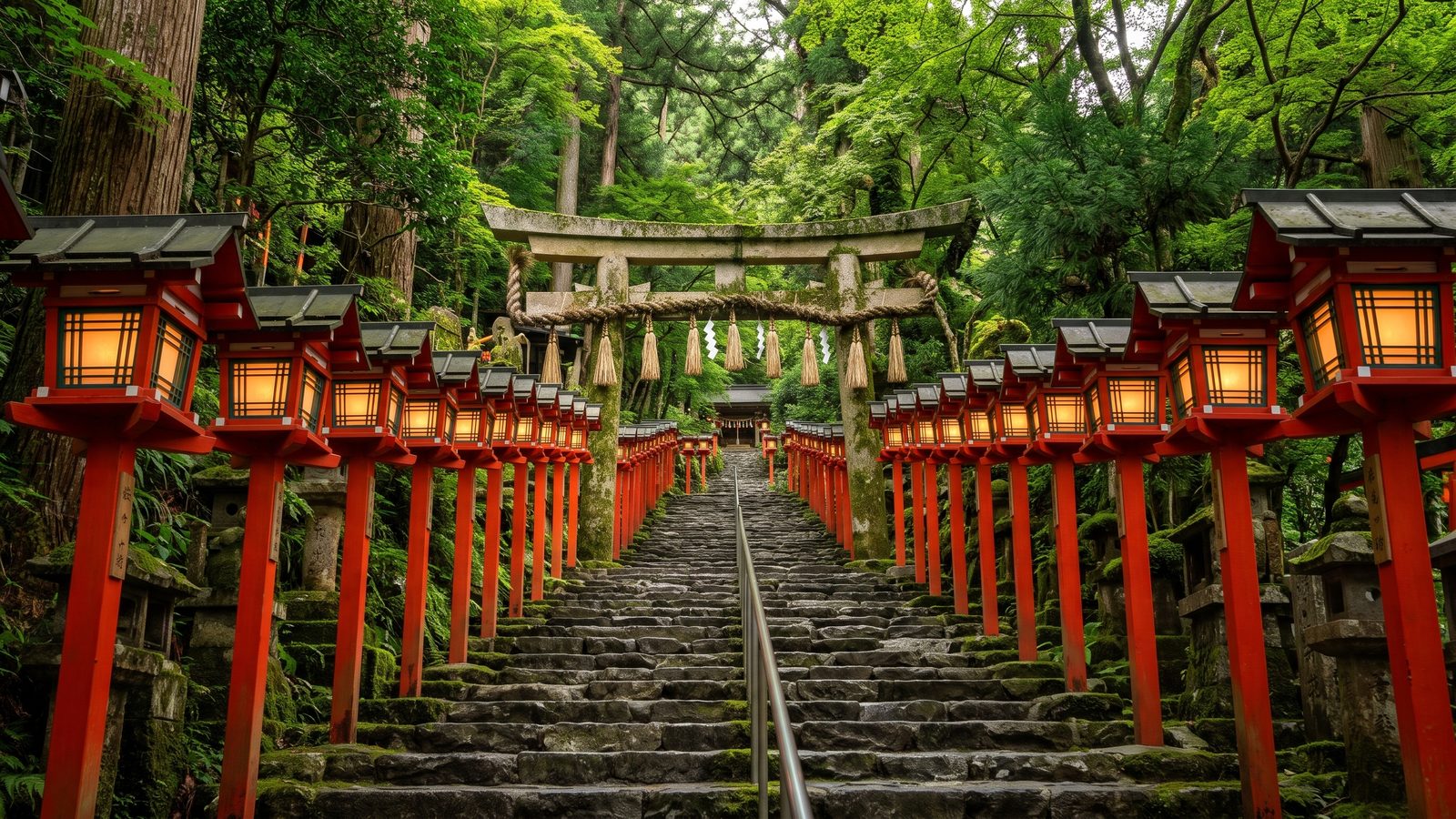
Nestled in the lush, ancient cedar forests north of Kyoto, Kifune Shrine offers a tranquil escape into Japan's sacred spiritual heritage. Dedicated to Takaokami no Kami, the deity of water, this revered site long predates Kyoto's era as the capital. As you ascend the iconic stone steps framed by traditional red lanterns, you step into a landscape where ancient myths, mountain springs, and timeless Shinto architecture blend seamlessly together.
This self-guided audio tour leads you along the sacred pathways of Kifune. From unique water fortune-telling rituals to the legendary origins of the Kamo River's headwaters, you will experience the quiet power and enduring beauty of one of Kyoto's most magical forest sanctuaries.
Listen to a sample
The opening of this tour, exactly as AllTours narrates it on site.
What you'll hear on this tour
Stop 1. The Sacred Springs of Life
You stand beside the Go-shinten, the Divine Spring whose crystal-clear waters bubble directly from deep within the ancient mountainside. This pure flow serves as the very heartbeat of Kifune Shrine, sustaining both the vibrant forest ecosystem and centuries of sacred tradition. As you listen to the constant, gentle murmur echoing through the trees, you feel the serene vitality that has drawn pilgrims here for generations. Visitors seek purification in these pristine currents, connecting directly with the water deity's protective spirit. The continuous spring isn't merely a backdrop; it is the living wellspring of life and spiritual energy that defines Kifune.
Stop 2. Legend of the Yellow Boat
Your journey into the past traces a legendary voyage up the Yodo and Kamo rivers. According to myth, Empress Iwanaga-hime sails upstream in a yellow boat seeking the headwaters of life, establishing Kifune's original sanctuary higher up at Okunomiya. This sacred point marks the source of the Kamo River, the essential lifeblood of historical Heian-kyo. As Kyoto grows into the imperial capital during the mid-Heian period in the tenth century, priests relocate the primary shrine structures down to this current site for easier access. Imperial envoys frequently travel here to offer prayers for rain and flood prevention, anchoring Kifune as the essential guardian of Kyoto's water.
Stop 3. Harmony of Stone and Cypress
As you climb the rhythmic stone stairs, notice how every step deliberately draws your gaze upward toward the sanctuary above. Traditional wooden lanterns line your path, casting a soft glow through paper panes to frame the ceremonial ascent. Ahead stands the main hall, featuring classic nagare-zukuri architecture with an unpainted cypress roof that sweeps forward like a protective wing. The structure relies on natural wood pillars left deliberately unadorned, allowing the shrine to merge naturally with the surrounding cedar forest rather than overpower it. This understated elegance showcases traditional Japanese craftsmanship perfectly adapted to the steep mountain terrain.
Stop 4. Ascending to the Sanctuary
You arrive at the serene main precinct of Kifune Shrine, dedicated to Takaokami no Kami, the revered deity of water. Here, ancient tradition meets lived devotion. You can participate in a unique ritual by dipping paper omikuji slips into the sacred spring water, watching secret fortunes slowly reveal themselves on the wet paper. History lives in every corner of this hall; Emperor Daigo prayed right at this holy ground for rain back in 930 AD. Although reconstructed in 2003, the present main hall preserves centuries of architectural harmony and spiritual resonance, welcoming all who climb these iconic forest steps.
Planning your visit
- Best time to go
- Early morning or late afternoon, especially during summer for cool mountain air or autumn for vibrant foliage.
- Approximate duration
- About 1 to 1.5 hours
- Where to start
- At the base of the iconic lantern-lined stone staircase leading to Kifune Shrine's main complex.
Access and conditions change seasonally — check the official site before you go.
Frequently asked questions
Is Kifune Shrine worth visiting?
Yes, Kifune Shrine is well worth visiting for its striking lantern-lined stone steps, unique water fortune-telling rituals (mizu-ura omikuji), and peaceful forest setting in the mountains north of Kyoto.
How long do you need at Kifune Shrine?
Most visitors spend about 1 to 2 hours exploring the main shrine precinct, walking the lantern-lined staircase, and experiencing the water fortune-telling ritual.
What is the history behind Kifune Shrine?
Kifune Shrine is an ancient Shinto site dedicated to the water deity Takaokami no Kami. Myth holds that Empress Iwanaga-hime traveled up the river in a yellow boat to establish its original sanctuary at Okunomiya, making it a vital guardian of Kyoto's water supply since before the Heian period.
Keep exploring
Header image is an AI-generated illustration of Kifune Shrine. AllTours.ai is an AI audio tour guide — point your camera at any landmark and hear its story.