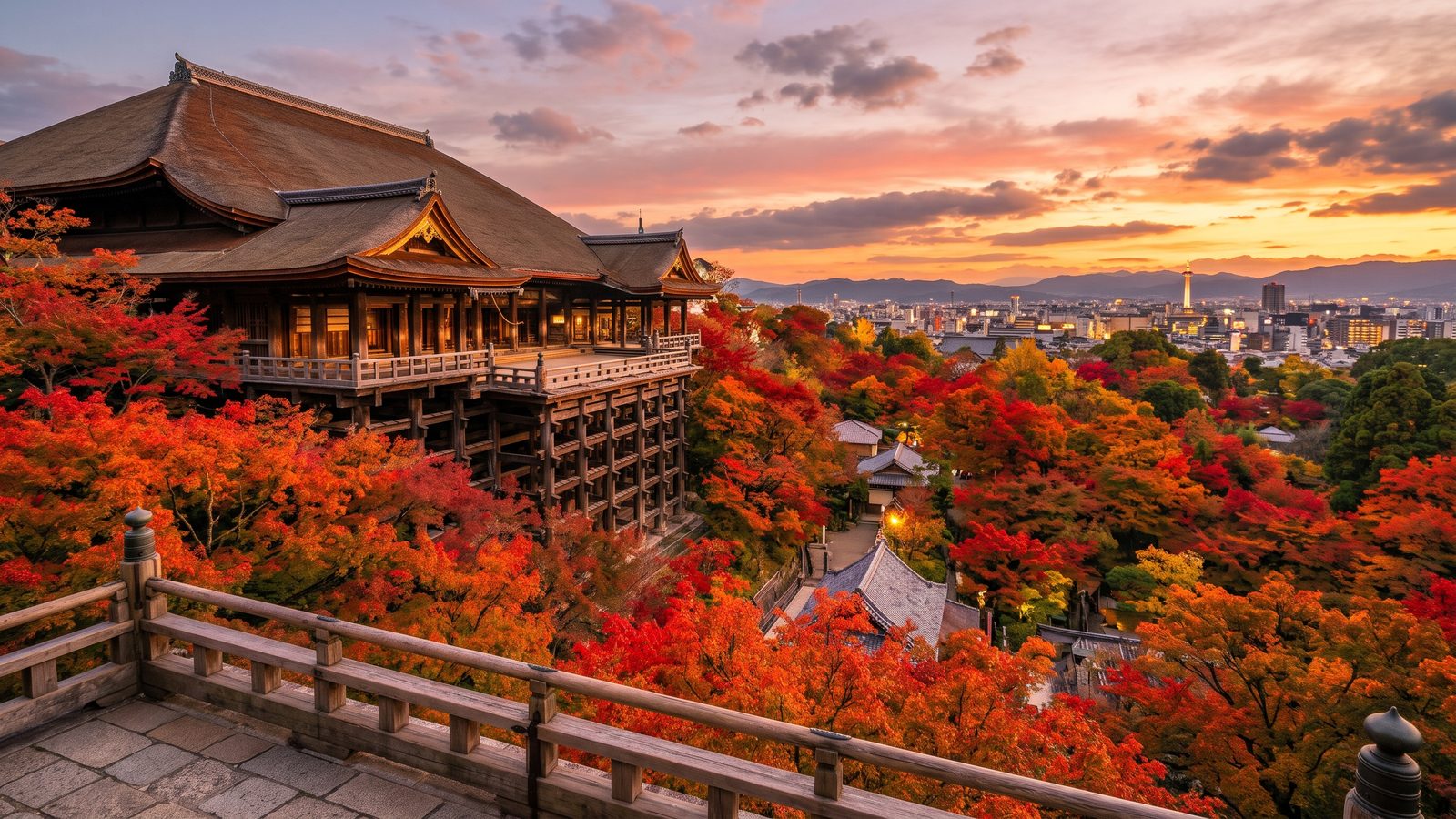
Welcome to Kiyomizu-dera, Kyoto's ancient hillside sanctuary dedicated to Kannon, the goddess of mercy. Perched high above the city on Mt. Otowa, this UNESCO World Heritage site invites you to wander through over a millennium of spiritual history. As you explore its bustling precincts, monumental gates, and surrounding maple woods, you will experience the living traditions, architectural wonders, and breathtaking panoramic vistas that define Japan's cultural heritage.
This self-guided audio tour leads you past iconic pavilions, ancient springs, and sacred shrines. You will uncover hidden garden paths, stand on the famous nail-free wooden stage, and discover why millions of pilgrims have made the journey up these sacred slopes since the eighth century.
Listen to a sample
The opening of this tour, exactly as AllTours narrates it on site.
What you'll hear on this tour
Stop 1. The Engineering of the Main Hall
You stand before the Hondo, or Main Hall, a masterpiece of ancient Japanese craftsmanship constructed using the kakezukuri suspended-stage technique. This massive wooden structure projects over the cliff, supported by 139 zelkova pillars over 12 meters tall. Master carpenters built this entire hall without using a single nail, relying instead on interlocking timber joinery called kigumi, held together by friction and gravity. Above you, the sweeping roof features traditional hiwadabuki style, made from countless carefully layered sheets of cypress bark. As you gaze at this cantilevered balcony engineered over centuries ago, you witness a profound harmony between human ingenuity and natural forces, designed to withstand earthquakes while protecting the sacred waterfall below.
Stop 2. Panoramic Views from the Wooden Veranda
You step onto the Kiyomizu-no-butai, the temple's famous wooden veranda, and gaze across the valley toward the Kyoto skyline. Beneath your feet, the forested slopes shift dramatically with each season. In spring, delicate clouds of pink cherry blossoms envelope the hillside, turning into a lush emerald canopy during the summer months. Autumn ignites the landscape in brilliant shades of crimson and gold, framing the distant vermilion Koyasu Pagoda nestled within the trees. Far beyond the vibrant forest, the city of Kyoto spreads out toward the surrounding mountains. Standing high on this elevated sanctuary, you take in an unforgettable panorama that captures the perfect balance between nature, historic architecture, and urban life.
Stop 3. Sacred Waters and the Dark Corridor
You immerse yourself in the spiritual heart of Kiyomizu-dera, starting with its principal deity, the Eleven-Headed Kannon Bodhisattva. Below the hall, you visit the Otowa Waterfall, where pure mountain water gives the temple its name, meaning Pure Water Temple. Here, you reach out with a long-handled ladle to choose one of three distinct streams representing blessings for health, success, or love. Nearby, you can experience the profound Tainai Meguri, or Womb Walk. You enter a completely dark pitch-black underground corridor, guiding yourself solely by holding onto a beaded rope. Moving blindly through the blackness symbolizes returning to the womb, until you emerge into the light, reborn and spiritually renewed by Kannon's compassion.
Stop 4. Tradition, Matchmaking, and Faith
You feel the deep cultural energy that has drawn pilgrims to these slopes for over a thousand years. Beyond the main hall lies Jishu Shrine, where visitors seek luck in love by walking between two designated love stones with their eyes closed, hoping to reach the opposite stone successfully. Throughout the temple grounds, you encounter traditions that have shaped the Japanese lexicon. The famous expression "to jump off the stage at Kiyomizu" stems directly from this wooden platform, serving as a national idiom for taking a bold, decisive leap of faith. Every stone, ritual stream, and votive banner here reflects a living heritage, connecting your modern footsteps with centuries of personal devotion and hopeful prayers.
Stop 5. A Millennium of Devotion and Rebirth
You trace the temple's remarkable origin back to 778 AD, when the monk Enchin discovered the sacred spring and established a modest hermitage. Soon after, General Sakanoue no Tamuramaro expanded the sanctuary to honor Kannon, founding Kiyomizu-dera as an official temple affiliated with the ancient Hosso school of Buddhism. Over the centuries, devastating fires repeatedly destroyed the complex, forcing the Main Hall to be rebuilt ten times. Royalty, shoguns, and pilgrims continually restored the sacred site, maintaining its original architectural design across generations. The Main Hall standing beside you today dates back to 1633, commissioned by Shogun Tokugawa Iemitsu. This continuous cycle of destruction and reconstruction highlights the enduring spiritual authority of Kiyomizu-dera.
Stop 6. Intimate Spaces and Borrowed Scenery
You wander along quiet sub-temple pathways to discover Kiyomizu-dera's intimate, tranquil garden pockets. Unlike vast imperial parks, these hidden green spaces weave seamlessly into the natural hillside terrain, featuring moss-covered stones, gentle streams, and artfully sculpted pine trees. Notice how the landscapers employed the concept of shakkei, or borrowed scenery, deliberately framing the distant Higashiyama mountains as a living background for the gardens. Pure water from the mountain spring flows through small ponds and stone channels, creating a peaceful soundscape designed to prepare your mind for contemplation. As you pause in these quiet corners, a single ancient tree or weathered stone invites you to slow down and connect with nature's quiet beauty.
Planning your visit
- Best time to go
- Early morning right at opening to avoid peak crowds, or autumn and spring for vivid foliage and cherry blossoms.
- Approximate duration
- about 1.5 to 2 hours
- Where to start
- The main entrance gate (Niomon Gate) at the top of Matsubara-dori slope.
Access and conditions change seasonally — check the official site before you go.
Frequently asked questions
Is Kiyomizu-dera worth visiting?
Yes, Kiyomizu-dera is one of Kyoto's most famous UNESCO World Heritage sites, renowned for its massive wooden stage built without nails, stunning seasonal scenery, and rich spiritual heritage.
How long do you need at Kiyomizu-dera?
Most visitors spend 1.5 to 2 hours exploring the Main Hall, drinking from the Otowa Waterfall, walking through the precinct shrines, and enjoying the panoramic views over Kyoto.
When was Kiyomizu-dera built and why?
Kiyomizu-dera was founded in 778 AD by the monk Enchin near the Otowa Waterfall, and expanded by General Sakanoue no Tamuramaro to fulfill a vow to the Goddess of Mercy, Kannon.
Keep exploring
Header image is an AI-generated illustration of Kiyomizu-dera. AllTours.ai is an AI audio tour guide — point your camera at any landmark and hear its story.