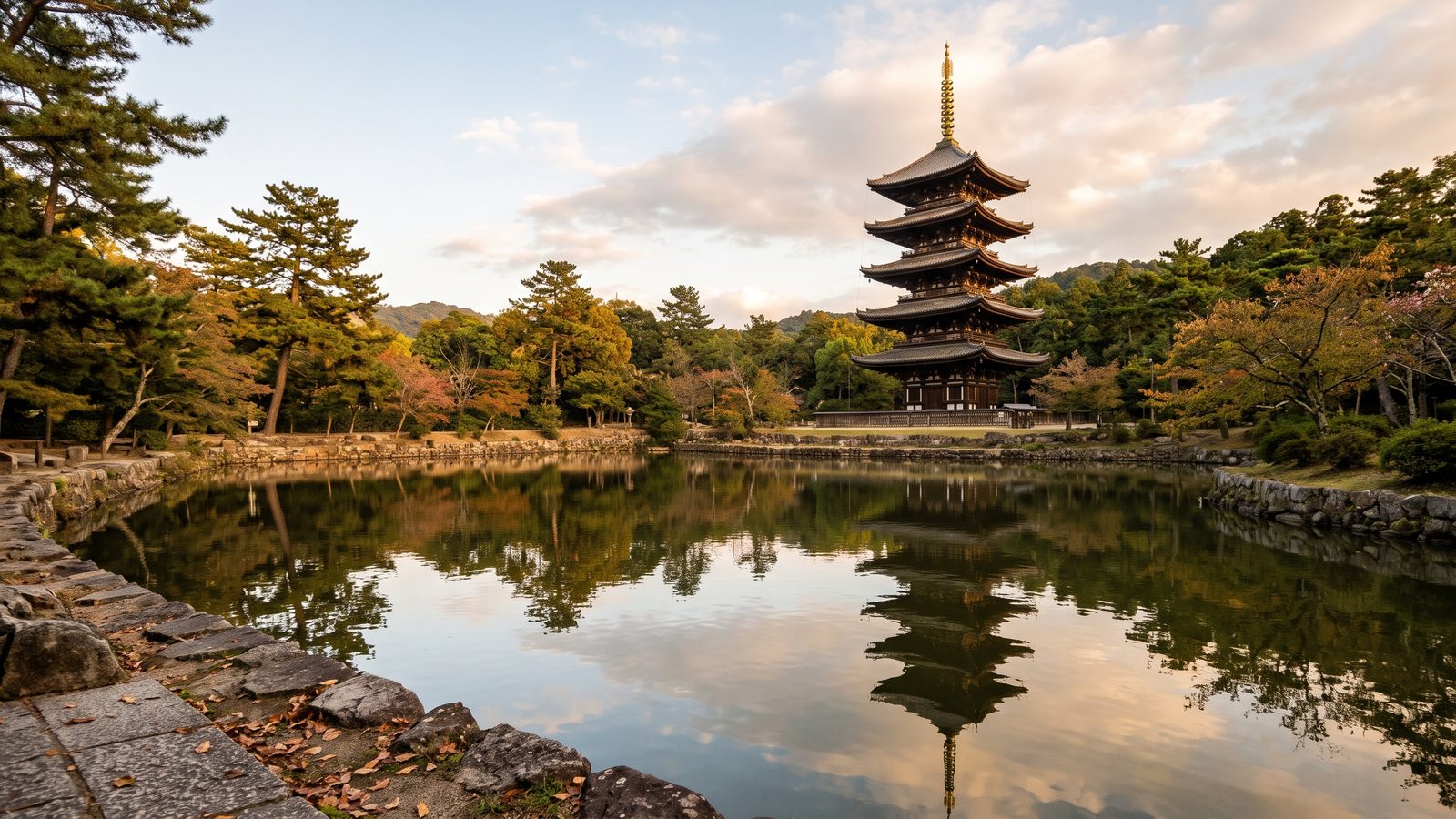
Towering over Nara Park, the Five-Storied Pagoda at Kofuku-ji stands as Japan's second tallest wooden pagoda and a timeless symbol of spiritual resilience. Rebuilt in 1426 after centuries of fires and political tumult, this majestic 50-meter masterpiece reflects the power of the Fujiwara clan and the genius of ancient Japanese carpentry. As you wander the sacred temple grounds, you follow in the footsteps of emperors, monks, and pilgrims.
This self-guided audio tour reveals the inner workings of ancient earthquake-resistant engineering, the profound Buddhist symbolism behind each tier, and Nara's rich legacy as Japan's first permanent capital. Step closer to appreciate the nail-less joinery, deep sweeping eaves, and enduring atmosphere of one of Japan's most celebrated historic treasures.
Listen to a sample
The opening of this tour, exactly as AllTours narrates it on site.
What you'll hear on this tour
Stop 1. Nara's Soaring Sacred Icon
You stand before Japan's second tallest wooden pagoda, a 50-meter structure embodying enduring faith and architectural mastery. Though originally commissioned in 730 by Empress Komyo, this pagoda rose five times from devastating fires, with the current iteration dating to 1426. As your gaze ascends the five tiers, notice how each story represents one of the Buddhist cosmic elements: earth, water, fire, wind, and void. At the top sits the sorin spire with its nine rings, symbolizing nine heavens. Inside, the central shinbashira pillar acts as a structural and spiritual anchor, while interlocking wooden joinery secures the edifice without a single nail. You are witnessing an enduring masterpiece of sacred craftsmanship.
Stop 2. Ancient Seismic Engineering Secrets
Look closely at the five floating tiers to uncover ancient seismic secrets. You are viewing a millennium-old lesson in earthquake resistance. A central wooden pillar, the shinbashira, runs through the core without rigid attachments, allowing each story to sway independently during tremors in a brilliant energy-dissipating movement known as the snake dance. Notice the deep, sweeping eaves, or sori, crafted from solid cypress wood. These graceful roofs extend outward to shield the complex joinery from centuries of rain and sun. Built entirely without nails through sophisticated interlocking wooden brackets, this architectural marvel combines aesthetic elegance with extreme durability, standing strong against the forces of nature across generations.
Stop 3. Rising from Ashes Across Centuries
As you gaze upon this towering structure, you trace a history defined by resilience. The temple's origins date back to 669, established by Kagami-no-Ōkimi for her husband Fujiwara no Kamatari's recovery. When the capital moved to Nara in 710, Kamatari's son Fuhito relocated the temple here, establishing it as the Fujiwara clan's tutelary sanctuary. The first five-storied pagoda arose in 730, but fires from lightning and military conflicts repeatedly razed the grounds. Five separate times, the powerful clan and devoted craftsmen rebuilt this sacred tower. The majestic pagoda before you today dates to 1426, standing as a living symbol of unwavering spiritual devotion spanning nearly eight centuries.
Stop 4. Heart of the Powerful Fujiwara Clan
You are walking through the heart of Kofuku-ji, historically one of Nara's revered Seven Great Temples. Beyond serving as a place of worship, this complex functioned as the ultimate political and spiritual stronghold for the aristocratic Fujiwara family. In ancient times, the temple even commanded its own formidable force of warrior monks who directly influenced capital politics. As you explore the grounds, notice the Central Golden Hall and the serene Octagonal Hall, Hokuen-do. These sacred structures have welcomed emperors, regents, and high priests seeking political alliances and divine blessings. Today, these hallowed grounds remain a living chronicle of Japan's imperial heritage and artistic grandeur.
Stop 5. Living Tradition and Artistic Inspiration
Observe the quiet reverence around you as pilgrims practice junrei, the ancient tradition of ritual circumambulation. This towering pagoda is far more than a historical monument; it remains a central pillar of Japanese cultural and spiritual life. For centuries, its sweeping eaves and dignified silhouette have inspired waka poets, painters, and artisans, making it a prominent motif in classical literature and art. The gentle rustle of leaves combined with distant temple bells creates Nara's iconic meditative atmosphere. As you stand here, you connect with a living legacy that continues to celebrate harmony with nature, deep artistic dedication, and the transient beauty of existence.
Stop 6. The First Capital of Imperial Japan
You are standing in Nara, the historical birthplace of Japan's imperial legacy. From 710 to 784 AD, this city—then named Heijo-kyo—served as the nation's very first permanent capital. Designed after the grid layout of Tang Dynasty Chang'an, ancient Nara flourished as a vibrant center for international diplomats, scholars, and artists. During this pivotal Nara Period, Buddhism took firm root, shaping the cultural landscape with grand monuments like Kofuku-ji. As you look around, you might see free-roaming deer wandering nearby. Long considered sacred messengers of Kasuga Taisha, these deer embody the seamless blend of divine tradition and natural harmony that defines Japan's ancient Southern Capital.
Planning your visit
- Best time to go
- Early morning or late afternoon when light illuminates the wooden eaves and crowd levels in Nara Park are lower.
- Approximate duration
- about 45 minutes
- Where to start
- In front of the Five-Storied Pagoda on the main Kofuku-ji temple grounds.
Access and conditions change seasonally — check the official site before you go.
Frequently asked questions
Is Kofuku-ji Five-Storied Pagoda worth visiting?
Yes. Standing over 50 meters tall, it is Japan's second tallest five-storied pagoda, an architectural landmark of Nara, and an extraordinary example of 15th-century wooden craftsmanship and seismic design.
How long do you need at Kofuku-ji Five-Storied Pagoda?
A visit focused on the Pagoda and immediate grounds takes about 30 to 45 minutes. If exploring the broader Kofuku-ji complex and nearby Nara Park, plan for 1 to 2 hours.
When was Kofuku-ji Five-Storied Pagoda built and why was it rebuilt?
First constructed in 730 by Empress Komyo, the pagoda burned down five times over the centuries due to lightning strikes and war. The structure standing today was rebuilt in 1426.
Keep exploring
Header image is an AI-generated illustration of Kofuku-ji Five-Storied Pagoda. AllTours.ai is an AI audio tour guide — point your camera at any landmark and hear its story.