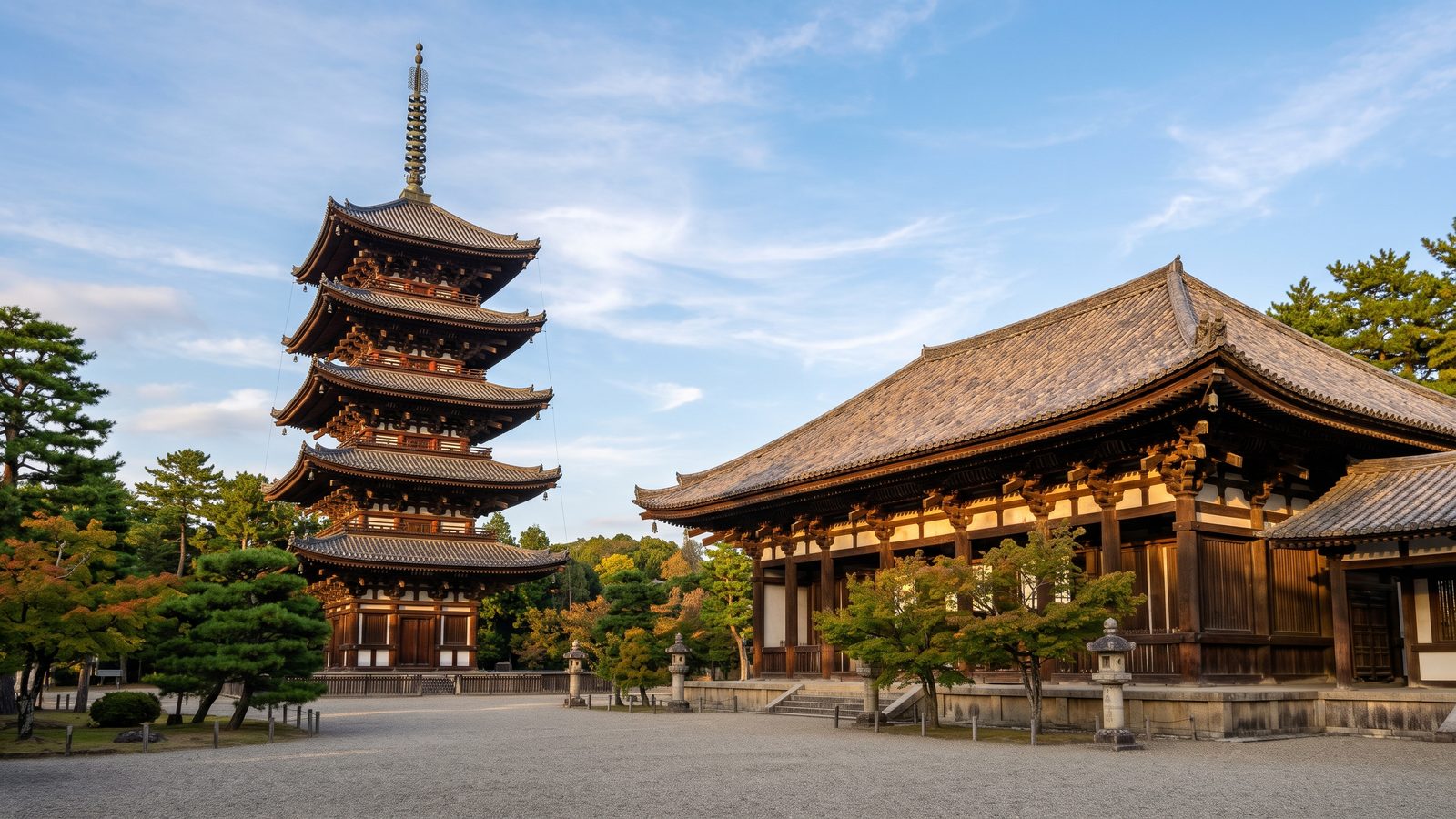
Welcome to Kōfuku-ji, one of Nara's famous Seven Great Temples and a UNESCO World Heritage site deeply tied to Japan's ancient capital. Founded in 669 and relocated here in 710, Kōfuku-ji served as the spiritual headquarters for the powerful Fujiwara clan. Today, its iconic Five-story Pagoda and grand halls stand as enduring symbols of cultural resilience, artistic patronage, and sacred tradition.
This self-guided audio tour walks you through Kōfuku-ji's dramatic history, architectural masterpieces, and spiritual legacy. As you explore the temple grounds, you will discover how warrior monks, court aristocrats, and master craftsmen shaped the heart of Nara across more than thirteen centuries.
Listen to a sample
The opening of this tour, exactly as AllTours narrates it on site.
What you'll hear on this tour
Stop 1. Rising Phoenix of Nara's Skyline
You gaze up at the majestic Five-Story Pagoda, soaring 50 meters into the Nara sky as Japan's second-tallest wooden pagoda. Standing as Kōfuku-ji's ultimate landmark, this structure is not its original incarnation. Devastating fires claimed its predecessors five times over the centuries, yet unwavering devotion inspired its rebuilding time and again. The soaring tower you see today dates back to 1426, faithfully preserving ancient designs. As you admire its subtle architectural details and graceful proportions, remember its core purpose: an eternal sacred reliquary enshrining Buddha's relics, anchoring this powerful temple complex through centuries of destruction and rebirth.
Stop 2. Masterpieces of Bracket and Beam
You step closer to examine the intricate craftsmanship defining Kōfuku-ji's historic structures. Look at the Five-Story Pagoda to admire its classic wa-yo style, where elaborate tokyo bracket systems extend outward to support deep, sweeping wooden eaves. Nearby, you observe the Hokuen-do, or Northern Octagonal Hall, which incorporates a clever mokoshi—a lower lean-to roof—creating the visual illusion of a two-story building. As you explore the grounds, you are witnessing centuries of painstaking reconstruction. Craftsmen have meticulously preserved original Heian and Kamakura period architectural designs, demonstrating extraordinary devotion to enduring Japanese building traditions across every timber and joint.
Stop 3. Mind Over Matter: Hossō Wisdom
You stand within the spiritual domain of the Hossō school, one of Japan's oldest Buddhist traditions and the core philosophy of Kōfuku-ji. Originating in China, this consciousness-only doctrine teaches that all perceived reality springs entirely from the human mind. Here, generations of dedicated monks rigorously studied complex sutras, striving to transcend illusory perceptions and uncover fundamental truths. As you look toward the towering pagodas, reflect on their ultimate sacred function: housing holy relics of the Buddha. These sacred structures serve as powerful focal points for your own quiet meditation along the eternal path toward spiritual awakening.
Stop 4. Armies, Ashes, and Aristocrats
You trace the dramatic historical legacy of Kōfuku-ji back to 669, when Kagami-no-Ōkimi founded its predecessor to pray for her husband, Fujiwara no Kamatari. Following its relocation to Nara in 710, it grew into the supreme tutelary temple of the formidable Fujiwara clan. Over the centuries, Kōfuku-ji commanded vast political influence across Japan, even commanding its own formidable armies of warrior monks. You walk across grounds that witnessed repeated catastrophic fires, including the devastating destruction of 1180. Yet after every disaster, the temple rose anew from the ashes, demonstrating an unyielding spirit that defied complete destruction.
Stop 5. Sacred Art and Aristocratic Rituals
You immerse yourself in a cradle of early Japanese Buddhist culture, where spiritual devotion intertwined with high court aristocracy. As the primary temple of the powerful Fujiwara clan, Kōfuku-ji served as a grand patron of the arts, fostering a rich sculptural tradition that came to define Nara-period aesthetics. Court nobles gathered here to participate in elaborate religious rituals, seeking divine favor and political legitimacy. As you walk among these historic halls, you feel the profound echoes of an era when aristocratic ambition and deep Buddhist piety merged, forever shaping Japan's cultural and national identity.
Stop 6. The Fujiwara Clan's Spiritual Anchor
You feel the formidable weight of ancient authority surrounding you at Kōfuku-ji. More than just a quiet place of worship, this grand complex served as the spiritual and political anchor for the Fujiwara clan, one of the most powerful families in Japanese history. Through their patronage, Kōfuku-ji accumulated immense wealth and authority. As you walk these historic grounds, you witness a story written in survival. Devastating fires repeatedly burned these sacred halls to the ground, yet each rebuild renewed the clan's spiritual power and commitment, leaving an indelible imprint on the land beneath your feet.
Planning your visit
- Best time to go
- Early morning or late afternoon for quiet grounds and golden light on the pagoda.
- Approximate duration
- about 1 hour
- Where to start
- In front of the Five-story Pagoda near the Eastern Golden Hall.
Access and conditions change seasonally — check the official site before you go.
Frequently asked questions
Is Kōfuku-ji worth visiting?
Yes, Kōfuku-ji is a UNESCO World Heritage site and one of Nara's Seven Great Temples. It features Japan's second-tallest five-story pagoda and deep historical connections to early Japanese Buddhism and the Fujiwara clan.
How long do you need at Kōfuku-ji?
Most visitors spend around 45 to 60 minutes walking through the grounds, admiring the outdoor architecture, and taking in the iconic Five-story Pagoda.
Who founded Kōfuku-ji Temple?
Kōfuku-ji was originally founded in 669 by Kagami-no-Ōkimi to pray for the recovery of her husband, Fujiwara no Kamatari. It was relocated to Nara in 710 when Nara became the national capital.
Keep exploring
Header image is an AI-generated illustration of Kōfuku-ji. AllTours.ai is an AI audio tour guide — point your camera at any landmark and hear its story.