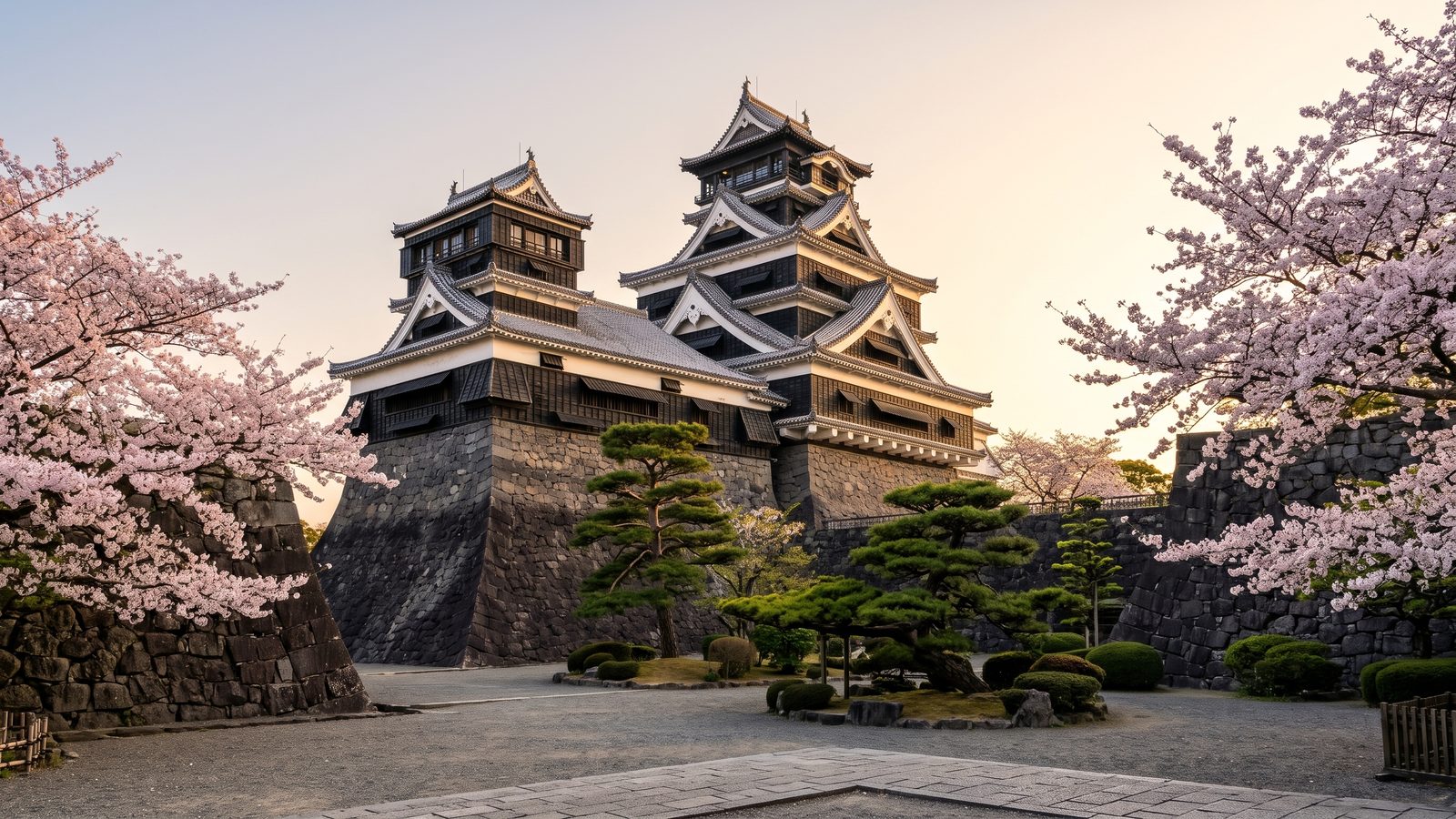
Welcome to Kumamoto Castle, one of Japan's most formidable fortress complexes. Initiated in 1601 by Lord Kato Kiyomasa, a veteran warrior who applied his extensive battlefield experience, this stronghold was built as an ultimate war machine. Though the main keep fell to fire during the 1877 Satsuma Rebellion, its imposing stone walls and original turrets still showcase a masterclass of Edo-period defensive engineering.
As you walk through the castle grounds today, you step into a landscape shaped by samurai culture, dramatic sieges, and remarkable resilience. From hidden trap gates to serene dry landscape gardens, this self-guided audio tour reveals the strategic genius and artistic spirit that defined Kumamoto's ruling lords.
Listen to a sample
The opening of this tour, exactly as AllTours narrates it on site.
What you'll hear on this tour
Stop 1. The War Machine and Legendary Siege
You stand on ground where strategic genius met ultimate resilience. Long before Kato Kiyomasa built this stronghold, Chiba Castle occupied the site. Drawing from his Korean campaign experiences, Kiyomasa transforms it into a terrifying fortress. You observe clever traps like the hidden ugurumon gate and the dark, labyrinthine kuragari tsuro passages built for sudden counter-attacks. During the 1877 Satsuma Rebellion, General Tani Tateki and 3,500 troops hold this ground against Saigo Takamori's 13,000 elite samurai for 52 brutal days. Although the main keep mysteriously burns during the siege, the walls endure, standing proud today through ongoing restoration after the 2016 earthquake.
Stop 2. Impenetrable Slopes and Mortarless Masonry
You gaze up at the magnificent musha-gaeshi stone walls, marveling at their legendary ogi-kobai or fan slope design. Notice how the dry-stone gradient gradually steepens into a near-vertical curve, making it practically impossible for attacking samurai to scale—hence their return-a-warrior name. Nearby, you inspect the original Edo-period Uto Turret, a rare surviving structure featuring a five-story exterior cleverly hiding a three-story interior. Its white plaster walls, dark timber accents, and intricate chidori-hafu gables capture the classic Japanese fortress aesthetic. Every unmortared stone locks tightly into place, demonstrating structural integrity that has withstood severe earthquakes and relentless sieges.
Stop 3. Deadly Traps and Overlapping Fire
You step through a masugata gate complex, realizing you have entered a fatal bottleneck. If invaders breach the outer entrance, they find themselves trapped within a tight courtyard, exposed to defensive fire from surrounding turrets on every side. Look directly above to spot the angled ishiotoshi stone-dropping windows, designed for dropping rocks, hot water, or arrows onto attackers below. Scanning the massive stonework, you see narrow sama slits cut precisely for bowmen and gunners. Each opening creates overlapping fields of fire with zero blind spots. You feel the tactical tension embedded in every angle, engineered to bleed an invading army dry.
Stop 4. Commanding Vistas Over City and Caldera
You reach the top floor of the reconstructed main keep and gaze across Kumamoto City. From this lofty vantage point, you see the Shirakawa River snaking through the modern urban landscape below, serving as a key natural defense barrier for the fortress. On clear days, the distant silhouette of the Aso Caldera appears on the horizon, anchoring the castle within Kyushu's dramatic volcanic heartland. Looking down into the inner baileys, you trace the complex layered walls and turrets designed to break invading forces. You imagine Lord Kiyomasa standing right here, surveying both his military defenses and the prosperous rice fields below.
Stop 5. Tranquil Havens of Dry Landscapes
You transition from fierce fortifications to the tranquil elegance of the castle gardens. Inside the Honmaru Goten area, you admire the karesansui dry landscape, where raked gravel simulates flowing water around carefully placed rocks representing mountains and islands. Moving along the winding paths of the chisen-kaiyu-shiki strolling garden, you wander past meticulously pruned pine trees, vibrant azaleas, and velvety moss. Stone lanterns and water basins guide your eyes towards the soaring stone walls, seamlessly blending nature with military architecture through borrowed scenery. You experience the quiet reflection that Hosokawa lords once enjoyed between administrative duties and samurai training.
Stop 6. Artistry, Swords, and Samurai Tradition
You discover that Kumamoto Castle was far more than a fortress—it was a thriving cultural center. Here, samurai balanced martial prowess with refined arts like ikebana flower arrangement and the tea ceremony. In the surrounding castle town, local craftsmen developed Higo Zogan metalwork, embedding intricate gold and silver inlays into samurai sword guards and armor. This distinct aesthetic infused strength with delicate beauty. Today, the castle grounds continue this legacy during the annual Kumamoto-jo Aki Matsuri autumn festival, where you can watch traditional yabusame horseback archery. You feel how deeply samurai traditions continue to shape the artistic soul of Kumamoto.
Planning your visit
- Best time to go
- Early morning or late afternoon for gentle light on the stone walls; spring cherry blossom season and autumn offer stunning foliage.
- Approximate duration
- About 2 to 3 hours
- Where to start
- Begin at the main entrance approach near Ninomaru Park.
Access and conditions change seasonally — check the official site before you go.
Frequently asked questions
Is Kumamoto Castle worth visiting?
Yes, Kumamoto Castle is considered one of Japan's most impressive fortress complexes, renowned for its massive curving stone walls, strategic defensive features, and deep samurai history.
How long do you need at Kumamoto Castle?
Most visitors spend about 2 to 3 hours exploring the main keep, Uto Turret, defense gates, Honmaru Goten gardens, and surrounding park grounds.
Why is Kumamoto Castle famous historically?
Kumamoto Castle is famous for Kato Kiyomasa's masterclass in defensive architecture—such as steep musha-gaeshi walls—and for holding off a 52-day siege by 13,000 samurai during the 1877 Satsuma Rebellion.
Keep exploring
Header image is an AI-generated illustration of Kumamoto Castle. AllTours.ai is an AI audio tour guide — point your camera at any landmark and hear its story.