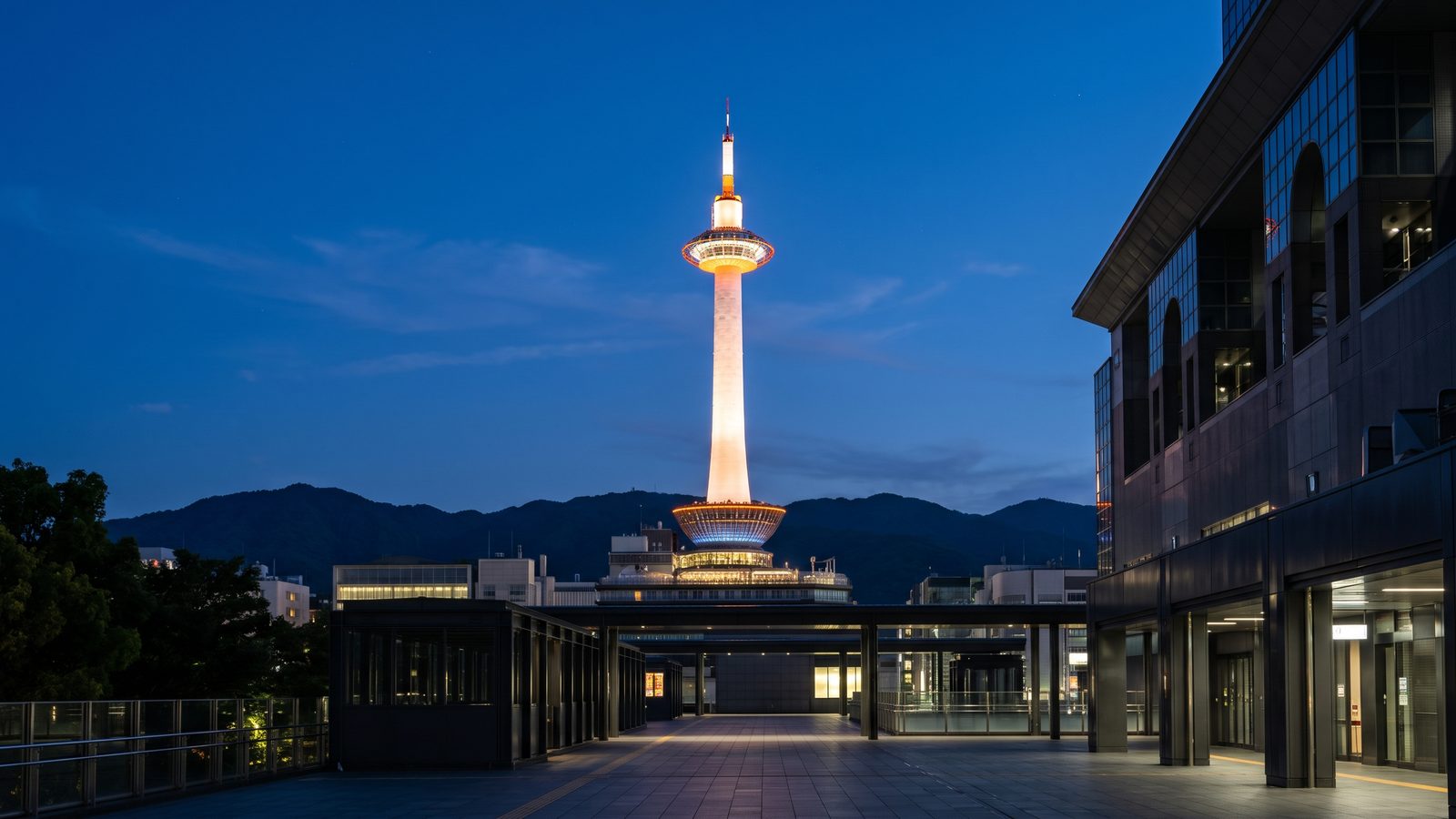
As you step out of Kyoto Station, a striking white spire rises high above the historic rooftops. Completed in 1964 alongside the Shinkansen and Tokyo Olympics, Kyoto Tower stands as a bold statement of modern post-war Japan. Designed to resemble a traditional Japanese lighthouse, this iconic 131-meter landmark offers an intriguing contrast to Kyoto’s ancient temples, inviting you to discover the city from a brand-new perspective.
With this self-guided audio tour, you will uncover the engineering marvels, sweeping 360-degree mountain-framed vistas, and rich dining experiences hidden within the tower complex. From basement bathhouses to sky-high lounges, explore how this controversial architectural icon became a beloved symbol of Kyoto's forward-looking spirit.
Listen to a sample
The opening of this tour, exactly as AllTours narrates it on site.
What you'll hear on this tour
Stop 1. A Modern Lighthouse Over Ancient Roofs
You stand before Kyoto Tower, a gleaming white and red beacon completed in 1964 to coincide with the Tokyo Olympics and the debut of the Shinkansen. As you gaze up, you see how its lighthouse-inspired silhouette offers a deliberate departure from traditional Japanese architecture. Although its modern aesthetic initially sparked debate amidst Kyoto's ancient temples, the tower now stands as a beloved symbol of the city's forward-looking spirit. Look closely at its lower structure, and you notice how the tower seamlessly integrates into a multi-story commercial and hotel complex below, pioneering mixed-use urban design right at the city's main gateway.
Stop 2. Unbending Steel and Engineering Audacity
Look up at the smooth, porcelain-like exterior of the spire. Unlike traditional lattice towers with exposed girders, architect Mamoru Yamada designed this 131-meter structure using a hollow cylinder made of lightweight, welded steel plates. You are looking at a radical engineering solution inspired by the strength of a lighthouse. Notice how the entire tower section rests directly atop a nine-story building, making it appear to rise organically from the streetscape. This tubular construction allows the tower to sway gently and absorb earthquake and typhoon forces, standing resiliently above the city while offering a striking visual contrast to the intricate wooden temples below.
Stop 3. Panoramic Vistas of Mountain and Temple
Step onto the observation deck and immerse yourself in an incredible 360-degree panorama of Kyoto. As you look north, you trace the ancient grid pattern of Heian-kyo stretching towards the Kitayama mountains. To the east, you spot the wooden stage of Kiyomizu-dera perched against the verdant slopes of the Higashiyama range, along with the bright vermilion trail of Fushimi Inari Taisha. Turning west, your eyes find the towering five-story pagoda of Toji Temple standing sentinel. At dusk, watch as the historical urban landscape transforms into a glittering sea of lights nestled within the surrounding mountain peaks.
Stop 4. Reading the Ancient Blueprint from Above
From high above, you can read Kyoto's meticulous urban planning like an open blueprint. Notice how the low-rise skyline creates a vast sea of roofs, preserved through strict building regulations to maintain its historic heart. You trace the silver ribbon of the Kamo River dividing the eastern districts, while the green expanse of the Kyoto Imperial Palace grounds marks the serene center of imperial history. To the southwest, Toji Temple's pagoda pierces the skyline as a solitary vertical accent. You see how the surrounding basin geography of Higashiyama and Arashiyama cradles the modern city, defining its historical and spiritual boundaries.
Stop 5. Culinary Adventures from Sky to Cellar
Your journey through Kyoto Tower extends far beyond the scenery into a world of rich culinary offerings. High up at 100 meters, you can relax in the Sky Lounge KUU, sipping crafted drinks while watching the city lights glitter below. On the lower levels, the Tower Terrace restaurant invites you to taste delicate obanzai, Kyoto's traditional home cooking made with local seasonal vegetables. Down in the basement at Kyoto Tower Sando food hall, you navigate a lively market of stalls serving crispy takoyaki, rich matcha desserts, regional ramen, and local sake, making every stop inside the tower a delicious exploration.
Stop 6. Seamless Hospitality at Kyoto's Gateway
As you explore the base of the tower, you discover the integrated Kyoto Tower Hotel, which has welcomed travelers directly from Kyoto Station since 1964. Notice how the lower hotel floors form the strong foundation supporting the massive steel tower above. Within this multi-functional complex, you find modern comforts alongside surprising traditions—including a public bathhouse, or onsen, hidden in the basement level where you can soak and relax after a day of sightseeing. Stepping straight from the station concourse into this all-in-one hub, you experience a seamless blend of convenient hospitality, diverse dining, and historic Japanese bathing culture.
Planning your visit
- Best time to go
- Late afternoon before sunset to watch the twilight turn into glittering city lights.
- Approximate duration
- about 1 hour
- Where to start
- Kyoto Station Karasuma Exit, directly across from the main entrance of Kyoto Tower.
Access and conditions change seasonally — check the official site before you go.
Frequently asked questions
Is Kyoto Tower worth visiting?
Yes, Kyoto Tower offers a unique 360-degree viewpoint over Kyoto's low-rise skyline framed by surrounding mountains. Besides the observation deck, the complex includes a lively food hall, seasonal dining, and a traditional basement bathhouse.
How long do you need at Kyoto Tower?
Most visitors spend between 45 minutes to 1.5 hours exploring the observation deck views, browsing the lower floor shops, or getting a bite to eat.
When was Kyoto Tower built and why was it controversial?
Completed in 1964 alongside the Tokyo Olympics and Shinkansen debut, Kyoto Tower was initially controversial because its modern steel lighthouse design contrasted sharply with the city's ancient wooden temples.
Keep exploring
Header image is an AI-generated illustration of Kyoto Tower. AllTours.ai is an AI audio tour guide — point your camera at any landmark and hear its story.