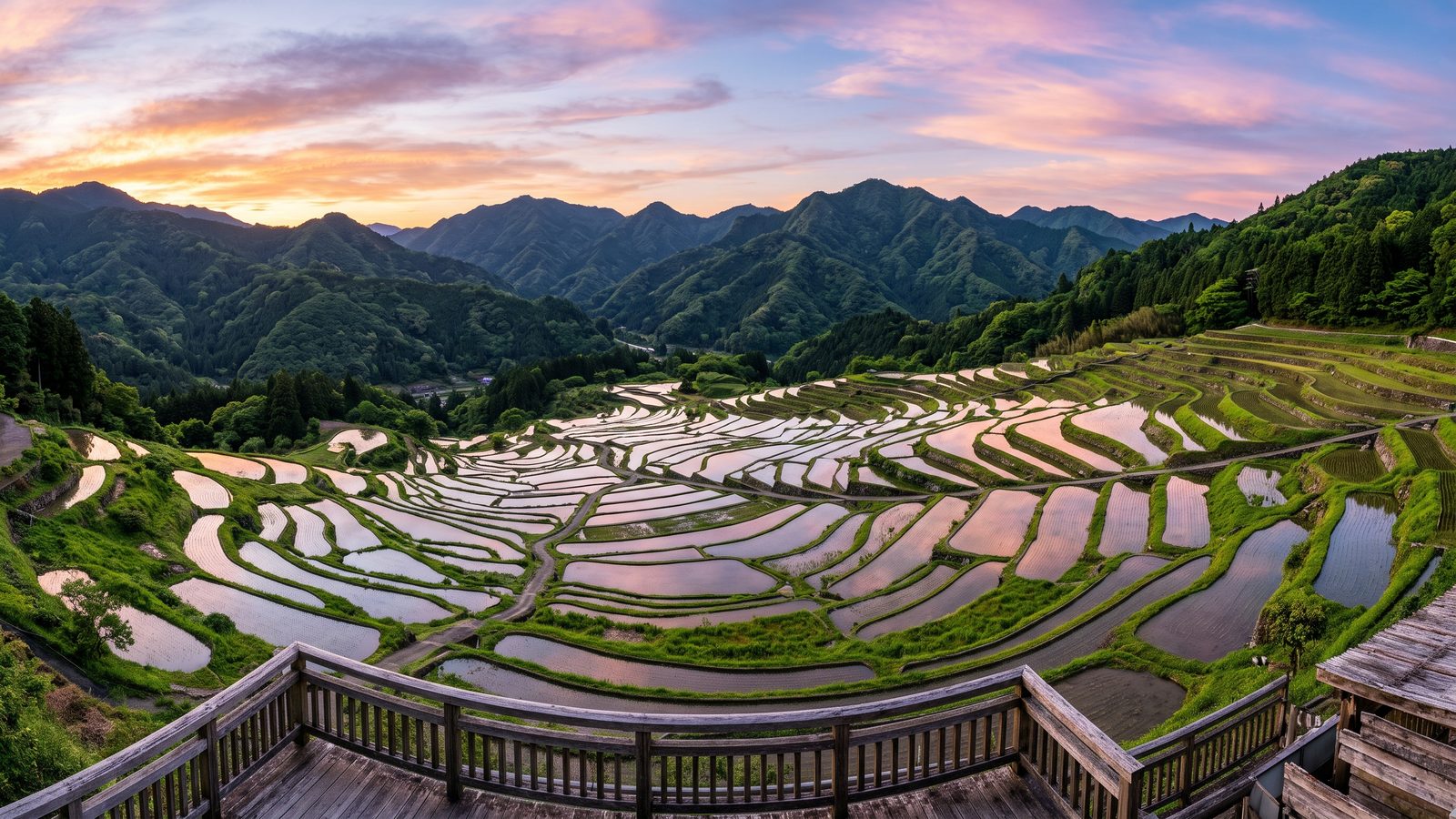
You stand before Maruyama Senmaida, one of Japan's most spectacular agricultural landscapes, hidden away in the mountains of Kumano in Mie Prefecture. Over 1,340 small rice paddies descend like a green staircase down the steep hillside. As you explore this living heritage, your self-guided audio tour reveals the centuries-old farming traditions, pristine mountain ecosystems, and communal spirit that keep these historic terraces thriving today.
Walk ancient footpaths framed by mountain spring water and moss-covered stone statues. Whether watching spring water mirror the morning sky or seeing summer emerald greens sway gently in the breeze, you experience an intimate connection between human craftsmanship and the enduring natural rhythms of rural Japan.
What you'll hear on this tour
Stop 1. A Cascading Mosaic of Mirror Paddies
You gaze across Maruyama Senmaida as over 1,340 individual paddies cascade down the mountain like a sculpted, verdant staircase. In spring, each tiny plot transforms into a shimmering mirror reflecting the sky's soft blues and clouds. Come summer, the entire valley bursts into a brilliant tapestry of emerald green as young rice plants sway gently in the mountain breeze. Light shifts dramatically across these terraced steps during sunrise and sunset, painting the landscape in shades of orange and lavender. You feel the cool mountain air carrying the fresh scent of damp soil as you take in this evolving masterpiece shaped by human hands and nature.
Stop 2. Capturing Golden Rays and Mirror Reflections
You step into a photographer's paradise where early morning light transforms quiet water into a canvas of liquid gold. To capture the famous water reflections, you wait for the stillness of dawn before the wind stirs the paddies. You use a wide-angle lens to trace the curved lines leading down the valley, or switch to a telephoto lens to isolate delicate light patterns on individual rice stalks. During the quiet blue hour before sunrise, you set up your tripod as the water deepens to indigo. A polarizing filter cuts through the glare, revealing vibrant skies mirrored perfectly in the mountain steps beneath you.
Stop 3. Hand-Crafted Farming on Gravity-Fed Steps
You observe an extraordinary farming tradition where modern machinery gives way to pure human dedication. Because these tiny paddies—some no larger than a single tatami mat—sit on steep slopes, tractors cannot reach them. You watch farmers cultivate cold-tolerant rice using simple hand tools like hoes and rakes. Mountain spring water feeds the fields through a remarkable gravity-driven system, channeling clean water step-by-step from top to bottom. In late spring, families gather to plant seedlings by hand, bending together in unison. When autumn arrives, workers harvest the crops manually with sickles, bundling and sun-drying the rice directly on the terrace edges.
Stop 4. Walking Ancient Paths Beside Mossy Guardians
You hike along narrow, winding footpaths that farmers have trodden for centuries. These paths, barely a few feet wide, wind between the terraced fields, giving you changing perspectives as you climb higher into the valley. Beside you, the soothing soundtrack of mountain water trickles constantly down through narrow stone channels. As you climb the steeper inclines, you spot small, moss-covered jizo stone statues watching quietly over the trails and fields. Sweeping vistas stretch out toward distant mountain peaks, rewarding your effort with panoramic views across the shimmering steps of the valley below.
Stop 5. A Pristine Mountain Spring Ecosystem
You look closely at the pure spring water flowing into each paddy from the ancient forests above. This continuous, mineral-rich stream fuels a thriving aquatic ecosystem hidden within the rice fields. Iridescent dragonflies hover over the water while tiny loaches stir the soil below, aerating the earth in a natural tilling process. You listen to the vibrant chorus of tree frogs, whose presence confirms a clean environment free of harmful pesticides. The stepped paddies filter the mountain water naturally as it flows downhill, creating vital habitats for wildflowers, native grasses, and pollinators across the hillside.
Stop 6. Community Bonds and Sacred Harvest Shrines
You feel the deep cultural heartbeat of Maruyama Senmaida, where life revolves around the seasonal rice cycle. Here, villagers practice tasukeai, a tradition of mutual help where neighbors maintain the intricate fields together. Knowledge of water management and soil care passes down naturally from elders to younger generations. Every spring, the ta-ue rice planting becomes a joyous celebration of shared labor. Small Shinto shrines dedicated to Inari Okami, the deity of rice and prosperity, dot the terraces, where locals offer prayers for bountiful harvests. This spiritual connection to the land forms the soul of the local community.
Planning your visit
- Best time to go
- Spring (May) for mirror-like water reflections, summer for vibrant emerald green fields, or early morning at dawn for clear photography.
- Approximate duration
- about 1.5 to 2 hours
- Where to start
- The main observation deck viewpoint overlooking Maruyama Senmaida Rice Terraces.
Access and conditions change seasonally — check the official site before you go.
Frequently asked questions
Is Maruyama Senmaida Rice Terraces worth visiting?
Yes, Maruyama Senmaida is widely considered one of Japan's most scenic terraced rice field landscapes, boasting over 1,340 beautifully maintained paddies carved into the mountainsides of Kumano.
How long do you need at Maruyama Senmaida Rice Terraces?
Most visitors spend between 1 and 2 hours walking the narrow footpaths, admiring the mountain views, taking photos from the observation points, and exploring the agricultural terraces.
What is the history and cultural tradition behind Maruyama Senmaida?
Maruyama Senmaida has been farmed for centuries using traditional hand labor and gravity-fed mountain spring irrigation. The local community preserves the fields through mutual aid (tasukeai) and honors Inari Okami, the Shinto deity of rice.
Keep exploring
Header image is an AI-generated illustration of Maruyama Senmaida Rice Terraces. AllTours.ai is an AI audio tour guide — point your camera at any landmark and hear its story.