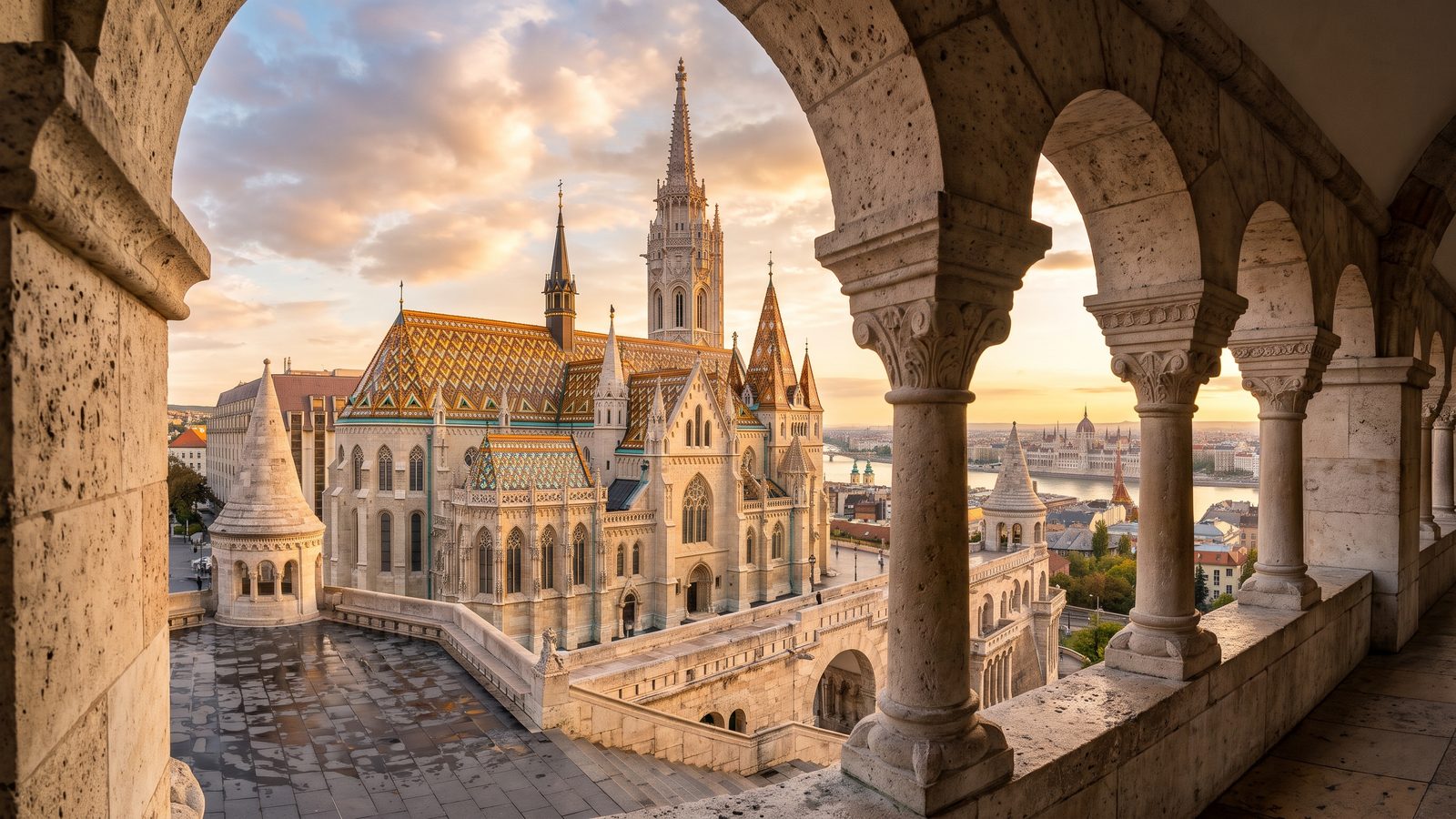
Welcome to Matthias Church, the spectacular Gothic masterpiece standing proudly atop Buda Castle hill. As you step near its intricately patterned roof and soaring spire, you enter a sanctuary that has witnessed the crowning of Hungarian kings, centuries of war, and dramatic transformations. This self-guided audio tour leads you through the church's storied walls, uncovering sacred art, royal legends, and stunning architecture at your own comfortable pace.
Whether you are admiring the vibrant Zsolnay ceramic tiles from Fisherman's Bastion or standing beneath the painted vaults inside, every detail tells a tale of resilience. Let the narrated stories guide your gaze across rich frescoes, royal crypts, and historic towers as you explore this iconic symbol of Hungary.
Listen to a sample
The opening of this tour, exactly as AllTours narrates it on site.
What you'll hear on this tour
Stop 1. Centuries of Conquest and Rebirth
Step onto ground that has echoed with centuries of Hungarian history. Originally founded in the 13th century after the Mongol invasion, this sacred site spent centuries as the Church of Our Lady before King Matthias Corvinus expanded it in the 15th century. You stand where dramatic history unfolded: when Ottoman forces conquered Buda in 1541, they converted this Christian sanctuary into the city's grandest mosque for 145 years, whitewashing frescoes and removing altars. Following the Habsburg reconquest, Baroque updates gave way to a massive late 19th-century Neo-Gothic restoration by architect Frigyes Schulek. As you gaze at the building today, you witness a romanticized medieval past rebuilt from ashes and conquest.
Stop 2. Masterpiece of Gothic Revival Design
Look up at the remarkable vision of architect Frigyes Schulek, who reimagined this landmark during its late 19th-century Gothic Revival. You immediately notice the dramatic Zsolnay porcelain roof tiles, forming a brilliant geometric kaleidoscope of emerald, ruby, and gold across the rooftop. Trace your gaze up the soaring Béla Tower, where delicate stone tracery and pinnacles reach dramatically toward the sky. As you explore the exterior and main façade, admire the grand western rose window that channels natural light into the sanctuary. Inside, intricate vaulted ceilings and painted motifs inspired by medieval Hungarian art create a seamless, harmonious synthesis of High Gothic grandeur and national romanticism.
Stop 3. A Kaleidoscope of Color and Art
As you walk through the interior, vibrant colors immediately surround you. Look up at the extraordinary Secessionist frescoes painted by Károly Lotz and Bertalan Székely, which burst with Hungarian folk motifs and vivid historic scenes. Notice how stained-glass windows cast colorful light across ornate altars and the finely detailed pulpit. In the quiet depths of the church, you discover the royal crypt holding the sarcophagi of King Béla III and Anne of Antioch. You can also view the interior from the Royal Oratory above, gaining a noble vantage point over the sweeping nave, ornate columns, and shimmering decorative details that make this interior unforgettable.
Stop 4. The Stage of Royal Coronations
Step inside and feel the living cultural heart of Hungary surrounding you. Within these historic walls, Hungarian monarchs received their crowns, most famously during the grand coronation of Emperor Franz Joseph I and Empress Elisabeth, fondly known as Sisi. You can see how national identity is woven into every arch, from the folk-art patterns of the Zsolnay roof tiles to the rich artistic details adorning the nave. As you listen to the subtle echoes throughout the hall, remember that this church remains a premier classical music destination, famous for its magnificent acoustics that have carried sacred choral works and grand orchestral masses for generations.
Stop 5. Capturing Light, Roofs, and Details
To capture the most striking photographs of Matthias Church, start outside at Fisherman's Bastion, where you can frame the diamond-patterned Zsolnay roof against the sky, particularly during golden hour when sunlight illuminates the colorful tiles. Inside, focus your lens on the grand rose window above the main entrance, watching how changing daylight filters through intricate stained glass. Keep your camera steady to capture the deep shadows and warm highlights along the vaulted ceiling. Look closely for fine details—the carved pulpit, gilded altars, and subtle column textures—to frame compelling close-ups that highlight the church's extraordinary medieval craftsmanship.
Stop 6. Spiritual Sanctuary Across the Eras
Reflect on the deep spiritual heritage embodied in this historic sanctuary. Originally dedicated to the Virgin Mary, the church served as the spiritual center of Hungarian Catholicism, where divine right met national destiny during solemn royal coronations with the Holy Crown of Hungary. Feel the weight of its complex past as you recall its conversion into an Ottoman mosque, when Christian symbols were hidden away for over a century. Following its joyful reconsecration, the church reclaimed its role as a house of Catholic worship, restored to Gothic glory with roof patterns that subtly symbolize divine harmony and point your thoughts toward heaven.
Planning your visit
- Best time to go
- Early morning or late afternoon during golden hour for optimal lighting on the Zsolnay roof tiles and fewer crowds.
- Approximate duration
- about 1 hour
- Where to start
- In front of the main entrance on Trinity Square (Szentháromság tér), directly facing the church façade.
Access and conditions change seasonally — check the official site before you go.
Frequently asked questions
Is Matthias Church worth visiting?
Yes, Matthias Church is one of Budapest's most iconic landmarks, famous for its colorful Zsolnay tiled roof, royal coronation history, vibrant interior frescoes, and dramatic Gothic architecture overlooking the Danube.
How long do you need at Matthias Church?
Most visitors spend about 45 minutes to 1 hour exploring the church interior, royal crypt, and atmospheric details, with extra time if visiting nearby Fisherman's Bastion.
Why is it called Matthias Church?
Originally dedicated as the Church of Our Lady, it was renamed after Hungary's 15th-century ruler King Matthias Corvinus, who heavily rebuilt the church and added his royal raven emblem to the tower.
Keep exploring
Header image is an AI-generated illustration of Matthias Church. AllTours.ai is an AI audio tour guide — point your camera at any landmark and hear its story.