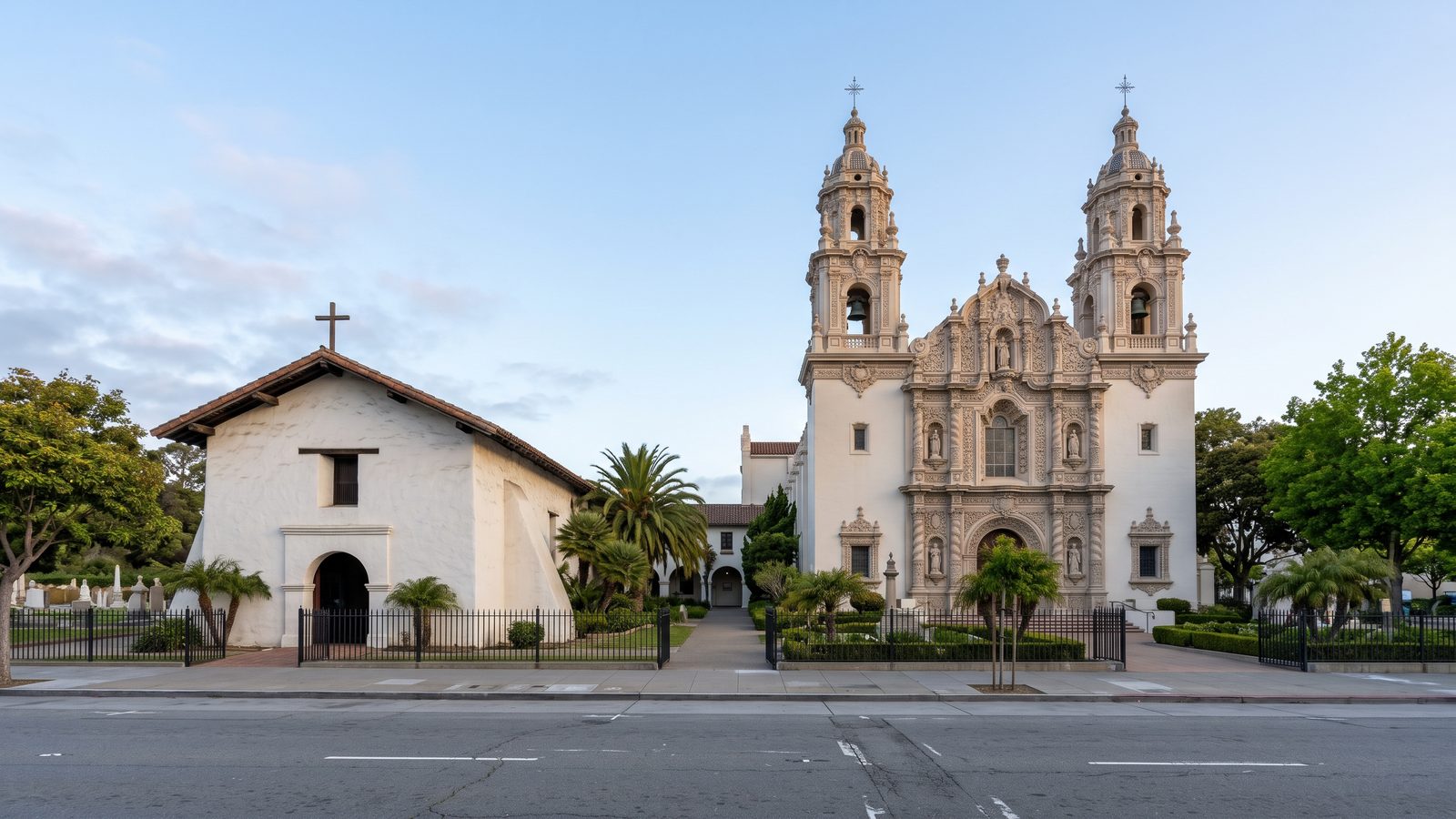
Step into San Francisco's rich origins at Mission Dolores Basilica, officially known as Mission San Francisco de Asís. Founded in 1776, this historic complex stands as the city's oldest surviving structure. Here, humble 18th-century adobe craftsmanship sits side-by-side with grand 20th-century Neoclassical architecture, surviving devastating earthquakes and fires while preserving centuries of native Ohlone and Spanish colonial history.
As you explore the sanctuary, tranquil gardens, and historic cemetery, you will walk through layers of faith, culture, and even Hollywood cinema. Use this audio tour to navigate the quiet interior, admire ancient redwood timbers, and experience a living monument that shaped the modern spirit of San Francisco.
Listen to a sample
The opening of this tour, exactly as AllTours narrates it on site.
What you'll hear on this tour
Stop 1. Inside the 1791 Adobe Sanctuary
You step inside the original Mission Church, San Francisco's oldest intact building, completed in 1791. Feel the immediate drop in temperature as you stand surrounded by four-foot-thick adobe walls, crafted from clay and straw by Ohlone converts and Spanish padres. Look up at the ceiling to admire the vibrant geometric patterns, painted with natural pigments by indigenous artisans. These ancient designs and hand-hewn redwood timber roof supports survived the devastating 1906 earthquake while much of the city burned. As you walk through this cool, quiet space, you experience a rare, physical connection to the earliest days of San Francisco's complex history.
Stop 2. Tale of Two Architectural Eras
Look closely at the striking visual dialogue standing before you. To your left, the original Mission Dolores showcases the functional simplicity of Spanish Colonial design, with its thick mud-brick walls and unadorned facade holding three statue niches. Now, turn your gaze toward the magnificent Basilica next door, completed in 1918. Its soaring twin bell towers, ornate classical columns, and dramatic central dome create a grand Neoclassical counterpoint to the humble mission. Together, these two adjacent buildings showcase over a century of evolving architectural ambition, standing side by side in remarkable harmony against the bright San Francisco sky.
Stop 3. Birthplace of San Francisco
You stand on the birthplace of modern San Francisco. Father Francisco Palóu founded this site on June 29, 1776, just days before the signing of the Declaration of Independence. The survival of this fragile adobe outpost is nothing short of miraculous. While Mexican secularization stripped away mission lands in the 1830s, and the great 1906 earthquake leveled surrounding neighborhoods, these thick clay walls held fast. As you walk around the grounds, consider how Ohlone labor built the city's foundation, creating an enduring symbol of continuity that links early Spanish colonial ambitions directly to the thriving metropolis you see today.
Stop 4. Peaceful Sanctuary in the Mission Garden
Step into the tranquil Mission Garden and feel the immediate shift from city noise to serene quiet. Recreated to reflect early Franciscan life, this cloister garden once provided essential sustenance, medicinal herbs, and vegetables for the community. Notice the ancient, gnarled olive trees around you, direct descendants of those planted over two centuries ago. As you wander past grapevines grown for sacramental wine and vibrant blooming roses, imagine the padres working and praying in these very grounds. This lush, sacred haven offers you a reflective space to contemplate the survival, faith, and daily rhythms of the mission's earliest inhabitants.
Stop 5. Convergence of Ohlone and Spanish Worlds
Here at Mission Dolores, you encounter a complex tapestry woven from two radically different worlds. Long before Franciscan friars arrived, the Ramaytush Ohlone people lived on this land, practicing sacred ceremonies tied to nature. When Spanish missionaries established the site, they introduced European customs, Catholic rituals, and the Spanish language. As you explore, you see how indigenous traditions subtly endured within the imposed colonial structure, creating a unique Californio Catholic culture. Pay attention to the subtle native artistic influences in the architecture, which reveal how the Ohlone people adapted, survived, and fundamentally shaped the cultural identity of early California.
Stop 6. An Unbroken Chain of Devotion
You are walking through a living spiritual epicenter that has maintained an unbroken chain of faith for over 240 years. Imagine early Franciscan friars gathering here for daily Mass, chanting solemn prayers that echoed off adobe walls alongside the quiet whispers of native worshippers. From its 18th-century origins as a remote frontier mission to its present status as a celebrated basilica, this site remains an active place of worship. Today, regular sacraments and services continue inside these hallowed halls, inviting you to reflect on the enduring power of belief that has consecrated this ground through centuries of change.
Planning your visit
- Best time to go
- Morning on weekdays for quiet contemplation and optimal light on the Basilica's facade.
- Approximate duration
- About 45 to 60 minutes
- Where to start
- In front of the original adobe Mission Dolores Church façade.
Access and conditions change seasonally — check the official site before you go.
Frequently asked questions
Is Mission Dolores Basilica worth visiting?
Yes, Mission Dolores Basilica is well worth visiting as San Francisco's oldest surviving structure (founded in 1776). It offers a unique combination of original 18th-century adobe architecture, native Ohlone artwork, a stunning 1918 Neoclassical basilica, historic gardens, and Hollywood history as seen in Hitchcock's Vertigo.
How long do you need at Mission Dolores Basilica?
Most visitors spend between 45 minutes to an hour exploring the original adobe church, the grand basilica next door, the tranquil garden, and the historic cemetery.
What is the history of Mission Dolores Basilica?
Founded on June 29, 1776, by Father Francisco Palóu and built with the labor of the local Ohlone people, Mission Dolores (Mission San Francisco de Asís) is the birthplace of San Francisco. The original adobe sanctuary was completed in 1791 and famously survived the 1906 earthquake and fire, while the larger Neoclassical Basilica was built beside it in 1918.
Keep exploring
Header image is an AI-generated illustration of Mission Dolores Basilica. AllTours.ai is an AI audio tour guide — point your camera at any landmark and hear its story.