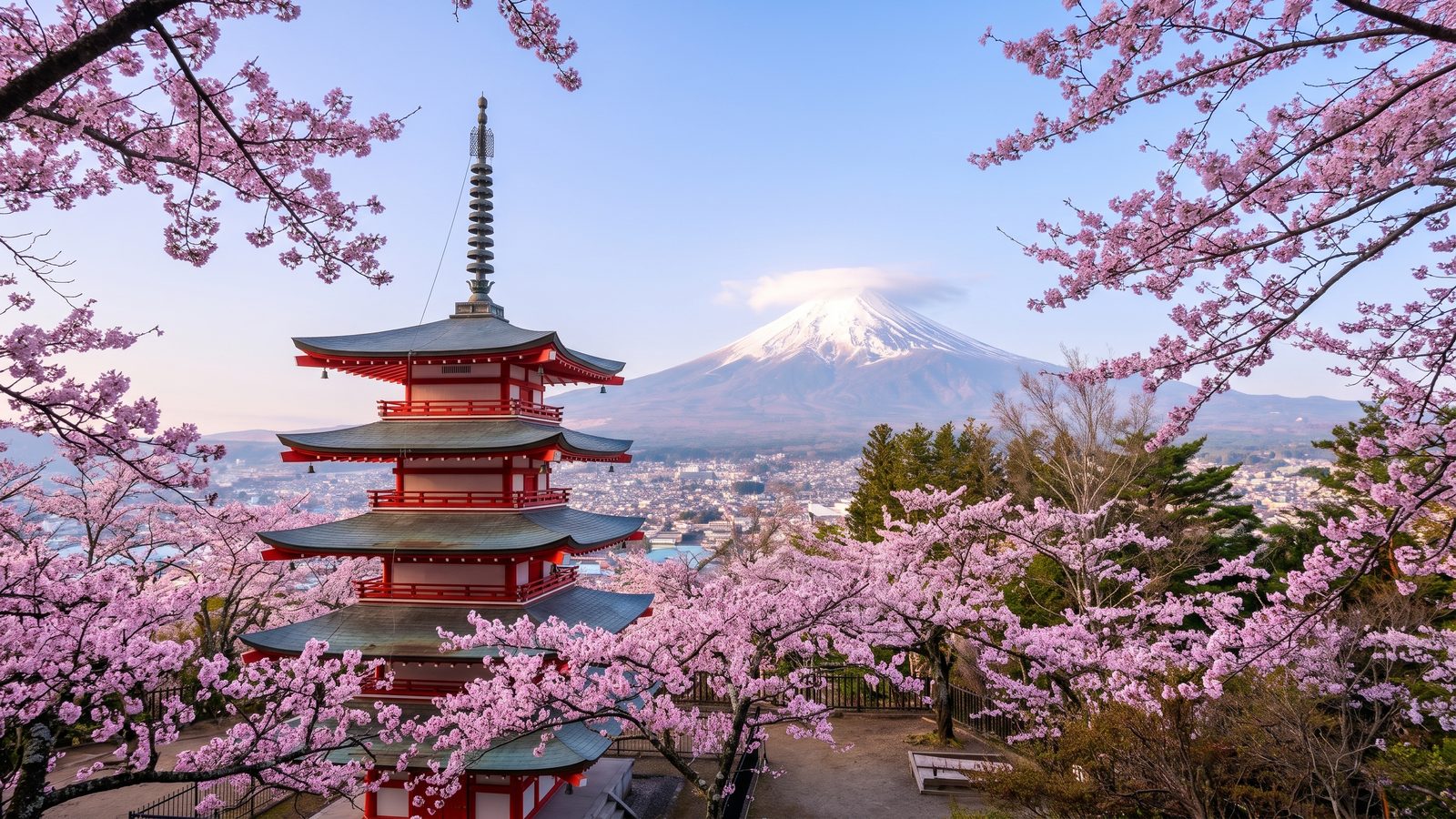
Welcome to Mount Fuji, Japan’s iconic peak rising 3,776 meters above Shizuoka and Yamanashi. This majestic stratovolcano is celebrated not only for its remarkably symmetrical cone, but also for its profound spiritual inheritance and enduring inspiration across Japanese art and poetry. As you explore its sacred slopes, you stand before a sacred landscape that has drawn pilgrims, artists, and nature lovers for centuries across every changing season.
Whether you come during the summer climbing season to witness the glorious sunrise known as Goraiko, or admire its snow-capped silhouette framed by springtime cherry blossoms, Mount Fuji offers a transformative journey. Dive into its deep geological origins, architectural shrine heritage, and timeless cultural legends through this immersive audio experience.
Listen to a sample
The opening of this tour, exactly as AllTours narrates it on site.
What you'll hear on this tour
Stop 1. Volcanic Powers and Alpine Realms
As you gaze upon Mount Fuji, you stand before an active stratovolcano whose powerful breath shapes the surrounding landscape. Below you, the stunning Fuji Five Lakes reflect its perfect silhouette, formed when ancient lava flows dammed river valleys. Snowmelt and subterranean springs filter into these pristine waters. Looking up the slopes, you observe a dramatic environmental shift. Broadleaf forests surrounding the mountain's base transition into subalpine conifers such as Japanese larch and hemlock. Higher still, past the treeline, resilient alpine vegetation clings to volcanic soil despite extreme winds. At the summit sits a massive caldera over 600 meters wide, reminding you of the formidable forces beneath this serene, world-famous silhouette.
Stop 2. Princesses of the Moon and Blossoms
Here on the slopes of Mount Fuji, you walk through landscapes steeped in ancient folklore. Legend tells of Princess Kaguya, the moon child who left behind an elixir of immortality. Heartbroken by her return to the heavens, the Emperor ordered the potion burned atop the mountain closest to heaven—this very peak. People say smoke once billowed from the summit, earning Fuji the name 'Fushi,' or immortality. You also feel the protective spirit of Konohanasakuya-hime, the Shinto goddess of cherry blossoms and volcanoes. She embodies Fuji's striking duality: the fragile beauty of springtime blooms paired with raw volcanic might, guarding the mountain's fiery heart while ensuring its timeless majesty.
Stop 3. The Muse of Japanese Woodblocks
You stand before the timeless muse that inspired master artists like Katsushika Hokusai and Utagawa Hiroshige. Through his famous series Thirty-six Views of Mount Fuji, Hokusai captured the peak’s eternal calm. In The Great Wave off Kanagawa, you see Fuji standing steadfast behind towering, frothing seas, contrasting nature’s violent power with the mountain’s calm presence. In Red Fuji, also known as Fine Wind, Clear Morning, he captures the peak glowing in crimson dawn light, a rare moment seen only under precise atmospheric conditions. These vibrant ukiyo-e woodblock prints immortalized Fuji’s sacred aura around the world, deeply influencing Western Impressionists and transforming this sacred peak into a universal symbol of artistic beauty.
Stop 4. Sacred Pilgrimages of Purification
As you explore Mount Fuji’s lower slopes, you enter a domain revered for centuries as a sacred residence of the gods. Pilgrims known as yamabushi once scaled these volcanic ridges as acts of intense purification and spiritual enlightenment, viewing the arduous ascent as a journey toward celestial realms. Pilgrim masters called oshi guided these faithful travelers, providing spiritual preparation and organizing shelter along the paths. You see the deep devotion reflected in the Sengen shrines built around the base and summit to honor Konohanasakuya-hime. Though historic prohibitions restricted women from climbing until the late nineteenth century, Mount Fuji remains a profound sanctuary where ancient faith intertwines with nature.
Stop 5. Centuries of Eruptions and Ascetics
You are looking at a geological wonder that began taking shape over 100,000 years ago as overlapping volcanoes created New Fuji atop Old Fuji. The mountain’s southeast flank bears the prominent crater of the Hoei eruption of 1707, a cataclysmic event that blanketed Tokyo in ash and reshaped the surrounding terrain. Alongside this fierce geological timeline runs a deep human history. Ascetics from the Shugendo tradition began climbing these volcanic slopes as early as the seventh century, seeking spiritual enlightenment amidst the raw elements. Although sacred restrictions barred women from ascending until 1872 during the Meiji era, Mount Fuji now welcomes everyone to experience its enduring history.
Stop 6. Shrines Built for the Divine Peak
As you examine the structures around Mount Fuji, you discover an architectural tradition crafted specifically for mountain worship. At shrines like Fujisan Hongu Sengen Taisha, you observe the distinctive Sengen-zukuri style, featuring layered roofs, rich vermillion lacquerwork, and intricate wood carvings of mythological creatures. The main hall, or honden, reaches skyward to mirror the sacred peak itself. Surrounding torii gates mark threshold transitions into holy territory, while sturdy mountain huts along pilgrimage routes offer functional protection against the harsh elements. Every beam, roofline, and gate acts as a physical manifestation of faith, creating a harmonious architectural dialogue between human devotion and the grand divine volcano.
Planning your visit
- Best time to go
- Early morning during autumn or winter for clear visibility; July to early September for climbing the summit.
- Approximate duration
- About 3 hours
- Where to start
- Fujinomiya Station or Fujisan Hongu Sengen Taisha Shrine in Fujinomiya, Shizuoka.
Access and conditions change seasonally — check the official site before you go.
Frequently asked questions
Is Mount Fuji worth visiting?
Yes, Mount Fuji is exceptionally worth visiting for its magnificent symmetrical volcano, deep spiritual history, UNESCO World Heritage sites, and breathtaking surrounding lakes and shrines.
How long do you need at Mount Fuji?
A day trip of 3 to 6 hours is ideal for visiting base shrines and scenic viewpoints, while climbing to the summit typically requires 2 days with an overnight mountain hut stay.
What is the history of climbing Mount Fuji?
Climbing began in the 7th century with Shugendo ascetics seeking enlightenment. Pilgrimages grew throughout the Edo period, and historical restrictions against female climbers were officially lifted in 1872.
Keep exploring
Header image is an AI-generated illustration of Mount Fuji. AllTours.ai is an AI audio tour guide — point your camera at any landmark and hear its story.