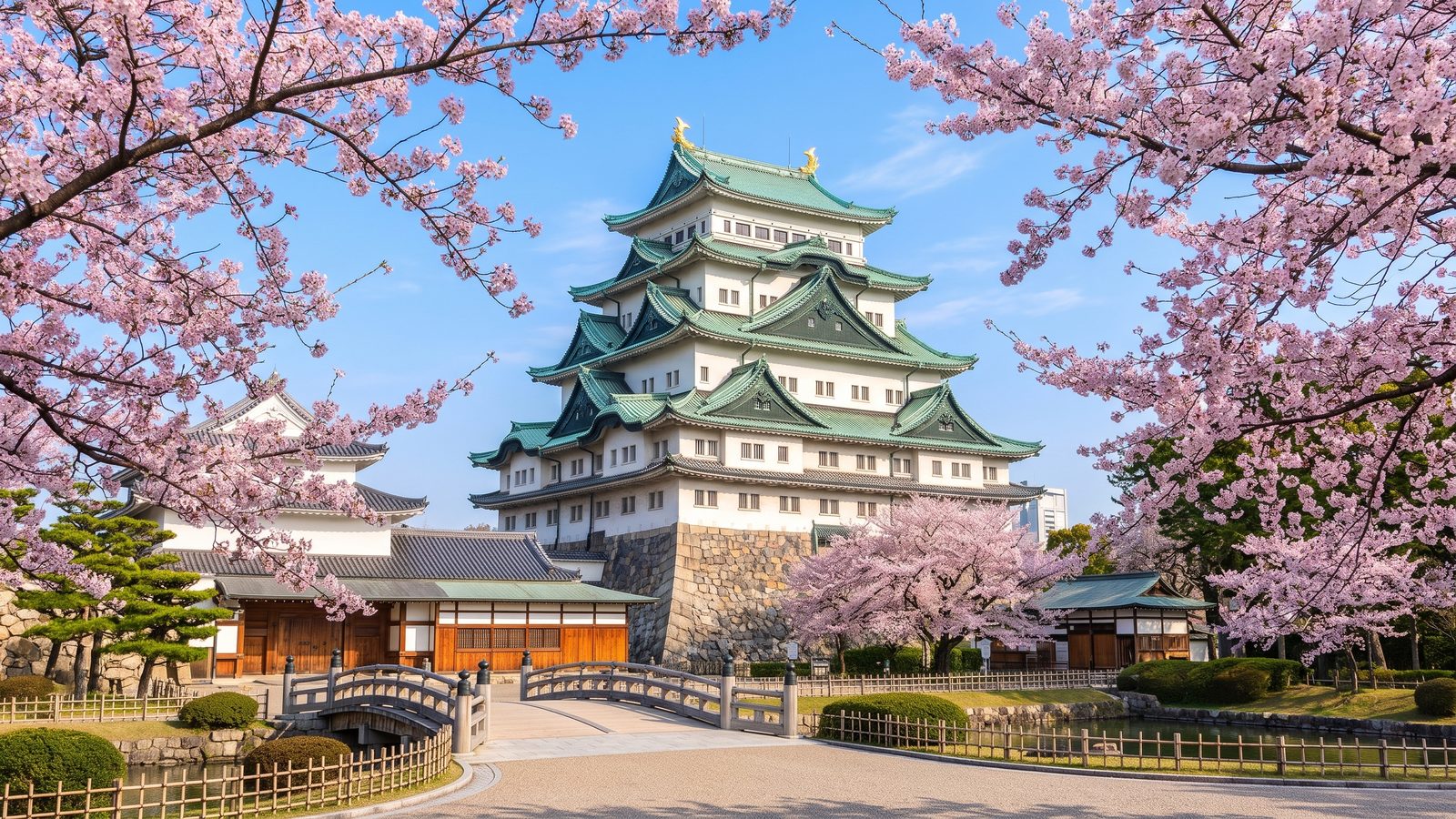
Welcome to Nagoya Castle, an iconic symbol of samurai heritage and Tokugawa power in Aichi Prefecture. Established in 1612 by Shogun Tokugawa Ieyasu, this formidable stronghold commanded the crucial Tokaido trade route for over two centuries. On this Nagoya Castle self-guided tour, you will discover meticulously restored palace chambers, impressive stone fortifications, and golden roof guardians while uncovering the fascinating history of Japan's feudal Edo period.
With your audio guide, explore the magnificent Honmaru Palace and marvel at its golden Kano school paintings and nail-less woodwork. Walk the sprawling castle grounds, take in panoramic city views, and immerse yourself in the art, architecture, and military strategy of the Owari Tokugawa clan.
Listen to a sample
The opening of this tour, exactly as AllTours narrates it on site.
What you'll hear on this tour
Stop 1. Shimmering Gold and Master Kano Artistry
As you step inside the meticulously restored Honmaru Palace, vibrant fusuma-e sliding door paintings immediately capture your attention. Crafted by the renowned Kano school, the official painters for the Tokugawa shogunate, these masterworks shimmer with real gold leaf, kinpaku. The reflective gold amplifies the light within the palace while showcasing supreme opulence. You observe majestic pine trees symbolizing longevity, alongside fierce tigers and leopards that mirror the power of the shogun. Delicate birds grace the Flower and Bird Room, painted alongside subtle Chinese sages. Each pigment, ground from natural minerals, retains its vivid luster, telling silent stories of status, beauty, and artistic patronage.
Stop 2. Masterful Wood Joinery and Golden Shachihoko
You stand before an extraordinary masterpiece of traditional Japanese castle engineering. Look up at the main keep's elegant silhouette, reconstructed using ancient kigumi joinery where hinoki cypress beams interlock perfectly without a single nail. Beneath the keep, observe the massive fan-shaped curve of the earthquake-resistant ishigaki stone walls, meticulously fitted to withstand centuries. At the top of the roof ridgeline, the shimmering golden shachihoko catch your eye. These mythical tiger-fish guardians feature detailed scales and protect the fortress. Inside the Honmaru Palace, you enter the shoin-zukuri architectural style, marveling at intricate ranma transoms and elaborate coffered ceilings that effortlessly blend defensive engineering with aesthetic grandeur.
Stop 3. Ieyasu’s Fortress and the Tenka Bushin
You travel back to 1610, when Tokugawa Ieyasu orders the construction of Nagoya Castle following the Battle of Sekigahara. Built to secure the Owari domain and the vital Tokaido road, the fortress relies on the clever Tenka Bushin system. Under this system, Ieyasu forces recent adversary daimyo to contribute immense labor and resources, draining their wealth while cementing his absolute shogunate authority. By 1612, this mighty stronghold becomes the home of the Owari Tokugawa, one of the elite Gosanke branch families. For over 250 years, it serves as a formidable eastern anchor, until tragic American firebombing destroys the original keep and palace on May 14, 1945.
Stop 4. Samurai Etiquette and Feudal Social Order
As you walk through the Honmaru Palace, you experience how shoin-zukuri architecture functioned as a cultural blueprint for Edo-period samurai etiquette. Notice the intentional progression of rooms, such as the magnificent Ōhiroma or Great Hall. Designed specifically for formal receptions and feudal diplomacy, every space dictates social hierarchy, guest placement, and ritual exchanges. The lord's refined aesthetic shines through ornamental alcoves, known as tokonoma, and staggered chigaidana shelves displaying seasonal flowers and carefully selected scrolls. This sophisticated arrangement continually reminds every visitor of the Owari Tokugawa's immense prestige and their dedication to the strict ceremonial standards that defined the shogunate era.
Stop 5. Strategic Panoramas from the Main Keep
Ascending to the top of the main keep, you gaze out across a commanding panorama that reveals the strategic genius of Tokugawa Ieyasu. Looking eastward, you see modern Nagoya sprawling far into the distance, a metropolis that grew directly around this historic seat of power. Below, the ancient ishigaki stone walls clearly delineate the castle grounds against the urban landscape, framing the serene pond of the Ninomaru Garden. To the south, you view the Kiso River plain, the historical route potential invaders would take. On clear days, distant peaks of the Japanese Alps emerge, completing a breathtaking backdrop that projected absolute authority over the domain.
Stop 6. Peaceful Havens at Tokugawa-en Garden
Stepping beyond the main grounds, you explore Tokugawa-en, a traditional Japanese garden that once graced the residence of the Owari Tokugawa lords. At its heart lies the central Ryūsen-ko pond, designed as a living panorama depicting the vast ocean fed by cascading mountain waterfalls. Vibrant koi swim beneath delicate azaleas and irises, embodying the seasonal shifts celebrated in Japanese aesthetics. Towering camphor trees provide a cool, purifying canopy over ancient pathways, while intricate moss gardens present a tiny universe in miniature. Here, you witness Nagoya’s deep respect for nature and harmonious urban ecology, preserved across centuries of patient artistry.
Planning your visit
- Best time to go
- Morning or early afternoon for quiet walks around the grounds; spring for cherry blossoms or autumn for vibrant foliage.
- Approximate duration
- About 1.5 to 2 hours
- Where to start
- Main Gate (Seimon) or East Gate (Higashimon) of Nagoya Castle.
Access and conditions change seasonally — check the official site before you go.
Frequently asked questions
Is Nagoya Castle worth visiting?
Yes, Nagoya Castle is well worth visiting for anyone interested in Japanese history, samurai culture, and traditional architecture. Its main highlights include the exquisitely restored Honmaru Palace with gold-leaf paintings, impressive stone walls, and the iconic Golden Shachihoko atop its roof.
How long do you need at Nagoya Castle?
Most visitors spend between 1.5 and 2.5 hours exploring Nagoya Castle. This allows ample time to tour the restored Honmaru Palace, walk around the inner courtyards and stone walls, and stroll through the surrounding gardens.
Who built Nagoya Castle and why?
Nagoya Castle was commissioned by Shogun Tokugawa Ieyasu in 1610 and completed in 1612. It was constructed as a strategic fortress to secure the Owari domain, protect the Tokaido road, and serve as the seat for the Owari branch of the Tokugawa family.
Keep exploring
Header image is an AI-generated illustration of Nagoya Castle. AllTours.ai is an AI audio tour guide — point your camera at any landmark and hear its story.