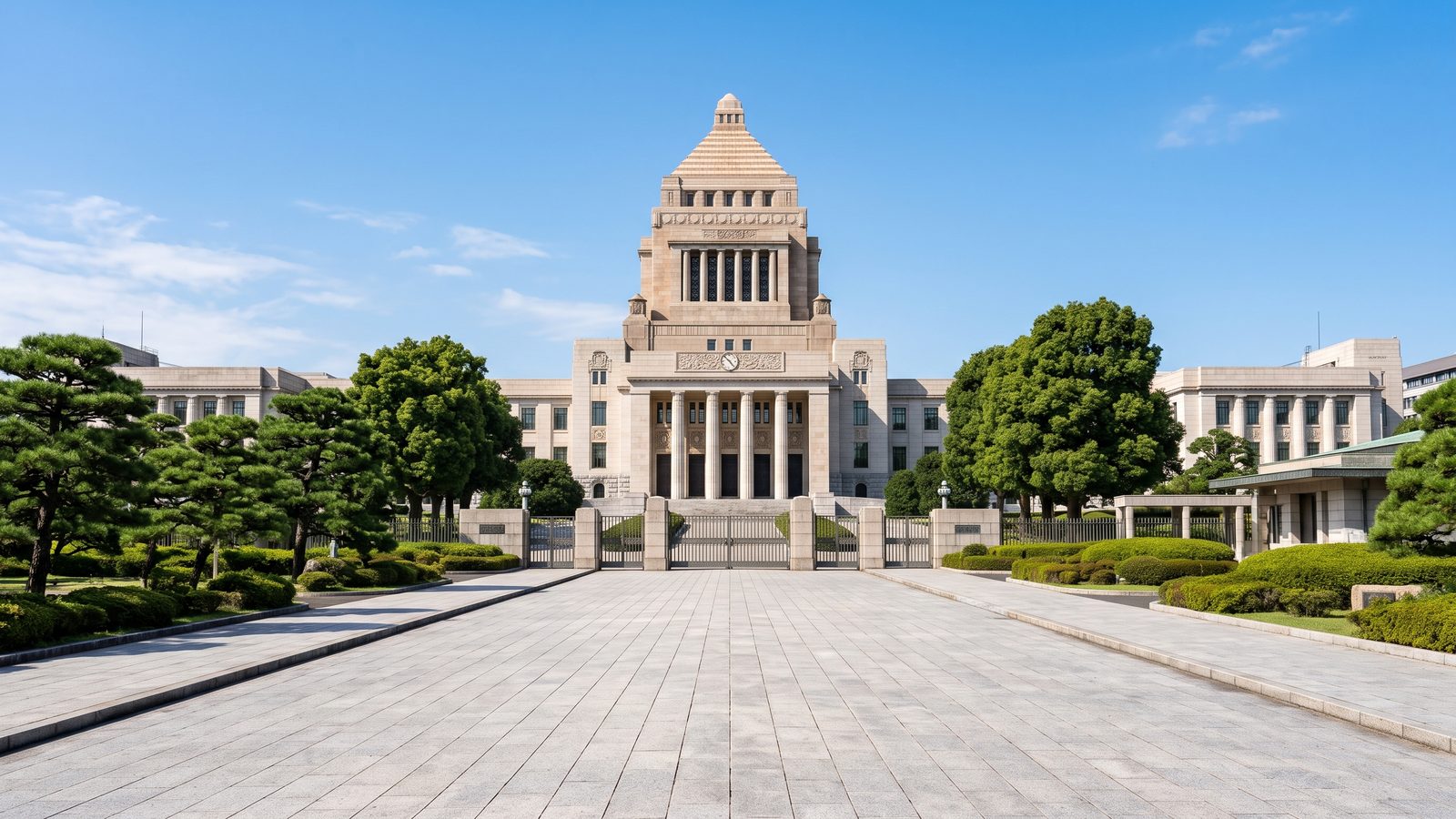
Welcome to the National Diet Building, the beating heart of Japanese democracy in Tokyo. Completed in 1936 after a monumental 17-year construction project, this massive granite landmark stands as a powerful symbol of the nation's journey into modern parliamentary governance. As you gaze upon its iconic 65-meter central tower, you are standing before the very place where Japan's national destiny, laws, and leadership are passionately debated and decided every day.
This self-guided audio tour walks you through the building's striking neo-Renaissance architecture, dramatic political history, and modern legislative importance. Discover how millions of domestic granite stones and symbolic design elements blend Western influences with distinct Japanese precision to create one of Tokyo’s most dignified imperial landmarks.
Listen to a sample
The opening of this tour, exactly as AllTours narrates it on site.
What you'll hear on this tour
Stop 1. Granite Walls and Pyramidal Towers
As you stand before this imposing structure, you observe a unique architectural synthesis. Rising high above the symmetrical wings is the distinctive 65-meter central tower, topped with a striking stepped pyramid. Unlike traditional European domes, this pyramid deliberately symbolizes national unity. Notice the meticulous granite masonry blanketing the exterior; builders consciously sourced these stones from Hiroshima and Okayama to highlight domestic craftsmanship and natural materials. Framing the tower are two neo-Renaissance wings that house the nation's legislative chambers. Together, these elements form a monumental design that feels deeply Japanese while drawing upon timeless classic styles.
Stop 2. The Symbolic Empty Tower
Look closely at the towering central pyramid soaring above the flanking legislative chambers. As you admire its dominant silhouette against the Tokyo sky, legend whispers an intriguing secret about its interior: the grand space beneath the pyramid was left intentionally empty, symbolically awaiting a future great leader. You see the sheer scale of the building, constructed over seventeen arduous years using more than two point five million granite stones gathered from prefectures across Japan. Every block represents a piece of the nation bound together, standing as an enduring physical testament to national unity, resilience, and monumental collective ambition.
Stop 3. Resilience Through Turbulent Decades
Step back in time as you reflect on the dramatic history etched into these granite walls. Construction began in 1920 after a disastrous fire destroyed the previous temporary parliament building, driving the nation to construct a permanent, fireproof home for democracy. Over seventeen years, thousands of workers labored to realize this grand vision. You stand where history unfolded, as this structure weathered the turbulent pre-war years, witnessed the dark rise of militarism, and remarkably survived the heavy destruction of World War II. Today, it stands as a resilient beacon of governance, embodying Japan's transformation into a modern parliamentary democracy.
Stop 4. Inside the Bicameral Chambers
Here at the center of Japanese power, you feel the weight of modern statecraft. Inside these historic walls, the bicameral National Diet works continuously to shape the nation's future. The House of Representatives occupies one side of the grand complex, while the House of Councillors occupies the other. As you explore, imagine the intense legislative debates taking place within the chambers where lawmakers enact national statutes, allocate budgets, and ratify critical foreign treaties. It is within this very building that representatives elect the Prime Minister, exercising the supreme authority of Japan's vibrant parliamentary system.
Stop 5. The Legislative Balance of Power
As you ponder the political life of Japan, you observe the delicate constitutional balance played out within these wings. The House of Representatives holds ultimate legislative superiority, retaining the primary power to initiate national bills, pass budgets, and designate the Prime Minister. Meanwhile, the House of Councillors acts as a vital deliberative body, offering critical oversight and thorough legislative checks. You sense the dynamic interplay of political parties and lawmakers engaged in rigorous, contentious debates. Every policy crafted here directly influences the daily lives of millions of citizens across the entire Japanese archipelago.
Stop 6. Civic Voices and Democratic Spirit
Beyond the formal halls of power, you witness how this monumental site bridges state authority with active civic culture. The grounds around the Diet Building serve as a vibrant public square where Japanese democracy comes alive. Citizens frequently gather along these avenues to express their collective voice through organized rallies, peaceful demonstrations, and direct petitions. You feel the pulse of a society where solemn institutional traditions exist alongside passionate public participation. This ongoing dialogue between elected officials and the public underscores a deeply rooted democratic spirit that continues to define contemporary Japanese political life.
Planning your visit
- Best time to go
- Morning on weekdays for fewer crowds around Nagatacho, or early evening to see the illuminated granite facade.
- Approximate duration
- about 1 hour
- Where to start
- Outside the main front gate facing the central tower on the Nagatacho side.
Access and conditions change seasonally — check the official site before you go.
Frequently asked questions
Is National Diet Building worth visiting?
Yes, the National Diet Building is well worth visiting for anyone interested in architecture, history, or politics. Its imposing 65-meter pyramid tower, domestic granite exterior, and historical role as the heart of Japanese democracy make it one of Tokyo's most impressive civic landmarks.
How long do you need at National Diet Building?
You generally need about 45 minutes to 1 hour to appreciate the building's monumental exterior architecture, explore the surrounding grounds, and complete this self-guided audio tour.
When was the National Diet Building constructed?
Construction on the National Diet Building began in 1920 after a fire destroyed the former temporary Diet building. It took 17 years to complete and officially opened in 1936.
Keep exploring
Header image is an AI-generated illustration of National Diet Building. AllTours.ai is an AI audio tour guide — point your camera at any landmark and hear its story.