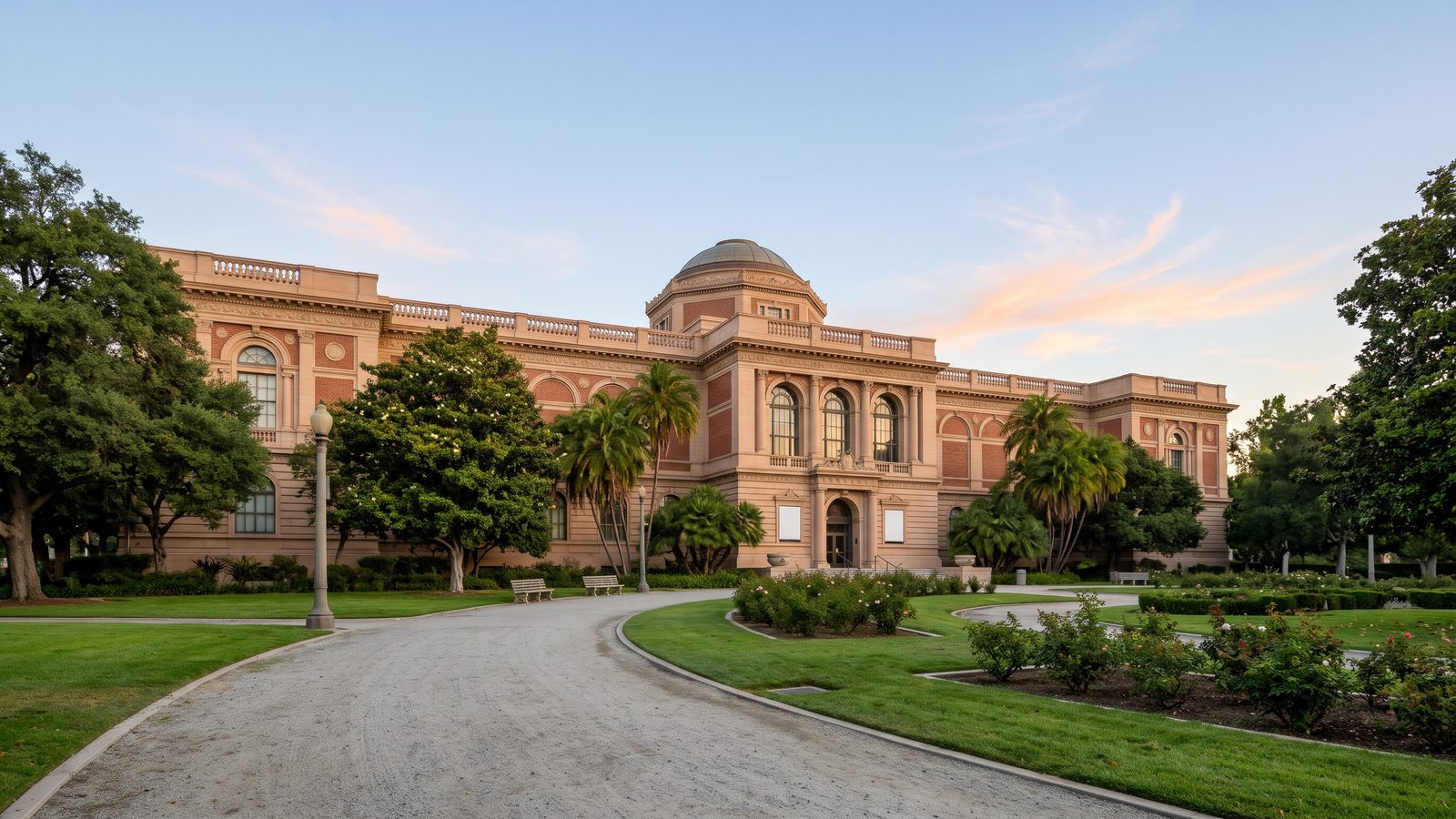
Step into a world of wonder at the Natural History Museum of Los Angeles County, founded in 1913. Located in Exposition Park, this iconic institution offers a journey through millions of years of Earth's history. From glittering gems to towering dinosaur skeletons like the Columbian mammoth and T. rex, you will explore vast collections that uncover our planet's rich past and human cultural heritage across the globe.
This self-guided audio tour walks you through grand halls of science, evolution, and human story. As you explore at your own pace, you will hear stories of daring expeditions, remarkable fossil finds, and intricate ancestral crafts that define our shared natural world.
Listen to a sample
The opening of this tour, exactly as AllTours narrates it on site.
What you'll hear on this tour
Stop 1. Titans of the Dinosaur Hall
Step into the Dinosaur Hall and stand face-to-face with titans of the prehistoric world. Before you towers the skeleton of Tyrannosaurus rex, an apex predator reconstructed to reveal its massive power. Take a close look at the serrated edges of its teeth, designed like deadly blades to shear through bone. Across the gallery, observe the long-necked Seismosaurus, one of the largest dinosaurs ever discovered. As you gaze up at its colossal frame, imagine the earth trembling beneath its weight during the Mesozoic Era. Each fossilized bone here captures a moment from ancient ecosystems, illustrating the incredible scale and diversity of life millions of years ago.
Stop 2. Imprints of Prehistoric Life
Examine these preserved remains to uncover the story of life's distant past. Here, you encounter the monumental Tyrannosaurus rex alongside delicate imprints of ancient nature, such as fossilized fern fronds that once carpeted prehistoric landscapes. Pay special attention to the remarkably preserved skull of a saber-toothed cat, featuring massive, curved canines that highlight the fierce predatory adaptations required for survival. Each specimen and fossil cast serves as a physical witness to ancient ecosystems, reflecting the relentless cycle of adaptation, extinction, and evolutionary change that has continuously reshaped our planet over millions of years.
Stop 3. Echoes of Human Craftsmanship
Walk through halls highlighting human ingenuity across millennia and continents. Look closely at the intricate Chumash basketry, where generations of ecological knowledge are woven directly into functional art. Nearby, examine Mesoamerican jade carvings that communicate deep spiritual beliefs and symbolic power. You can also observe delicate beadwork created by Plains tribes, where specific colors and patterns form a visual language used for centuries to convey identity and status. These cultural artifacts go far beyond aesthetics; they invite you to explore deep narratives of community, spirituality, and artistic legacy, illustrating how diverse societies have understood their worlds and expressed their traditions.
Stop 4. The Journey of Natural Selection
Observe the tangible evidence of life's long journey through natural selection. In this exhibit, you can trace subtle variations in finch beaks, demonstrating how species adapt to distinct island food sources—a vivid illustration of Darwinian principles. Follow the evolutionary shift as early amphibians transitioned from aquatic life onto land, giving rise to diverse reptile lineages. Nearby, admire the delicate, spiraling geometry of a fossilized ammonite shell. These marine mollusks thrived across millions of years through successful evolutionary design before being wiped out by a mass extinction event, revealing both the brilliance and vulnerability of life on Earth.
Stop 5. Daring Journeys of Discovery
Consider the intrepid naturalists and researchers whose daring journeys made these displays possible. The specimens around you were gathered by scientists who ventured into remote environments, from scorching deserts to freezing tundras. Transporting massive, fragile fossilized remains back to the lab required years of meticulous planning, logistical grit, and endurance against harsh elements. These expeditions were far more than simple collecting trips; they were dedicated scientific missions to piece together Earth's history. As you admire these ancient giants, remember the determination of early naturalists whose passion for exploration unburied these hidden treasures for us to see today.
Stop 6. Uncovering Earth's Hidden Mysteries
Reflect on the thrill of scientific discovery that drives every display in this museum. Imagine paleontologists carefully brushing away layers of dirt to reveal ancient fossils, or geologists reading rock layers to reconstruct the Earth's history. Every fossil fragment and towering skeleton represents a breakthrough moment when dedicated research solved another piece of our planet's puzzle. You are experiencing the result of uncounted hours of field research, intellectual breakthroughs, and curiosity. This museum celebrates humanity's relentless quest to understand the natural world, transforming forgotten sediment into profound insights about our shared past.
Planning your visit
- Best time to go
- Weekday mornings offer the quietest experience to view the exhibits without crowds.
- Approximate duration
- about 2 hours
- Where to start
- Begin your visit at the Grand Foyer inside the historic 1913 building entrance.
Access and conditions change seasonally — check the official site before you go.
Frequently asked questions
Is Natural History Museum of Los Angeles County worth visiting?
Yes, the museum is world-renowned for its impressive Dinosaur Hall, extensive fossil collection, cultural artifacts, and historic 1913 architecture, making it a top destination for visitors of all ages.
How long do you need at Natural History Museum of Los Angeles County?
Most visitors spend between 2 and 3 hours exploring the main galleries, including the Dinosaur Hall, fossil exhibits, and cultural collections.
When was the Natural History Museum of Los Angeles County founded?
The museum was founded in 1913 in Exposition Park, opening as a museum dedicated to history, science, and art before developing into the region's primary natural history institution.
Keep exploring
Header image is an AI-generated illustration of Natural History Museum of Los Angeles County. AllTours.ai is an AI audio tour guide — point your camera at any landmark and hear its story.