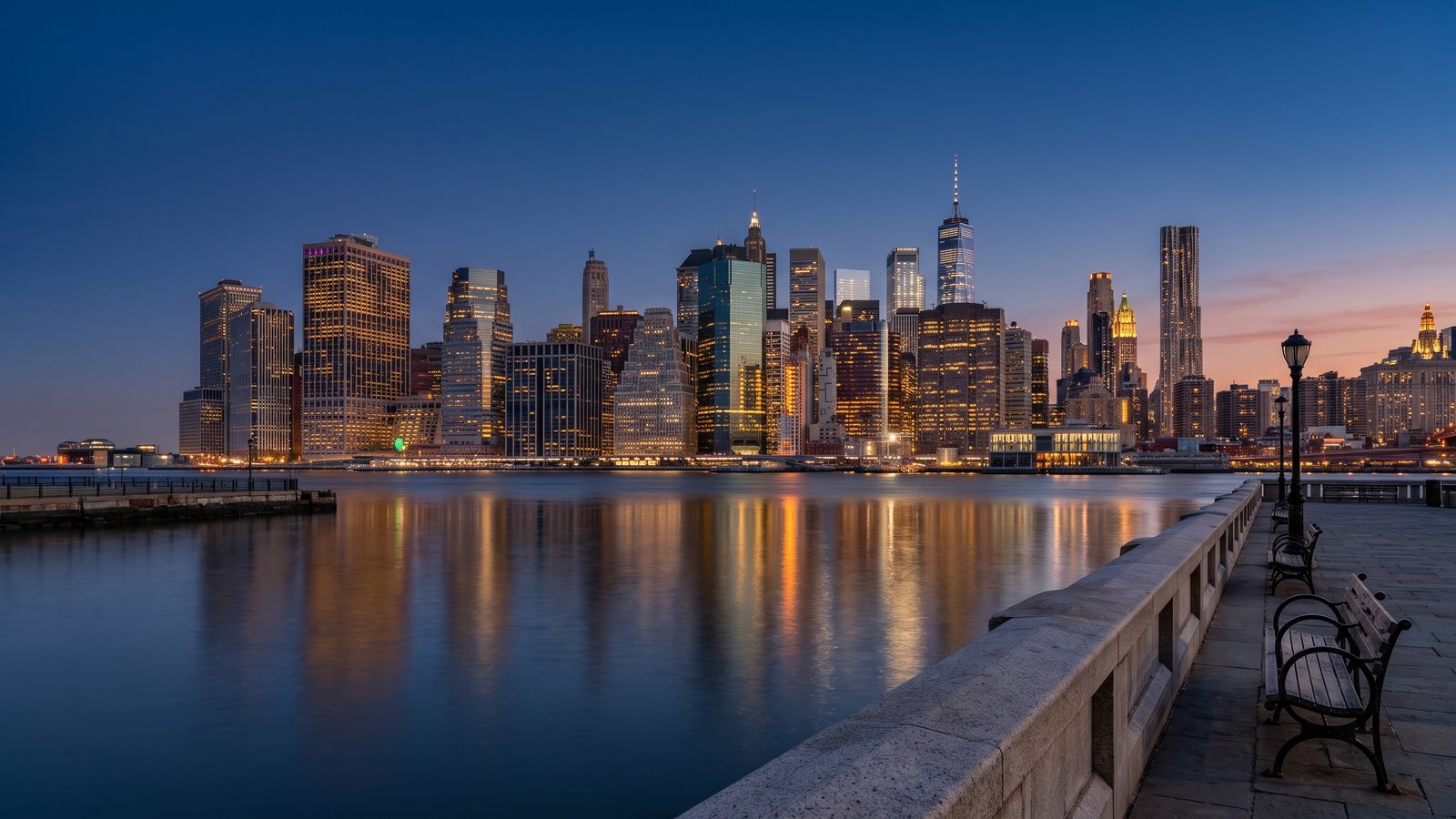
You step into the heart of New York City, where vertical architecture meets centuries of relentless ambition. From the ancestral homeland of the Lenape to the soaring Art Deco spires of Midtown, every block tells a story of constant reinvention. Put on your headphones and explore the legendary streets, roaring traffic, historic neighborhoods, and dazzling neon corridors that make this sprawling island metropolis a global icon of culture and human potential.
Experience Manhattan at your own pace as you navigate historic harbor roots, monumental Beaux-Arts landmarks, and world-famous nocturnal hotspots. This self-guided journey brings the city's living history to life, revealing how innovative engineering, bold design, and unstoppable human spirit created the modern center of the world.
What you'll hear on this tour
Stop 1. Spires of Skyward Ambition
You cast your gaze across this magnificent panorama, grasping the audacious spirit embodied in the skyline. This vertical history book features classic 1930s Art Deco spires like the Empire State and Chrysler Buildings, whose distinctive setbacks reach toward the sky in a bold reach against adversity. As your eyes sweep past sleek post-war glass and steel modernism, you notice modern supertalls like One World Trade Center shifting the city's visual balance. Each tower declares economic power and relentless innovation, creating a dynamic architectural dialogue between eras that continually reinvents itself with every passing sunrise and sunset.
Stop 2. From Lenapehoking to Empire City
Before skyscrapers pierce the clouds, you stand on Lenapehoking, the ancestral homeland where the Lenape people thrive for millennia along intricate island trails. In 1609, Henry Hudson charts these waters, leading Dutch settlers to establish New Amsterdam in 1624. You walk the land famously purchased by Peter Minuit for 60 guilders, a transaction that alters the continent's trajectory forever. After the British seize control in 1664 and rename it New York, the port becomes a hotbed of revolutionary fervor. You imagine the occupied city during the Revolutionary War, serving as a strategic prize that cements its enduring identity as a crucible of American ambition.
Stop 3. Cathedrals of Commerce and Culture
You look beyond vertical height to discover intricate architectural craft. At Beaux-Arts landmarks like the New York Public Library, colossal columns and allegorical sculptures convey civic pride through classical Roman and Greek traditions. Turning toward early skyscraper design, you admire the Woolworth Building, where architect Cass Gilbert wraps a steel skeleton in Gothic Revival terra cotta adorned with gargoyles and finials. Long before Art Deco arrives, this celebrated 'Cathedral of Commerce' showcases hidden engineering marvels beneath ornate facades. You experience how stone, steel, and terra cotta reflect each era's identity, from Gilded Age civic ambitions to twentieth-century commercial dominance.
Stop 4. Pulsating Beats and Secret Cellars
As dusk falls, you feel the city’s pulse quicken into a nocturnal playground shaped by continuous cultural reinvention. You trace Prohibition history through secret speakeasies before visiting Harlem's legendary jazz venues like the Cotton Club, where Duke Ellington redefines American music. You imagine the sparkling excess of disco at Studio 54 alongside the gritty downtown energy of CBGB, where punk rock emerges to influence global pop culture. Today, you explore intimate Greenwich Village jazz cellars, spectacular Broadway theaters, and energetic Brooklyn dance floors. From rooftop lounges overlooking skyline views to underground clubs, you immerse yourself in the endless after-dark magic of a city that never sleeps.
Stop 5. The Electric Glow of Broadway
You witness a city defined by millions of lumens, tracing a lineage from early gas lamps on Broadway to cutting-edge display technology. In Times Square, you look up at pulsating billboards that serve as meticulously engineered spectacles pushing the boundaries of visual art. You watch the Empire State Building's spire transform nightly into a dynamic canvas, illuminating the dark with precise colored shows honoring holidays, triumphs, and causes. From subtle bridge lighting to brilliant theater marquees, you stand in a competitive landscape where designers battle night with light, bathing the metropolis in a perpetual electric glow that promises endless urban possibilities.
Stop 6. The Rhythmic Symphony of Streets
You observe the relentless movement of Manhattan’s streets, a dynamic ecosystem dictated by island geography. Bridges and tunnels act as critical arteries, throttling the continuous flow of vehicles through narrow gridlines designed long before automobiles arrived. Yellow cabs weave through lanes while essential delivery trucks navigate tightly packed intersections to supply the city. As you listen, you hear the unmistakable New York symphony of car horns—a complex dialect of urgency and negotiation mastered by local drivers. This perpetual kinetic energy, continuing late into the night, reveals a living organism in constant motion, adapting relentlessly to sustain the metropolis's indomitable spirit.
Planning your visit
- Best time to go
- Spring (April–June) or autumn (September–November) offer ideal walking weather; evening hours are best for experiencing illuminated landmarks.
- Approximate duration
- About 2 to 3 hours
- Where to start
- Lower Manhattan near Battery Park or Midtown near Times Square.
Access and conditions change seasonally — check the official site before you go.
Frequently asked questions
Is New York City worth visiting?
Yes, New York City offers a world-class mix of landmark architecture, rich history, renowned nightlife, and iconic urban landscapes that make it an unmatched global destination.
How long do you need at New York City?
A stay of 3 to 5 days allows you to cover major highlights like Midtown, Lower Manhattan, Central Park, and top neighborhoods comfortably on foot or by public transit.
What is the early history of New York City?
Originally Lenapehoking, the homeland of the Lenape people, European settlement began when the Dutch established New Amsterdam in 1624, which was later seized by the British in 1664 and renamed New York.
Keep exploring
Header image is an AI-generated illustration of New York City. AllTours.ai is an AI audio tour guide — point your camera at any landmark and hear its story.