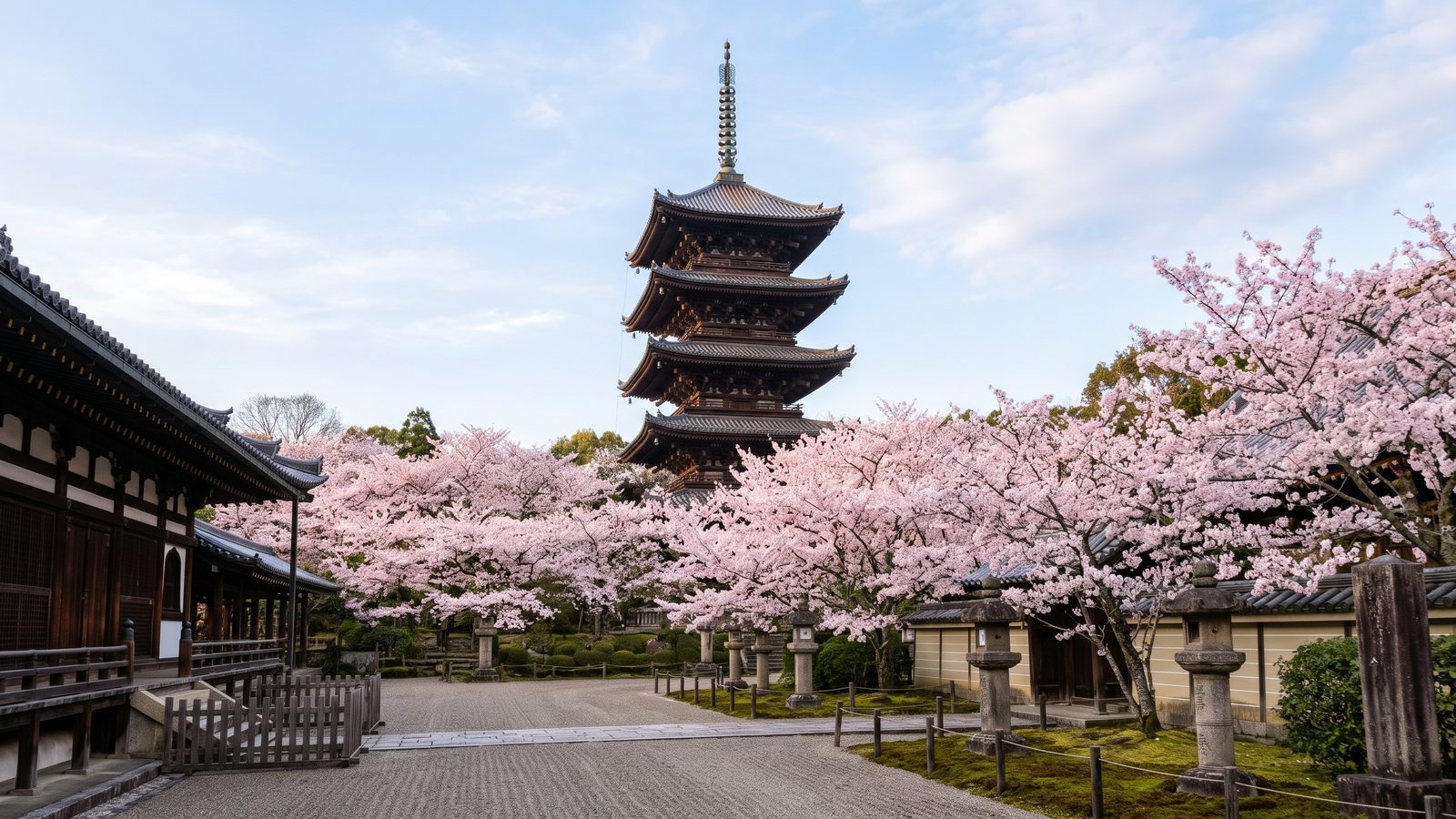
Step into Ninna-ji Temple, a majestic UNESCO World Heritage site in western Kyoto defined by its rich imperial lineage. Founded in 888 AD by Emperor Uda, this tranquil sanctuary became Kyoto’s first monzeki temple, where royal princes served as head priests for generations. As you explore its sweeping grounds, grand gates, and historic halls, you encounter an extraordinary fusion of sacred Shingon Buddhist tradition and aristocratic palace elegance.
With this self-guided audio tour, you walk through centuries of Japanese cultural history. From the National Treasure Golden Hall relocated directly from the Imperial Palace to the legendary late-blooming Omurozakura cherry blossoms, every step reveals architectural grandeur, peaceful stroll gardens, and enduring spiritual devotion.
Listen to a sample
The opening of this tour, exactly as AllTours narrates it on site.
What you'll hear on this tour
Stop 1. Wandering Through the Legendary Omurozakura Blossoms
You wander into the vibrant soul of Ninna-ji, surrounded by the famous Omurozakura cherry trees. Unlike typical tall cherry trees, these unique dwarf varieties grow surprisingly low to the ground, rarely exceeding head height. You walk directly through an intimate canopy of dense pink and white blossoms that bloom naturally a week later than the rest of Kyoto. Legend says these humble trees kept their low height out of deep respect for the common people who tended them. Leaving the orchard, you enter the Goten precinct, where a classic Edo-period stroll garden surrounds the tranquil Hyōtan-ike pond, offering meticulously placed pines, artistic stones, and serene reflecting waters.
Stop 2. The Golden Hall of Imperial Ceremonies
You stand before the Kondo, or Golden Hall, the sacred core of Ninna-ji and an officially designated National Treasure. As you admire its impressive timber facade, you are gazing upon genuine imperial heritage; this building originally served as the Shishinden, the primary state ceremony hall inside Kyoto’s Imperial Palace. Painstakingly dismantled and reconstructed here during the early Edo period, its grand scale reflects solemn royal authority. You look inside to discover the revered statue of Amida Nyorai flanked by the Four Heavenly Kings. Here, secular royal magnificence seamlessly blends with quiet spiritual power, surrounding you with centuries of imperial legacy.
Stop 3. Palace Design and the Five-Story Pagoda
You observe a masterclass in classical Japanese architecture as you explore the Omuro-gosho. Its elevated wooden walkways, cypress bark roofing, and fluid open layouts showcase the aristocratic shinden-zukuri style of the Heian court. Nearby, your gaze turns toward the soaring five-story pagoda, Goju-no-to. Notice how each roof tier decreases slightly in size as it ascends, creating a striking sense of vertical rhythm. Beneath the heavy eaves, intricate interlocking wooden bracketing called kumimono supports the structure without nails, granting the tall pagoda crucial flexibility during seismic activity. Every timber joint and ceramic roof tile highlights extraordinary craftsmanship spanning generations of master builders.
Stop 4. Esoteric Shingon Rites and Mini Pilgrimage
You enter the spiritual realm of the Omuro School of Shingon Buddhism, an esoteric tradition steeped in ritual and deep cosmic symbolism. Imperial princes once served as head priests here, lending supreme religious authority to these sacred grounds. As you walk the quiet paths, you follow the footsteps of pilgrims along the Omuro Hachijuhachi-sho, a miniature version of the famous 88-temple Shikoku pilgrimage route packed entirely within the temple grounds. Walking this scenic path allows you to symbolically gather spiritual merit from dozens of sacred sites. Inside the halls, sacred mandalas and the soothing presence of Amida Nyorai invite you into quiet, transformative meditation.
Stop 5. Aristocratic Arts and the Omuro Ikebana School
You step into the cultural heartland where the Omuro Ninnaji School of Ikebana was born. Inspired by the low-growing, delicate Omuro cherry trees, this refined flower-arranging tradition teaches harmony and the fleeting beauty of nature. As a monzeki temple ruled by royal abbots, Ninna-ji flourished for centuries as a center of courtly refinement. You walk where imperial prince-monks once composed delicate waka poetry, practiced master brushwork in calligraphy, and performed peaceful tea ceremonies. This aristocratic influence lives on today across delicate painted screen doors, exquisite lacquerware art, and the subtle, understated elegance that permeates every corner of these historic temple halls.
Stop 6. A Millennium of Devotion and Resilience
You trace a thousand years of royal devotion starting in 888 AD, when Emperor Uda founded Ninna-ji and retired here as its very first head priest. His decision established a long-standing royal tradition of imperial princes presiding over the temple. Although the catastrophic Onin War of the 15th century burned nearly the entire complex to ashes, Ninna-ji rose again during the early 17th century under Tokugawa shogunate patronage. Master artisans rebuilt its historic halls and relocated priceless original structures directly from the Imperial Palace. You stand in a resilient sanctuary that survived war and time to preserve priceless imperial legacy for modern visitors.
Planning your visit
- Best time to go
- Spring (mid-to-late April) for the late-blooming Omurozakura cherry blossoms, or early morning year-round for peaceful garden walks.
- Approximate duration
- about 1.5 to 2 hours
- Where to start
- Nio-mon Gate (the main outer entrance gate)
Access and conditions change seasonally — check the official site before you go.
Frequently asked questions
Is Ninna-ji worth visiting?
Yes, Ninna-ji is a UNESCO World Heritage site celebrated for its deep imperial history, National Treasure Golden Hall, five-story pagoda, beautiful stroll gardens, and the famous late-blooming Omurozakura cherry trees.
How long do you need at Ninna-ji?
Most visitors spend between 1 and 2 hours exploring the expansive grounds, including the Goten palace residence, gardens, Kondo Main Hall, and five-story pagoda.
Why is Ninna-ji historically significant in Kyoto?
Founded in 888 AD by Emperor Uda, Ninna-ji was Kyoto's first monzeki temple where retired emperors and royal princes served as head priests, bridging imperial palace architecture and Shingon Buddhist traditions.
Keep exploring
Header image is an AI-generated illustration of Ninna-ji. AllTours.ai is an AI audio tour guide — point your camera at any landmark and hear its story.