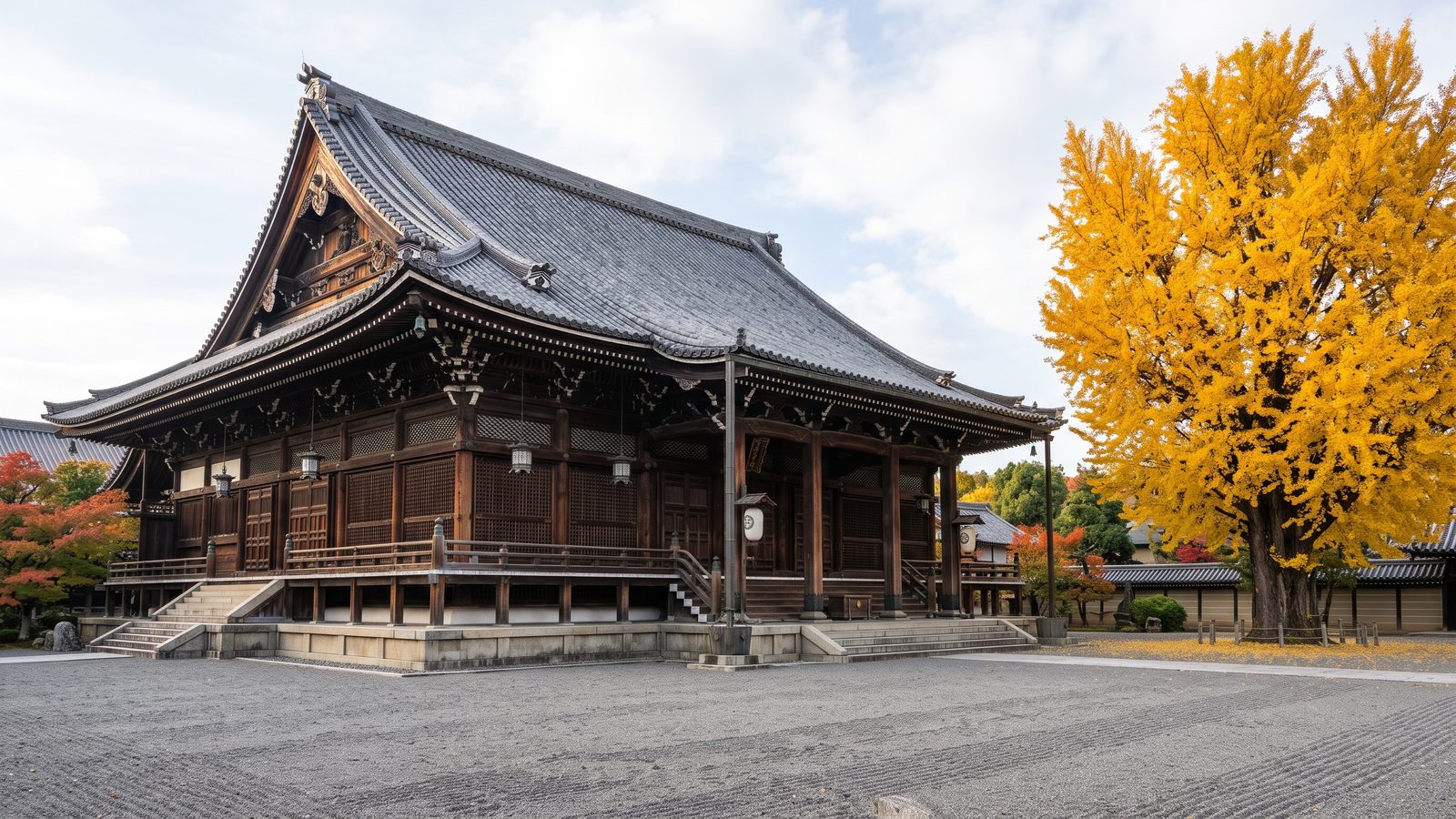
Welcome to Nishi Hongan-ji Temple, the magnificent spiritual center of Jodo Shinshu Buddhism in Kyoto. Established at this location in 1591, this vast complex showcases grand wooden architecture and centuries of devout history. As you wander past massive worship halls like the Goei-do and Amida-do, you enter a sacred realm where political strategy, imperial history, and profound Buddhist devotion intersect to create one of Japan's most celebrated historic sites.
This self-guided audio tour reveals the subtle details hidden throughout the temple grounds. From ornate Momoyama-period carvings to pristine dry landscape gardens, you will experience the living culture, artistic treasures, and architectural marvels that have sustained Japanese faith and aesthetic tradition across generations.
Listen to a sample
The opening of this tour, exactly as AllTours narrates it on site.
What you'll hear on this tour
Stop 1. The Day-Spending Gate and Golden Screens
You stand before the magnificent Karamon Gate, a Momoyama-period masterwork also known as the Higurashi-mon, or 'day-spending gate.' As your eyes trace its surface, you see mythical kirin and phoenixes carved into gilded cypress wood, bringing ancient Chinese mythology to life. Moving inside to the Shoin, or Abbot’s quarters, you are surrounded by brilliant fusuma-e painted screens crafted by master artists of the Kano school. Vibrant landscapes, delicate floral motifs, and bold flowers-and-birds designs shimmer against brilliant gold leaf backgrounds. Inside the famous Tiger Room, you confront fierce tigers and playful leopards depicted with startling realism, capturing both artistic brilliance and the spiritual strength of the abbot who once resided here.
Stop 2. Master Craftsmanship in Interlocking Wood
You observe the magnificent irimoya-zukuri roofline of the sweeping Goei-do hall, where graceful gables meet hip sections to efficiently shed Kyoto's rain. As you draw closer to the Karamon Gate, you discover rare mokkosan-zukuri gables carved into delicate melon-shaped contours. Craftsmen meticulously hand-planed every beam of hinoki cypress, assembling the structures with intricate kumiki interlocking wood joints that completely eliminate the need for metal nails. These precise joinery techniques allow the buildings to withstand time and seismic tremors while maintaining their spiritual grandeur. Looking above inside the hall, you admire coffered ceilings covered in intricate motifs, bathed in glowing lacquerwork and radiant gold leaf.
Stop 3. Political Rivalry and Spiritual Lineage
You trace the roots of this sacred institution back to the teachings of Shinran, the founder of Jodo Shinshu Buddhism. After moving multiple times, the temple received this strategic parcel of land in Kyoto in 1591 from the warlord Toyotomi Hideyoshi, solidifying its influence in the capital. However, just a decade later, shogun Tokugawa Ieyasu deliberately split the institution to weaken its growing political clout, establishing the rival Higashi Hongan-ji. You stand on grounds forged as much by fierce shogunate politics as by religious faith. This deliberate division permanently reshaped Japanese Buddhism, creating the twin Western and Eastern temples that still dominate Kyoto's spiritual landscape today.
Stop 4. The Meditative Dry Landscape Garden
You step before the Kokatei Garden, a serene karesansui dry landscape attributed to the famous tea master Kobori Enshu. Pristine white gravel is meticulously raked into smooth, rippling patterns that evoke a quiet, infinite ocean. Weathered stones rise deliberately from this sea of gravel, symbolizing sacred islands and distant mountain peaks. You notice gnarled pine trees, painstakingly shaped across generations to embody endurance and wisdom, standing in vivid contrast against vibrant green carpets of moss. This contemplative garden invites you to pause, turn your gaze inward, and appreciate the fleeting nature of time through the interplay of shifting seasonal light and still, sculpted elements.
Stop 5. Living Traditions of Faith and Art
As you walk the grounds, you observe visitors performing gassho, pressing their hands together in a timeless gesture of respect and interconnectedness. This temple serves as a living heart for Japanese cultural heritage. Centuries-old Gagaku court music and dance continue to be preserved here, connecting you directly to classical aesthetic traditions. Nearby traditional rooms host the quiet rituals of Chado, the Way of Tea, where simple gestures express the rustic beauty of wabi-sabi. Annual observances such as the Hoonko service gather devotees from across the nation to honor Shinran, proving that Nishi Hongan-ji remains a vibrant, active center where faith and living culture continuously thrive.
Stop 6. Hidden Genius and Architectural Secrets
As you explore further, hidden details reveal the brilliant ingenuity embedded in this sacred complex. Restoration experts frequently uncover original painterly brushstrokes under centuries of grime and find carpenters' layout marks hidden deep inside ancient timbers. You walk across the specialized uguisu-bari, or nightingale floors, whose pressure-sensitive wooden joists chirped underfoot as an early security system against intruders. Meanwhile, scholars working in the vast temple archives continuously discover forgotten sutra commentaries and historical letters that shed new light on Jodo Shinshu philosophy. Every corner of the temple holds silent clues, offering you a direct, intimate connection to the master artisans who built and preserved this landmark.
Planning your visit
- Best time to go
- Early morning for quiet reflection and soft sunlight on the wooden architecture, or late afternoon in autumn when the ginkgo leaves turn brilliant yellow.
- Approximate duration
- about 1 to 1.5 hours
- Where to start
- Begin your visit at the main entrance gate along Horikawa-dori, facing the grand courtyard between the Goei-do and Amida-do halls.
Access and conditions change seasonally — check the official site before you go.
Frequently asked questions
Is Nishi Hongan-ji Temple worth visiting?
Yes, Nishi Hongan-ji Temple is a UNESCO World Heritage Site renowned for its colossal wooden architecture, National Treasure Karamon Gate, and vibrant Momoyama-period artworks.
How long do you need at Nishi Hongan-ji Temple?
Most visitors spend between 1 and 1.5 hours exploring the main halls, inspecting the intricate gate carvings, and viewing the gardens and exterior artwork.
Why are there two Hongan-ji temples in Kyoto?
In 1602, Shogun Tokugawa Ieyasu deliberately split the powerful Jodo Shinshu sect to diminish its influence, creating Higashi (Eastern) Hongan-ji alongside the original Nishi (Western) Hongan-ji.
Keep exploring
Header image is an AI-generated illustration of Nishi Hongan-ji Temple. AllTours.ai is an AI audio tour guide — point your camera at any landmark and hear its story.