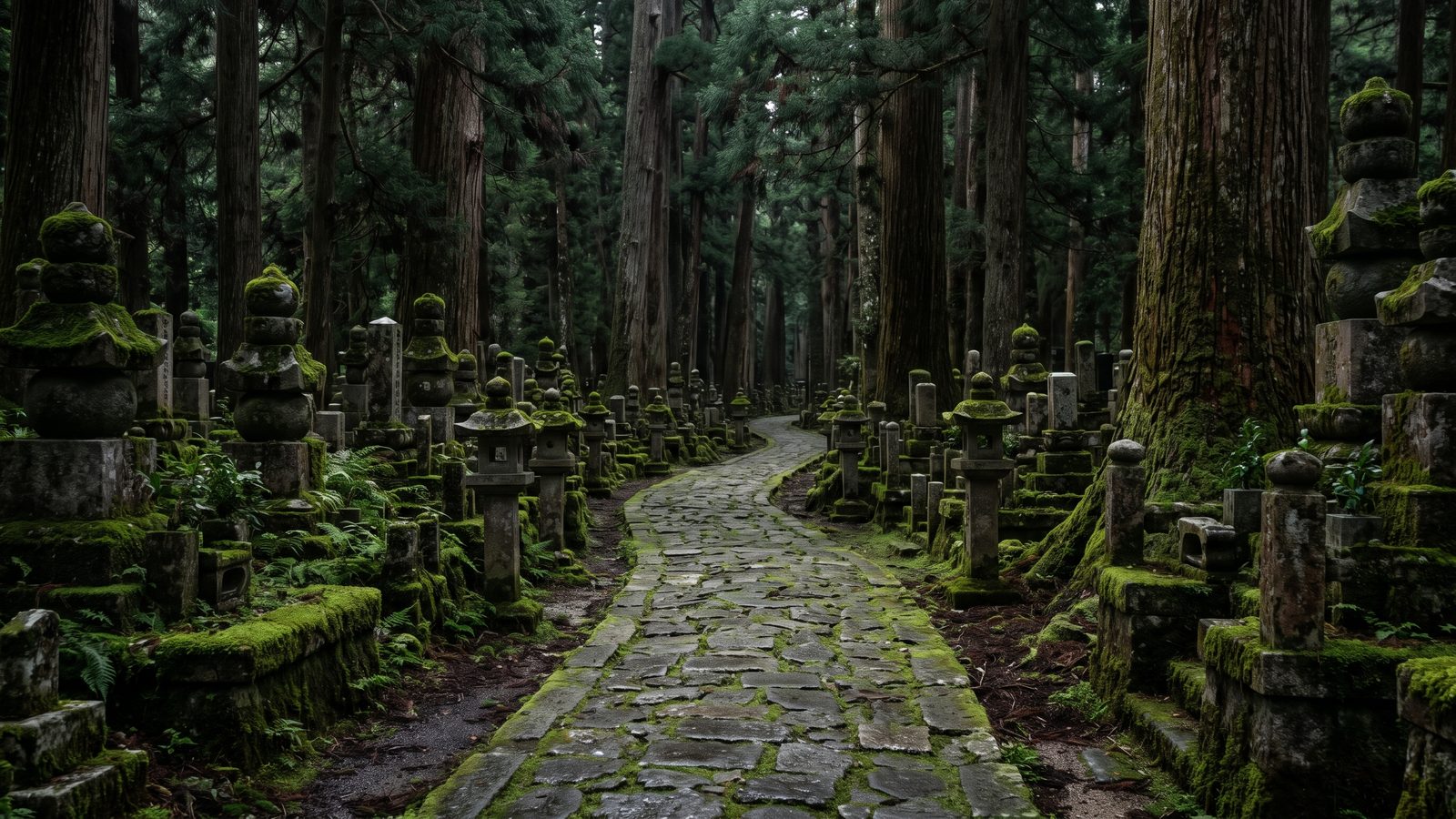
Step onto the stone path of Okunoin, the sacred heart of Mount Koya in Wakayama Prefecture. For over 1,200 years, this vast forest sanctuary has drawn millions of pilgrims seeking spiritual connection. As you walk beneath towering Japanese cedars past more than 200,000 moss-covered monuments, you enter a realm where history and faith interweave. Here, Kobo Daishi remains in eternal meditation, waiting for the future Buddha.
This self-guided audio tour reveals the deep spiritual energy, ancient history, and vibrant nature of Japan's most revered cemetery. From weathered samurai memorials to the glowing Torodo Lantern Hall, your walk through this living landscape will leave an indelible mark on your soul.
Listen to a sample
The opening of this tour, exactly as AllTours narrates it on site.
What you'll hear on this tour
Stop 1. A Living Tapestry of Souls
As you step deeper into the forest, you realize this is far more than a burial ground. Over 200,000 souls lie interred beneath the ancient canopy, each stone monument expressing a deep desire to rest near Kobo Daishi. For twelve centuries, emperors, powerful warlords like Oda Nobunaga's son, and common people have chosen this sacred earth, believing the master is not dead but in eternal meditation. You notice an extraordinary variety of memorials, ranging from weathered ancient stupas to modern corporate monuments. Soft green moss covers weathered stones, creating a profound, hushed atmosphere of reverence where the departed are believed to simply be waiting to awaken alongside the future Buddha.
Stop 2. Twelve Centuries of Devotion
You tread a path shaped by over 1,200 years of profound history. In 816 AD, the monk Kobo Daishi, Kukai, establishes Mount Koya as the retreat for Shingon Buddhism, seeking a peaceful sanctuary far from imperial distractions. When he enters eternal meditation here in 835 AD, Okunoin transforms from a quiet forest into Japan's supreme pilgrimage site. You follow in the footsteps of emperors, samurai, and Tokugawa shoguns who all seek spiritual merit by placing memorials near the revered master. As political eras shift and centuries pass, devotion continuously expands this sacred woodland, creating a timeless living monument where powerful feudal lords and humble commoners rest side by side in silent contemplation.
Stop 3. The Way of Esoteric Meditation
Here, you encounter the living heart of Shingon Buddhism, founded by Kobo Daishi. You reflect on his state of nyujo, an eternal meditative absorption where he continuously practices while awaiting Miroku Nyorai, the Future Buddha. This belief highlights the core teaching that Buddhahood can be realized in this present life. Along your walk, you pass countless Jizo Bodhisattva statues wearing red bibs, symbolizing boundless compassion that protects souls through rebirth and eases suffering. Nearby, thousands of glowing lamps in the Lantern Hall represent an unbroken lineage of prayer and faith. You feel the tangible spiritual energy offering a direct path toward enlightenment and liberation for all living beings.
Stop 4. Guardians of the Ancient Forest
You walk enveloped by towering Japanese cedar trees, or sugi, some standing over 50 meters tall with ancient roots winding beneath the moss-covered path. Damp earth and pine needles scent the fresh air around you, while dense canopies filter the sunlight into ethereal shafts that illuminate green-draped stone lanterns. Vibrant moss blankets every surface in deep shades of green, transforming weathered monuments into living sculptures. As you pause to listen, a quiet woodland symphony surrounds you: rustling leaves, distant bird calls, and soft breezes carrying ancient prayers through the branches. These venerable thousand-year-old trees stand as watchful guardians, breathing quiet life into this sacred sanctuary.
Stop 5. Footsteps of the Dedicated Pilgrims
You join a millennium-old stream of pilgrims who travel here seeking spiritual transformation. For many travelers, arriving at Okunoin marks the ultimate completion of the arduous Shikoku 88-temple pilgrimage circuit, an intense journey taking weeks or months on foot. You contemplate the determination and endurance required to carry only essential belongings while shedding worldly distractions along the way. Pilgrims arrive with hearts full of devotion to pay homage to Kobo Daishi, believing that connecting with him unlocks enlightenment. At his mausoleum, they leave osamefuda, or paper name slips, as tangible records of their journey, keeping alive a sacred tradition of self-discovery that spans centuries.
Stop 6. Where Earthly Bounds Dissolve
You feel a deep peace where the boundary between life and the afterlife grows thin. Kobo Daishi is present here in eternal meditative absorption, awaiting the arrival of the Future Buddha. You sense the tangible devotion of weary pilgrims completing their long journeys to seek blessings and connection. Countless Jizo Bosatsu statues stand along your route, their bright red bibs symbolizing compassionate protection for travelers and departed children. The serene air hums with ancestral veneration and continuous monastic prayers, maintaining an unbroken stream of sacred energy. This timeless spiritual atmosphere offers you quiet solace, connecting your steps to generations of enduring faith within this mystical forest sanctuary.
Planning your visit
- Best time to go
- Early morning for misty light filtering through cedars, or evening to see illuminated lanterns.
- Approximate duration
- About 1.5 to 2 hours
- Where to start
- Ichinohashi Bridge, the traditional entrance to Okunoin Cemetery.
Access and conditions change seasonally — check the official site before you go.
Frequently asked questions
Is Okunoin Cemetery worth visiting?
Yes, Okunoin Cemetery is widely considered one of Japan's most profound spiritual destinations. Featuring over 200,000 moss-covered gravestones beneath ancient cedars and the glowing Torodo Lantern Hall, it offers an atmospheric experience of history and faith.
How long do you need at Okunoin Cemetery?
Most visitors spend between 1.5 and 2 hours walking the cobblestone path through the cemetery to Kobo Daishi's mausoleum and the Lantern Hall.
Why is Okunoin Cemetery so historically important?
Founded in the 9th century when Kobo Daishi established Shingon Buddhism on Mount Koya, Okunoin became Japan's premier pilgrimage destination because believers hold that Kobo Daishi remains in eternal meditation here awaiting the future Buddha.
Keep exploring
Header image is an AI-generated illustration of Okunoin Cemetery. AllTours.ai is an AI audio tour guide — point your camera at any landmark and hear its story.