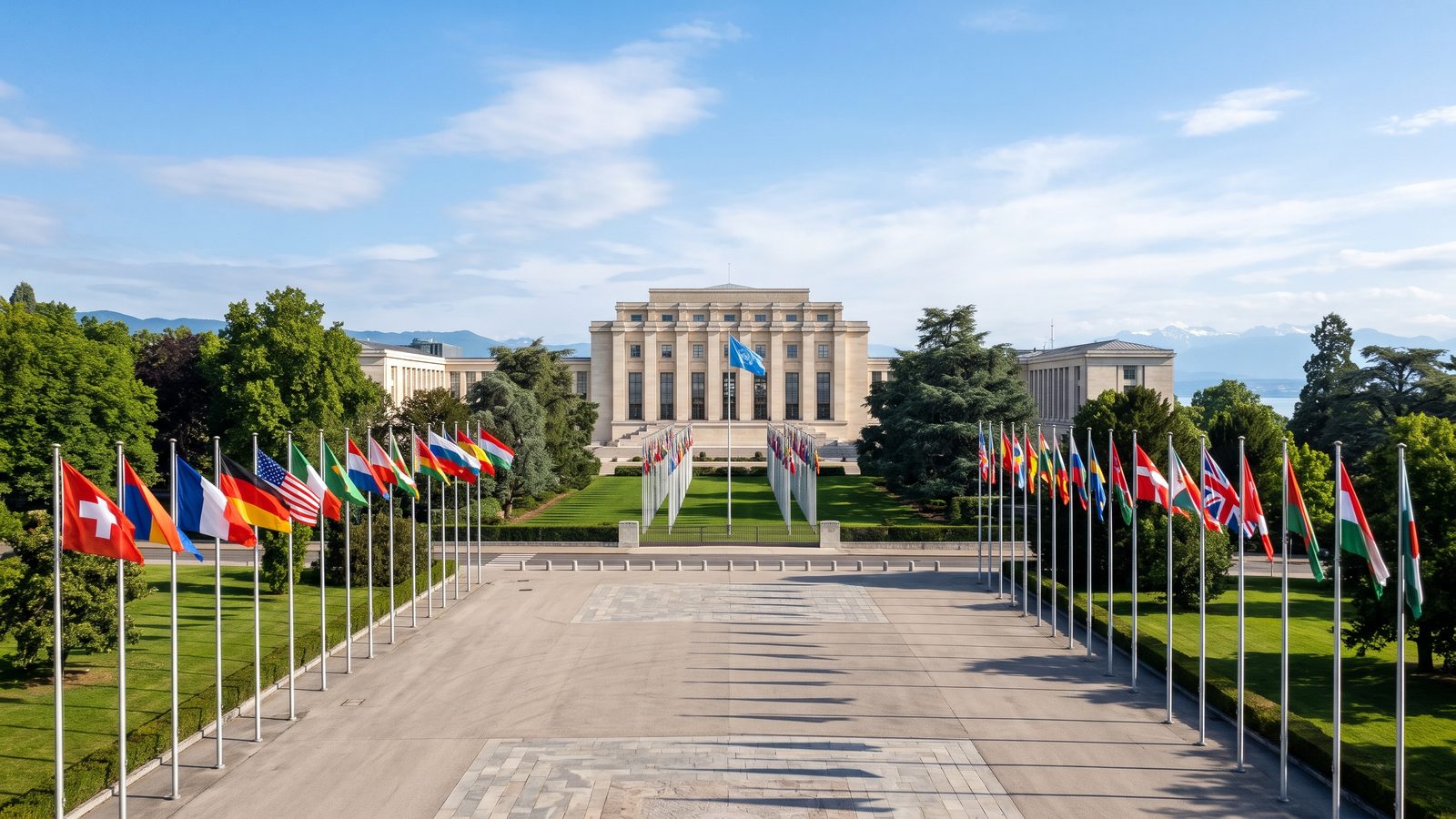
Welcome to the Palais des Nations, the European headquarters of the United Nations in Geneva and a living monument to international diplomacy. Standing as the second-largest UN office in the world, this sprawling complex originally housed the League of Nations following World War I. Today, its grand halls continue to serve as a vital stage where delegates gather from around the globe to negotiate treaties, champion human rights, and seek peaceful solutions.
With this self-guided audio tour, you will discover the rich history, striking Neoclassical architecture, and remarkable diplomatic gifts housed within these walls. Experience the quiet intensity of world-changing diplomacy and explore how humanity's shared vision for global cooperation has evolved across decades of history.
Listen to a sample
The opening of this tour, exactly as AllTours narrates it on site.
What you'll hear on this tour
Stop 1. Origins of a Global Dream
You stand before a complex conceived in the aftermath of World War I as the ambitious home of the League of Nations. Construction begins in 1929 and finishes in 1938, just as international tensions escalate across Europe. As you observe these imposing stone walls, you trace the story of an earnest endeavor that ultimately fails to avert the outbreak of World War II. Yet, this historic setback serves as a pivotal lesson, directly shaping the mission of the United Nations today. You are walking through the birthplace of modern international relations, where hard-earned lessons from the past continue to guide global efforts toward lasting peace.
Stop 2. Neoclassical Gravitas and Local Stone
You gaze at the deliberate Neoclassical grandeur of the Palais, constructed using Swiss Valser stone to convey enduring strength. Designed by a team of prominent architects including Carlo Broggi and Henri-Paul Nénot, every arch, column, and vast corridor projects an intentional feeling of permanence. As you walk through the complex toward the soaring Assembly Hall, you notice how the design balances grand symbolic weight with carefully engineered acoustics. You feel the physical manifestation of an ambitious twentieth-century vision, built to give monumental form to international dialogue and to host delegates from every corner of the globe under one roof.
Stop 3. A Living Gallery of Gifts
You step into hallways adorned with an extraordinary array of artwork, transforming the complex into a dynamic gallery of international understanding. Each intricate mural, detailed painting, and powerful sculpture you encounter is a diplomatic gift presented by a member state to express its unique heritage and shared human values. As you examine these diverse artistic expressions, you observe how member nations contribute their cultural narratives to this central hub of diplomacy. You realize that beyond political debates and official treaties, these creative works weave a vibrant tapestry of global culture that reminds all who enter of humanity’s universal aspirations for harmony.
Stop 4. The Art of Multilateral Consensus
You sense the quiet intensity of these historic chambers, where the delicate balance of international power plays out daily. Here, delegates representing diverse cultures and political systems engage in the meticulous dance of multilateral diplomacy. You imagine backroom discussions and formal debates where every spoken word is carefully weighed to bridge ideological divides. As you walk past these meeting spaces, you learn how negotiators forge consensus on critical humanitarian issues and draft binding international law. You are experiencing the very heart of global governance, where persistent dialogue transforms conflicting national interests into shared solutions for the entire planet.
Stop 5. The Quest for Global Tranquility
You pause in the quiet corridors where humanity's enduring quest for peace takes concrete shape. Within these walls, where the League of Nations first sought to prevent war, the United Nations now works tirelessly to negotiate disarmament treaties, mediate regional conflicts, and protect fundamental human rights. As you reflect on the monumental decisions made inside these chambers, you feel the tangible weight of deliberate, hopeful efforts to move the world away from violence. You realize that every resolution passed and every diplomatic dialogue held here represents a conscious, collective step toward building the bedrock of lasting global tranquility.
Stop 6. A Collective Vision for Humanity
You feel the distinct energy of a space entirely dedicated to global purpose, where nations with vastly different perspectives gather under a shared banner. As you walk through these halls, you reflect on how thousands of treaties, resolutions, and international standards have been crafted within these chambers to uphold human dignity across the globe. You observe how complex international efforts bring opposing viewpoints together to establish common goals for peace and development. Standing in this global crossroads, you absorb the powerful collective will of humanity continuously striving to build a safer, more unified world for future generations.
Planning your visit
- Best time to go
- Morning on weekdays for a quieter experience around Ariana Park and the main palace entrance.
- Approximate duration
- about 1.5 hours
- Where to start
- Outside the main gates of the Palais des Nations opposite the Broken Chair monument at Place des Nations.
Access and conditions change seasonally — check the official site before you go.
Frequently asked questions
Is Palais des Nations worth visiting?
Yes, as the European headquarters of the United Nations and the former seat of the League of Nations, the Palais des Nations offers a unique look into 20th-century diplomacy, architecture, and international history.
How long do you need at Palais des Nations?
Most visitors spend between 1 to 2 hours exploring the exterior grounds, viewing the artwork, and learning about the history of international diplomacy housed within the complex.
When was the Palais des Nations built?
Construction on the Palais des Nations began in 1929 and was completed in 1938 to serve as the headquarters for the League of Nations before becoming the UN's European base.
Keep exploring
Header image is an AI-generated illustration of Palais des Nations. AllTours.ai is an AI audio tour guide — point your camera at any landmark and hear its story.