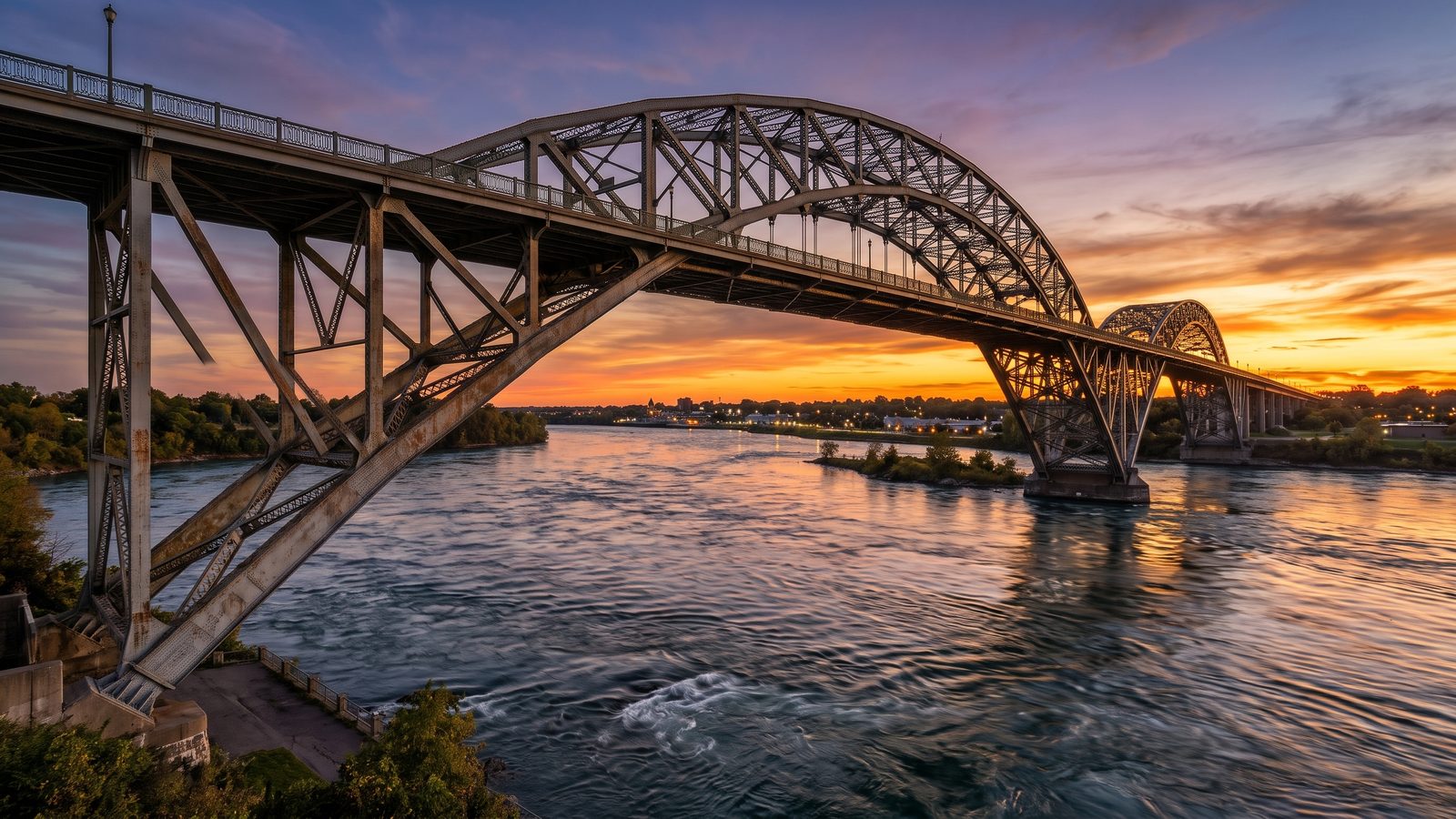
Welcome to the Peace Bridge, a monumental steel arch span connecting Buffalo, New York, to Fort Erie, Ontario. Spanning the powerful Niagara River near the mouth of Lake Erie, this historical structure stands as a living symbol of enduring friendship along the world's longest undefended border. As you walk or drive across, you participate in a continuous story of international cooperation, regional commerce, and shared history between two neighboring nations.
On this self-guided audio tour, you will uncover the visionary engineering, architectural details, and rich historical context behind this famous crossing. From its post-World War I origins to its subtle 'S' curve design, discover how a simple river crossing became an enduring international monument to peace and unity.
What you'll hear on this tour
Stop 1. A Century of Enduring Friendship
You stand before a monumental crossing conceived in the early twentieth century to replace fragile ferry service battling Niagara River ice flows. As you look across the water, imagine how post-World War I desires for reconciliation inspired this structure's profound name. The Peace Bridge officially commemorates a full century of unwavering peace between the United States and Canada, standing as a diplomatic achievement known worldwide. Groundbreaking began in 1925, requiring innovative engineering to overcome fierce currents before opening in 1927. Today, you witness a living monument that transformed regional trade, continuously cementing the vital economic and social ties between Western New York and Southern Ontario.
Stop 2. The Gentle Curve Across Water
Look closely at the magnificent steel structure beneath you and trace the distinctive "S" curve that glides over the river. Designed by visionary engineer Edward P. Lupfer, this subtle bend is a deliberate architectural choice that accommodates the differing approaches on the American and Canadian shores. Rather than drawing a simple straight line, the bridge makes a flowing, welcoming gesture that represents continuous harmony between two nations. As you observe the intricate latticework of steel trusses under the deck, you appreciate the early twentieth-century industrial prowess required to build it. Each beam and rivet has steadfastly weathered decades of heavy traffic, serving as a lasting testament to human connection.
Stop 3. Straddling an Invisible Boundary
As you pause along the span, you feel the unique significance of straddling an international boundary. There are no imposing walls or heavy fences marking the divide here; instead, you cross an invisible line representing the longest undefended border on Earth. You stand where millions of travelers have paused with passports ready, transitioning seamlessly between distinct legal systems, cultures, and currencies within just a few steps. The customs plazas on either shore act as daily stages for national sovereignty and mutual trust. Rather than separating communities, this managed border serves as a seam that allows families, trade, and shared ideas to flow freely in the spirit of peace.
Stop 4. Elegance Rooted in Strength
Notice the three main arch spans rising above the river, each engineered as a precise parabola to transfer immense weight down to massive concrete piers. These anchors are rooted deep within the riverbed, built to endure the crushing force of Niagara River currents while maintaining a robust aesthetic. Look up to contrast these heavy foundations with the light, almost filigree quality of the overhead steelwork. Along the walkway, simple steel railings guide your gaze toward panoramic views without obstructing the skyline. Even the bridge's lamp posts cast a warm light that highlights its structural rhythm against the night sky, transforming a vital transit artery into a carefully composed architectural landmark.
Stop 5. Arrival on Canadian Soil
As you approach the northern shore, you enter Fort Erie, Ontario, a community shaped by this vital connection. You see the active Canadian plaza processing millions of travelers and billions in trade every year, reflecting Canada's role as an essential economic partner. From this perspective, you appreciate the strategic importance of the Niagara River flowing into Lake Erie for Canadian shipping and industry. This very shoreline witnessed fierce fighting during the War of 1812, making the bridge's dedication to international peace resonate with profound historical weight. Standing on Canadian soil, you feel the shared prosperity and enduring diplomacy that bind these neighboring communities together.
Stop 6. The Living Ritual of Transition
Traversing the span, you feel subtle vibrations beneath your feet as the powerful Niagara River flows relentlessly below. Looking outward, you watch the skylines of Buffalo and Fort Erie shift and converge with every step you take. Passing the invisible midpoint brings a tangible sense of transition that goes beyond simple geography. You are actively participating in a daily ritual of international understanding alongside a steady stream of vehicles and pedestrians. The gentle curve guides your journey smoothly between two distinct national narratives. Notice how the riverbanks and shoreline vegetation change, signaling your entry into a new jurisdiction while celebrating a continuous tapestry of peaceful exchange.
Planning your visit
- Best time to go
- Daytime or late afternoon for clear views across the Niagara River and city skylines.
- Approximate duration
- about 30 to 45 minutes
- Where to start
- Pedestrian access area or plaza on the Buffalo, New York side of the bridge.
Access and conditions change seasonally — check the official site before you go.
Frequently asked questions
Is Peace Bridge worth visiting?
Yes, visiting the Peace Bridge provides striking panoramic views of the Niagara River and Lake Erie while highlighting a historic monument dedicated to international friendship.
How long do you need at Peace Bridge?
Most visitors spend about 30 to 45 minutes exploring the views, admiring the steel arch architecture, and learning about the history of the crossing.
Why was the Peace Bridge built?
It was built in the 1920s to replace difficult ferry travel across strong river currents and to celebrate a century of peaceful relations between the United States and Canada.
Keep exploring
Header image is an AI-generated illustration of Peace Bridge. AllTours.ai is an AI audio tour guide — point your camera at any landmark and hear its story.