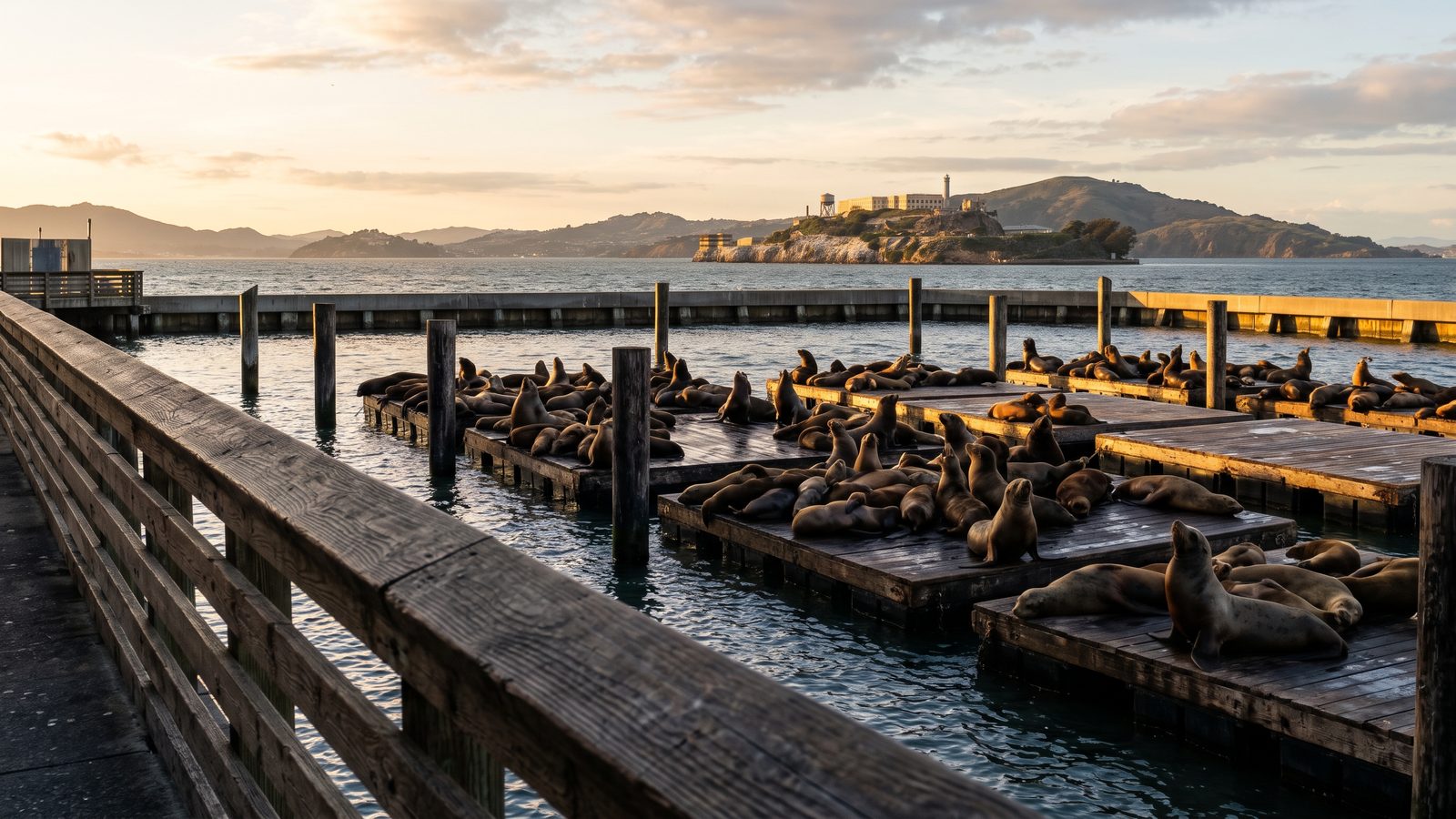
Welcome to Pier 39's K-Dock, where one of San Francisco's most boisterous and iconic wildlife spectacles awaits you. In late 1989, following the Loma Prieta earthquake, a few California sea lions arrived at this sheltered harbor marina. Soon, hundreds joined them, turning working docks into a thriving sanctuary. Today, these wild marine mammals offer an unforgettable glimpse into pinniped behavior right on the city's historic waterfront.
As you walk along the wooden viewing platform, you hear an echoing chorus of barks and watch comical battles for sunbathing real estate. This self-guided audio tour reveals their fascinating social dynamics, thermal adaptations, and historical arrival along the dynamic, fog-swept waters of the San Francisco Bay.
Listen to a sample
The opening of this tour, exactly as AllTours narrates it on site.
What you'll hear on this tour
Stop 1. Masters of the Marine World
You stand before a thriving colony of California sea lions, Zalophus californianus, perfectly adapted for life in San Francisco Bay. Look at their sleek, torpedo-shaped bodies gliding through the water, propelled effortlessly by strong fore-flippers. Listen to the constant chorus of barks, growls, and honks filling the air; this complex vocal dialogue allows them to claim territory and communicate socially. You can spot the massive bulls by their broad heads and deep vocalizations as they compete for warm sunning spots. Watch how they raise a flipper or splash water to thermoregulate, and notice their long whiskers, sensory tools that detect prey like herring and anchovies in murky bay waters.
Stop 2. Decoding Pinniped Social Life
Lean against the railing and observe the complex social hierarchy unfolding across K-Dock. You witness a giant bull assert his dominance with a deep roar that reverberates across the marina, prompting smaller males to scurry away. Watch closely as some animals raise a single flipper high into the air, exposing blood vessels to regulate their body temperature against the sea breeze. Notice the stark transformation when a clumsy, lumbering creature slides off the plank and instantly transforms into a fluid, graceful swimmer beneath the surface. Nearby, younger sea lions playfully nip and wrestle, sharpening the vital social and hunting skills they need to thrive in the wild.
Stop 3. An Accidental Wildlife Sanctuary
You are looking at K-Dock, a spot that transformed almost overnight from a working marina into a world-famous wildlife sanctuary. Starting around 1990, sea lions began claiming these floating wooden platforms, surprising city locals and boat owners alike. As you watch them jostle for prime real estate, you see an unscripted display of raw, wild nature thriving right in the middle of an urban environment. Their sudden splashes, territorial squabbles, and lazy stretches create a captivating spectacle. You aren't just visiting a typical city harbor; you are standing witness to an extraordinary example of nature's adaptability, where wild animals successfully carved out a home amidst human activity.
Stop 4. San Francisco's Famous Economic Engines
Look out across the crowded walkway and consider how these boisterous creatures became a cornerstone of San Francisco's vibrant tourist economy. Drawing millions of travelers to Pier 39 every year, this colony stands as one of the city's most beloved free outdoor attractions. As you listen to their echoing barks, realize that these animals directly fuel nearby seafood restaurants and souvenir shops lining the pier. Their sunbathing antics grace countless postcards and photo feeds worldwide, offering an iconic city symbol rivaling the Golden Gate Bridge. By choosing K-Dock as their permanent residence, these animals give you an authentic, unscripted wildlife encounter that defines the quintessential San Francisco visit.
Stop 5. Adaptable Urban Bay Dwellers
Observe how effortlessly these marine mammals have adapted to their man-made urban sanctuary. Following the 1989 Loma Prieta earthquake, sea lions recognized K-Dock as a safe, predator-free haul-out location with rich feeding grounds nearby. As you watch the colony, note the dynamic size differences; mature males can weigh twice as much as females and dominate the central planks with guttural roars. While many California sea lions migrate south for breeding seasons, a significant group chooses to reside right here at Pier 39 year-round. These expert hunters routinely dive deep into the bay to pursue anchovies and herring, using sensitive whiskers to navigate the dark waters beneath you.
Stop 6. The Dynamic San Francisco Bay
Turn your eyes outward toward the open water to take in the vast harbor surrounding Pier 39. This deep-water bay served as the historic gateway during the California Gold Rush, rapidly transforming a quiet settlement into a bustling global port. Feel the ocean air and notice the powerful tides and shifting currents that challenge local mariners every day. As you look out past the dock, you can see Alcatraz Island resting in the distance, often framed by the dramatic fog rolling across the Pacific. Today, fishing trawlers, commuter ferries, and massive container ships navigate these very waves, carrying forward a rich maritime tradition alongside the resident sea lion colony.
Planning your visit
- Best time to go
- Year-round, with winter months seeing peak sea lion numbers; visit in early morning or late afternoon for active behavior and fewer crowds.
- Approximate duration
- about 30-45 minutes
- Where to start
- K-Dock at the west side of Pier 39 along the marina viewing railing.
Access and conditions change seasonally — check the official site before you go.
Frequently asked questions
Is Pier 39 Sea Lions worth visiting?
Yes, watching the California sea lions at K-Dock is a uniquely authentic urban wildlife experience and one of San Francisco's top free attractions.
How long do you need at Pier 39 Sea Lions?
Most visitors spend 30 to 45 minutes watching the sea lions' playful behavior, listening to the audio tour, and taking photos from K-Dock.
Why did the sea lions come to Pier 39?
The sea lions first arrived in large numbers in late 1989 after the Loma Prieta earthquake, drawn by K-Dock's sheltered environment, lack of predators, and rich bay feeding grounds.
Keep exploring
Header image is an AI-generated illustration of Pier 39 Sea Lions. AllTours.ai is an AI audio tour guide — point your camera at any landmark and hear its story.