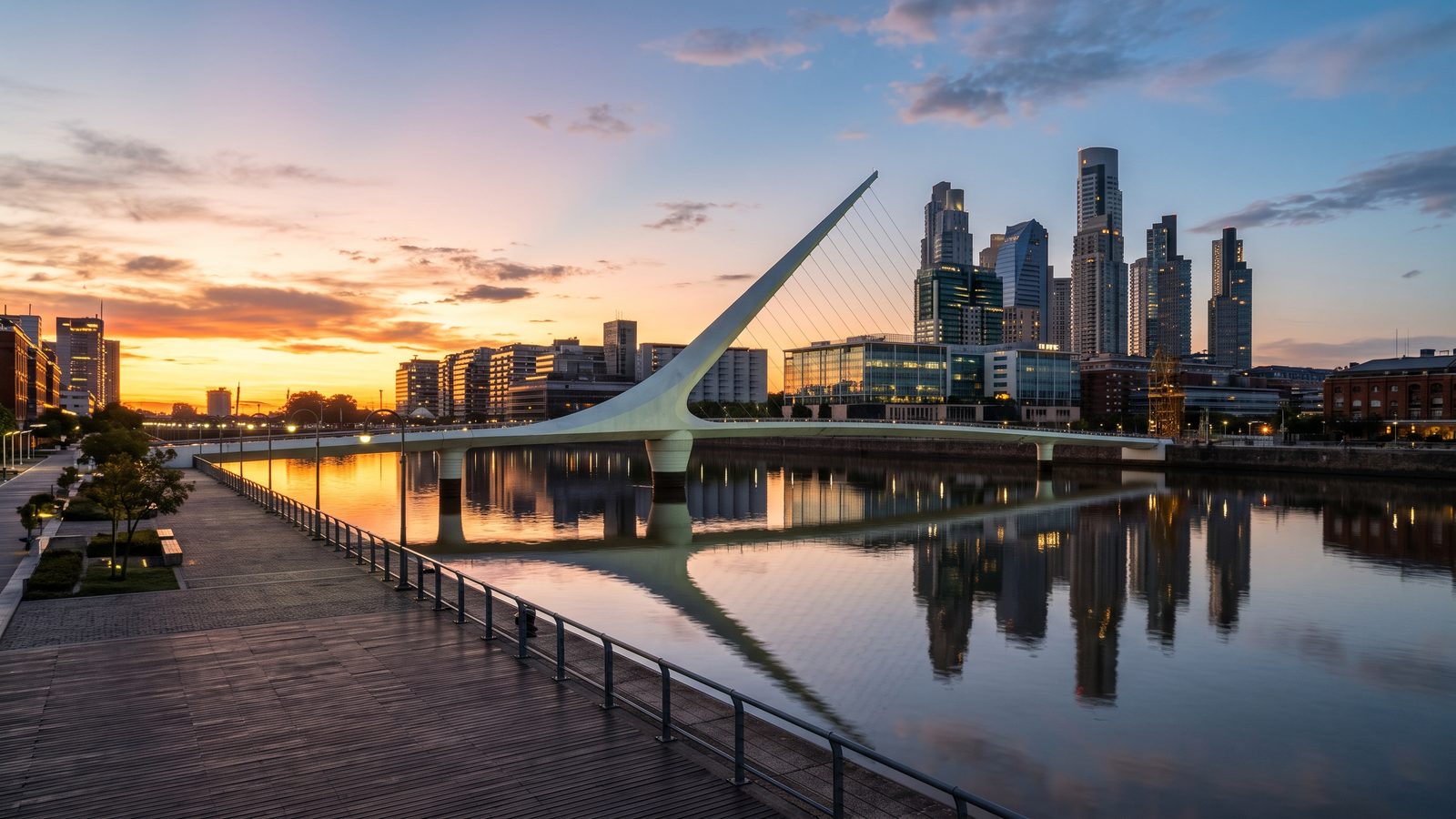
Welcome to Puente de la Mujer, the striking 'Woman's Bridge' that defines the skyline of Puerto Madero in Buenos Aires. Designed by renowned Spanish architect Santiago Calatrava and opened in 2001, this pedestrian bridge is both a vital crossing and a dynamic piece of kinetic sculpture. Its singular white mast and graceful cables evoke the posture of dancers performing a classic Argentine tango over the waters of Dock 3.
On this self-guided audio tour, you will discover the brilliant engineering behind the bridge's rotating deck, walk across its resilient lapacho wood planking, and explore how Puerto Madero transformed from historic cargo docklands into a thriving modern district filled with contemporary flair.
Listen to a sample
The opening of this tour, exactly as AllTours narrates it on site.
What you'll hear on this tour
Stop 1. Architectural Genius of Santiago Calatrava
You stand before an architectural masterwork designed by Santiago Calatrava. As you look up at this dynamic cantilever spar cable-stayed bridge, your eyes follow its single, sharply angled mast piercing the sky like a striking white needle. The entire structure suspends from this central element, which serves as both functional engineering and kinetic sculpture. Notice how the soaring angle visualizes a couple locked in a passionate tango embrace. When tall vessels approach the channel, this entire impressive assembly pivots a full ninety degrees to allow them passage. You are witnessing a bold harmony of advanced structural design, dynamic movement, and deep cultural symbolism floating gracefully over the water.
Stop 2. Strolling Along the Lapacho Deck
You step onto the bridge's pedestrian deck and feel the solid warmth of resilient lapacho wood beneath your feet. This rich, durable timber was carefully selected for its innate beauty and long-lasting strength against the elements. As you stroll along the elevated promenade, you enjoy an unparalleled vantage point over the tranquil water expanse of the Dique and the gleaming Puerto Madero skyline. Notice how the subtle curve of the wooden path gently guides your gaze forward, seamlessly drawing you into the dynamic interplay between contemporary architecture and the river. Every step along this path connects you directly to the modern pulse of Buenos Aires.
Stop 3. The Rotating Tango Mechanism
Focus your attention on the bridge's striking central mast, whose sharp forward angle embodies the posture of a man leading a tango dance. You observe how the entire middle section pivots precisely along this central axis, swinging ninety degrees in just a few minutes to clear the water channel for passing ships. An intricate web of white tension cables radiates outward from the mast, holding the elegant pedestrian deck in midair. This dynamic structural artistry highlights Santiago Calatrava's ability to transform everyday infrastructure into a breathtaking, moving spectacle right before your eyes.
Stop 4. Puerto Madero's Historic Docklands Reborn
As you gaze across the peaceful waterfront, you witness the dramatic transformation of Buenos Aires's historic docklands. These calm waters once bustled with cargo ships and industrial trade, but today they reflect the sleek lines of luxury yachts and contemporary high-rises. You feel the seamless blend of industrial heritage and modern elegance defining the reborn Puerto Madero neighborhood. Where dockworkers once shouted, you now hear the quiet lapping of waves against the docks. Take a moment to absorb this contrast, seeing how the city's rich maritime history lives side by side with its forward-looking vision of urban life.
Stop 5. An Emblem of Modern Buenos Aires
You immediately grasp how this soaring mast and delicate cable-stayed deck have transformed into an indelible symbol of modern Buenos Aires. Constantly photographed and recognized across the globe, the bridge perfectly captures the city's balance between cherished traditions like the tango and bold futuristic design. Its clean, instantly recognizable silhouette stands as a testament to Santiago Calatrava's creative vision. As you gaze at its sharp profile framed by sky and water, you recognize that this bridge does not just connect two banks of a dock; it powerfully embodies the vibrant, forward-looking identity of twenty-first-century Argentina.
Planning your visit
- Best time to go
- Late afternoon or early evening to catch the sunset light framing the white mast and modern skyline.
- Approximate duration
- About 30 to 45 minutes
- Where to start
- Dock 3 (Dique 3) promenade along the Puerto Madero waterfront.
Access and conditions change seasonally — check the official site before you go.
Frequently asked questions
Is Puente de la Mujer worth visiting?
Yes, Puente de la Mujer is one of the most famous modern landmarks in Buenos Aires. Designed by Santiago Calatrava, its unique tango-inspired silhouette and dynamic rotating mechanism make it a highlight of the Puerto Madero district.
How long do you need at Puente de la Mujer?
Plan for about 30 to 45 minutes. This gives you enough time to walk across the wooden deck, admire its structural design, photograph the modern skyline, and enjoy the waterfront.
When was Puente de la Mujer built and why is it famous?
Opened in 2001, Puente de la Mujer was designed by architect Santiago Calatrava. It is famous for its sleek cantilever spar design symbolizing a couple dancing tango and its ability to rotate 90 degrees for passing ships.
Keep exploring
Header image is an AI-generated illustration of Puente de la Mujer. AllTours.ai is an AI audio tour guide — point your camera at any landmark and hear its story.