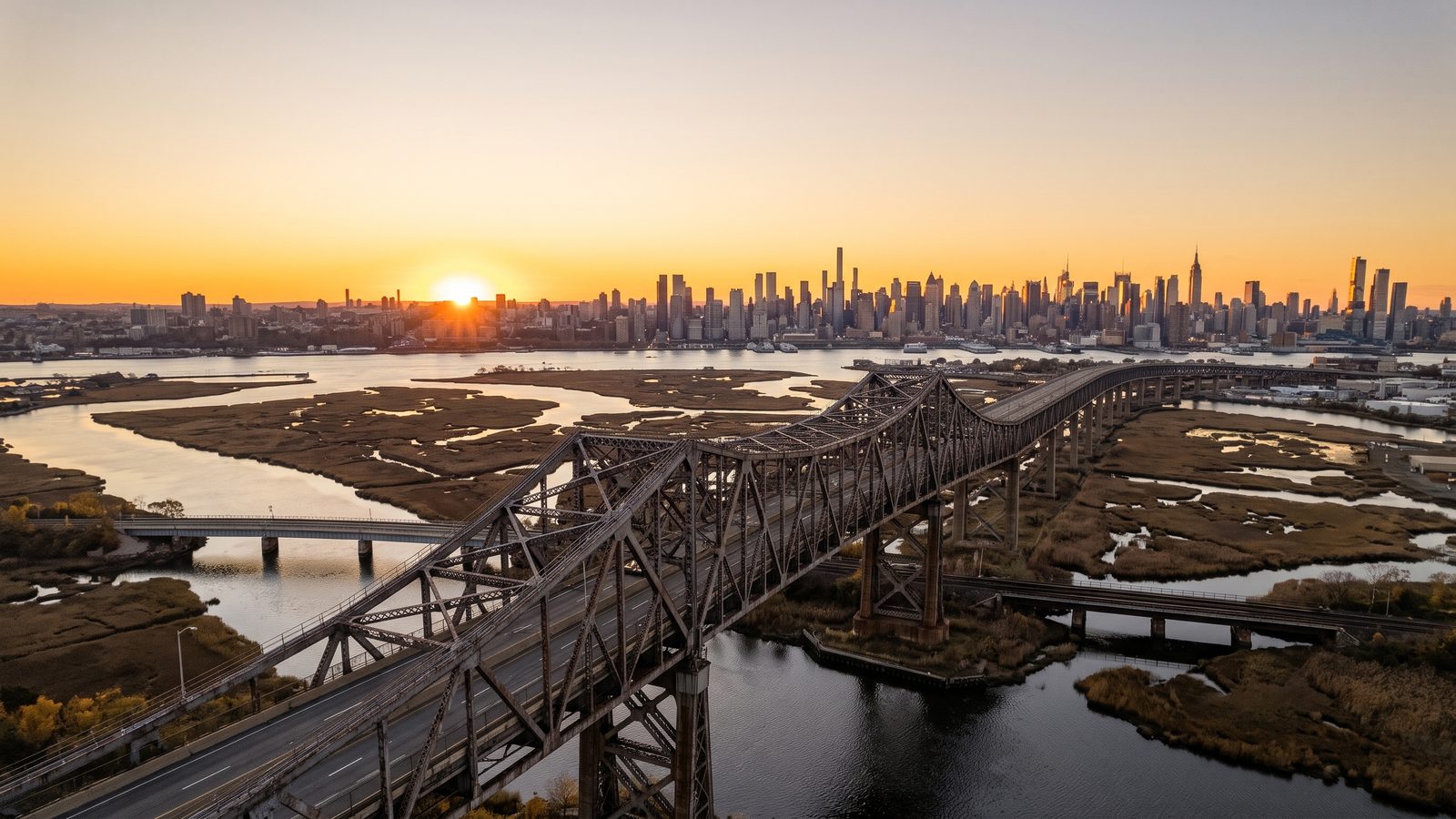
You are embarking on a journey across one of America's most famous elevated highways. Soaring above the marshlands and industrial corridors of northern New Jersey, the Pulaski Skyway links Newark and Jersey City in a dramatic web of steel and concrete. Built during the Great Depression, this historic landmark revolutionized metropolitan transit while offering riders unforgettable visual perspectives on the surrounding landscape and cityscapes.
As you travel along this engineering marvel, you will uncover the political battles, groundbreaking architectural choices, and daily rhythms that defined its legacy. Prepare to witness a monumental product of 1930s ambition that continues to connect regional commuters and global icons to this day.
What you'll hear on this tour
Stop 1. Masterpiece of Steel and Concrete
You stand before a colossal feat of early 20th-century engineering designed by Sigvald Johannesson. Look at how this multi-faceted elevated highway system seamlessly combines massive cantilever truss spans with sprawling plate girder viaducts crossing industrial marshlands. You notice the incredible structural integrity built into millions of hand-placed rivets securing over 50,000 tons of structural steel. Engineer Johannesson originally conceived a revolutionary double-deck design to split heavy traffic flows, solving severe urban congestion long before computer-aided engineering existed. Deep foundations sank into notoriously soft riverbed soil to support this immense weight. Every inch of this monumental superstructure demonstrates unprecedented ambition, creating a durable artery that still withstands modern traffic demands.
Stop 2. Born of Depression and Ambition
You travel back to the late 1920s, when booming automobile ownership choked local surface streets connecting to the newly opened Holland Tunnel. To solve this crisis, visionary builders initiated this monumental public works project in 1930, just as the Great Depression began crippling the nation. You feel the grit of thousands of desperate workers who found essential jobs assembling this elevated highway during an unprecedented economic collapse. Political turmoil soon erupted as local leaders, including Jersey City Mayor Frank Hague, famously mocked the project as a "Bridge to Nowhere." Opening in 1932 and named for Revolutionary War hero General Casimir Pulaski, this controversial structure instantly transformed regional commerce forever.
Stop 3. The River-Spanning Steel Cathedrals
You observe the defining silhouette of the Skyway: its massive cantilever truss bridges. These twin spans stretch over 1,250 feet each, engineered specifically to cross the wide marshlands of the Hackensack and Passaic Rivers. As you trace the complex web of steel girders, you see triangular patterns formed by thousands of massive riveted connections. Workers hoisted these enormous steel sections over treacherous, swampy terrain without needing extensive temporary supports inside deep river channels. This innovative cantilever method allowed continuous navigation while bridging Newark and Jersey City. You stand in awe of this cathedral of steel, a physical manifestation of industrial power bridging two major New Jersey cities.
Stop 4. Panoramas of Newark and Manhattan
As you elevate above the industrial landscape, you witness a striking contrast between two legendary urban skylines. Look right to see Newark’s evolving cityscape, where the Art Deco crown of the National Newark Building stands alongside sleek corporate glass towers. This view captures a visual timeline of industrial heritage giving way to modern rebirth. Turning east toward the horizon, you catch your first breathtaking view of the Manhattan skyline. Soaring towers in the financial district and midtown create a distant, glittering silhouette across the horizon. You stand at a unique elevated threshold, bridging New Jersey’s industrial heartland with one of the world's greatest global metropolises.
Stop 5. Industrial Modernism Above the Marshes
Look closely at the bold architectural statement surrounding you, a landmark of early 20th-century industrial modernism with Art Deco influences. You notice how the monumental scale serves as an intentional artistic choice, creating a dramatic sculptural profile against the urban background. Rhythmic patterns of heavy steel trusses and strong vertical piers evoke the powerful visual language of the machine age. Clean geometric lines demonstrate how form elegantly follows utilitarian function to create a captivating aesthetic experience. The elevated decks transform raw steel and concrete into a linear monument, acting as a permanent gateway that defines the surrounding metropolitan landscape with unadorned structural confidence.
Stop 6. The Pulse of Metropolitan Travel
You join the endless flow of traffic moving across this vital elevated artery. Every weekday, thousands of vehicles form a synchronized migration east toward Manhattan in the morning, then reverse direction as twilight falls. Beneath your vehicle, you feel the gentle sway of thousands of daily commuters navigating this crucial ribbon of steel. Below you, quiet industrial zones awaken as dawn breaks, while evening travel unveils glowing taillights stretching toward the horizon beneath the NYC skyline. Without this elevated bypass relieving congested surface streets, daily travel across the metropolitan area would grind to a halt, making this highway an indispensable lifeline shaping regional life every day.
Planning your visit
- Best time to go
- Clear mornings or early sunset hours for optimal skyline visibility and lighter traffic.
- Approximate duration
- About 30 to 45 minutes
- Where to start
- U.S. Route 1/9 northbound approach in Newark or Jersey City.
Access and conditions change seasonally — check the official site before you go.
Frequently asked questions
Is Pulaski Skyway worth visiting?
Yes, the Pulaski Skyway offers a unique historic perspective on early 20th-century engineering, industrial architecture, and dramatic views of both the Newark and Manhattan skylines.
How long do you need at Pulaski Skyway?
A drive across the Pulaski Skyway takes about 10 to 15 minutes depending on traffic, though planning 30 to 45 minutes allows time to take in the views from nearby vantage points.
When was the Pulaski Skyway built and who was it named after?
Construction began in 1930 during the Great Depression, and the highway opened in 1932. It was named in honor of General Casimir Pulaski, a Polish military commander and Revolutionary War hero.
Keep exploring
Header image is an AI-generated illustration of Pulaski Skyway. AllTours.ai is an AI audio tour guide — point your camera at any landmark and hear its story.