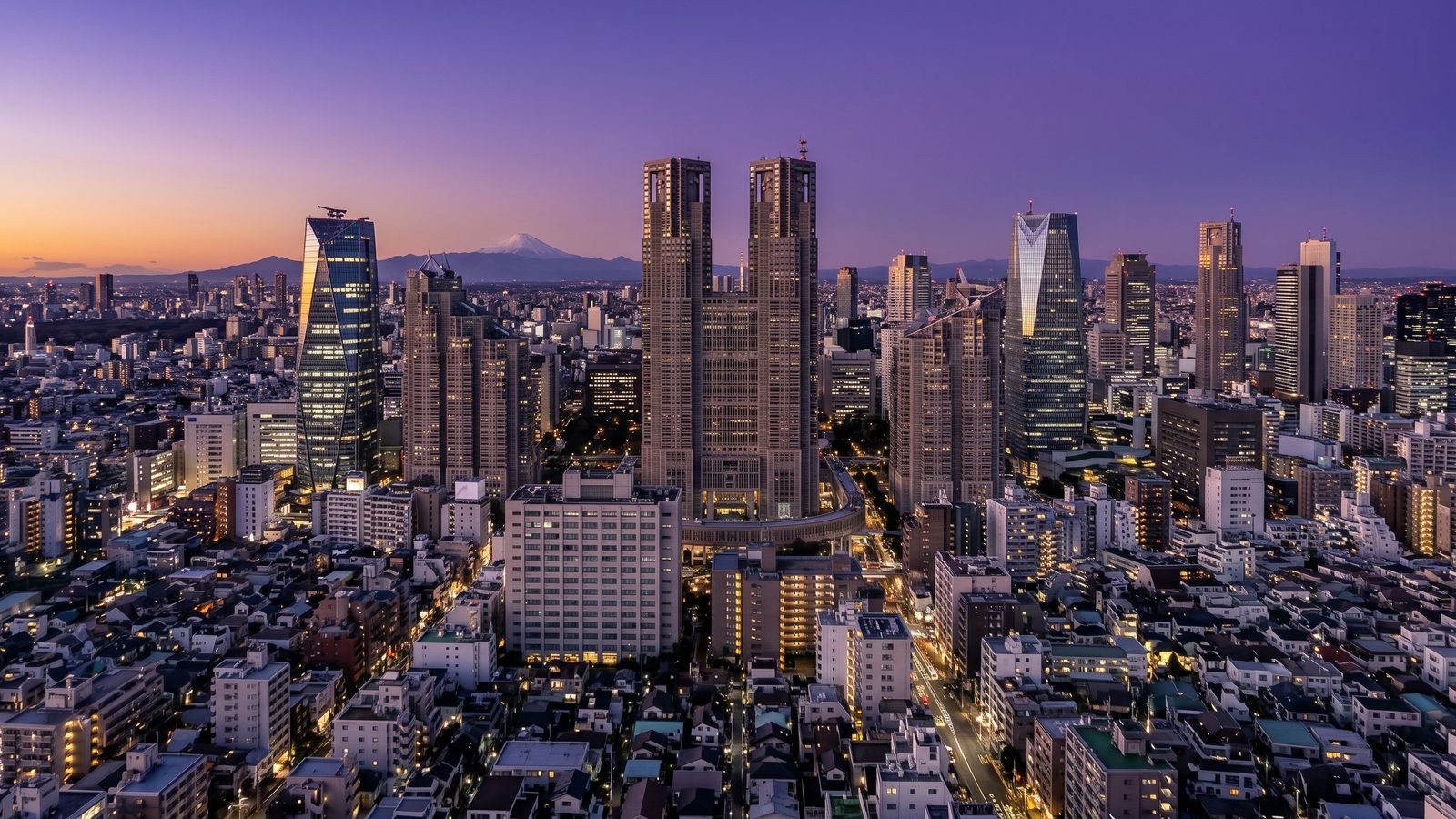
Welcome to Shinjuku, Tokyo's colossal vertical city where cutting-edge engineering meets vibrant urban life. Rising from a post-war landscape, this high-rise district showcases world-class architectural marvels, from Kenzo Tange’s majestic Tokyo Metropolitan Government Building to the sculpted lattice of the Cocoon Tower. As you walk among these looming giants, you will discover how modern technology, cultural discipline, and culinary artistry converge in a neighborhood that never truly sleeps.
This self-guided audio tour leads you through towering plazas, hidden basement dining alleys, and world-renowned nightlife districts. Whether admiring panoramic views of Mount Fuji or marveling at flexible seismic engineering beneath your feet, prepare to experience Tokyo’s ultimate symbol of ambition, innovation, and endless energy.
What you'll hear on this tour
Stop 1. Symphonies in Concrete and Glass
You stand surrounded by an extraordinary architectural gallery where Tokyo's ambition reaches skyward. Observe the Tokyo Metropolitan Government Building, crafted by Kenzo Tange; its twin towers boldly reinterpret Gothic cathedrals using modern steel and granite, grounded by a fortress-like lower facade designed to resist earthquakes. Turn your gaze to the Mode Gakuen Cocoon Tower, where a distinctive lattice shell symbolizes a nurturing environment for students. Nearby, the Shinjuku Park Tower raises a trio of interconnected spires crowned by verdant rooftops, integrating nature into the skyline. Even the Sompo Japan Building's Brutalist base offers a bold contrast to neighboring shimmering glass skins. You are witnessing an ongoing architectural conversation.
Stop 2. Engineering That Dances with Nature
Look up at these massive towers and consider the hidden technological marvels beneath your feet. You are walking through a living laboratory of urban engineering, where post-war land transformed into a futuristic vertical city. Rather than standing rigid, these structures are engineered to dance with nature during seismic events. Developers pioneered flexible base isolation systems and advanced damping technologies, allowing immense skyscrapers to sway safely and absorb earthquake forces like protective springs. From early computer modeling to high-strength steel and advanced concrete, every building maximizes resilience. Smart climate controls and efficient elevator logistics continuously redefine modern high-rise living in this marvel of human ingenuity.
Stop 3. Tokyo's Horizon and Endless Tapestry
Standing high above the city, you do not just observe Tokyo—you feel its vibrant pulse. From the Tokyo Metropolitan Government Building’s North observation deck on a clear winter morning, look west to admire the majestic, snow-capped Mount Fuji rising against the horizon. Turn eastward, and an endless urban canvas unfolds before you, featuring the red glow of Tokyo Tower and the sky-piercing Skytree. As dusk falls, this panorama transforms into a shimmering galaxy of light. Look down to trace illuminated highways glowing like pulsing arteries across the landscape, stretching your vision past Shinjuku Gyoen all the way to the distant shimmer of Yokohama Bay.
Stop 4. Neon Alleys and Memory Lanes
As twilight fades into night, you step into a dramatically shifted landscape bursting with electric energy. In Kabukicho, colossal neon signs and glittering billboards light up the streets, while arcade chimes, karaoke melodies, and the rich scent of grilling yakitori fill the air. Beyond this glowing spectacle, you wander into the labyrinth of Golden Gai. Here, tiny, intimate bars barely larger than a closet host eccentric owners and creative regulars along worn wooden counters. Nearby, stroll through Omoide Yokocho, or Memory Lane, where smoky food stalls under train tracks preserve a nostalgic glimpse into post-war drinking culture and Tokyo’s authentic nocturnal heart.
Stop 5. Elevated Arts and Basement Flavors
Here in the skyscrapers, dining is refined into an elevated art form. On upper levels, Michelin-starred restaurants serve exquisite kaiseki meals and light, crisp tempura suspended hundreds of feet above glowing city vistas. Master chefs craft teppanyaki or Japanese-infused French cuisine right before your eyes. Yet, as you venture into the building basements, a completely different culinary world invites you inside. Cozy izakayas and vibrant ramen shops serve steaming broths and savory yakitori skewers to late-night commuters. From refined tasting menus overlooking the skyline to humble basement eateries, every bite you take offers a memorable journey through Japan’s rich gastronomic traditions.
Stop 6. Precision, Art, and Urban Harmony
Look closely at the plazas and facades around you, and you discover a cultural homage to precision and functional beauty. These skyscrapers represent Japan's pursuit of progress while balancing ancient aesthetic sensibilities with futuristic vision. Subtle patterns on the building skins echo traditional motifs, while peaceful public art installations soften the surrounding steel and glass. You feel the disciplined energy of the local work ethic in the steady flow of daily commuters moving through the district. Between the towering structures, carefully landscaped gardens offer serene spaces for quiet contemplation, demonstrating a deep respect for harmony amidst the fast-paced pulse of the city.
Planning your visit
- Best time to go
- Clear winter mornings offer the best chance to see Mount Fuji, while dusk into early evening provides spectacular night views and lively nightlife.
- Approximate duration
- About 2 to 3 hours
- Where to start
- West Exit of Shinjuku Station, near the Tokyo Metropolitan Government Building plaza.
Access and conditions change seasonally — check the official site before you go.
Frequently asked questions
Is Shinjuku Skyscraper District worth visiting?
Yes, the district offers an extraordinary mix of iconic modern architecture, free panoramic observation decks, world-class dining, and vibrant nightlife areas like Kabukicho and Golden Gai.
How long do you need at Shinjuku Skyscraper District?
Plan to spend 2 to 3 hours exploring the towers, observation decks, and plazas. If you stay for dinner or explore the nightlife alleys of Golden Gai, budget 4 hours or an entire evening.
How was the Shinjuku Skyscraper District developed?
Built largely on the site of a former water purification plant, the district was developed in the post-war era as a new high-rise civic center to relieve congestion in central Tokyo, pioneering advanced seismic engineering.
Keep exploring
Header image is an AI-generated illustration of Shinjuku Skyscraper District. AllTours.ai is an AI audio tour guide — point your camera at any landmark and hear its story.