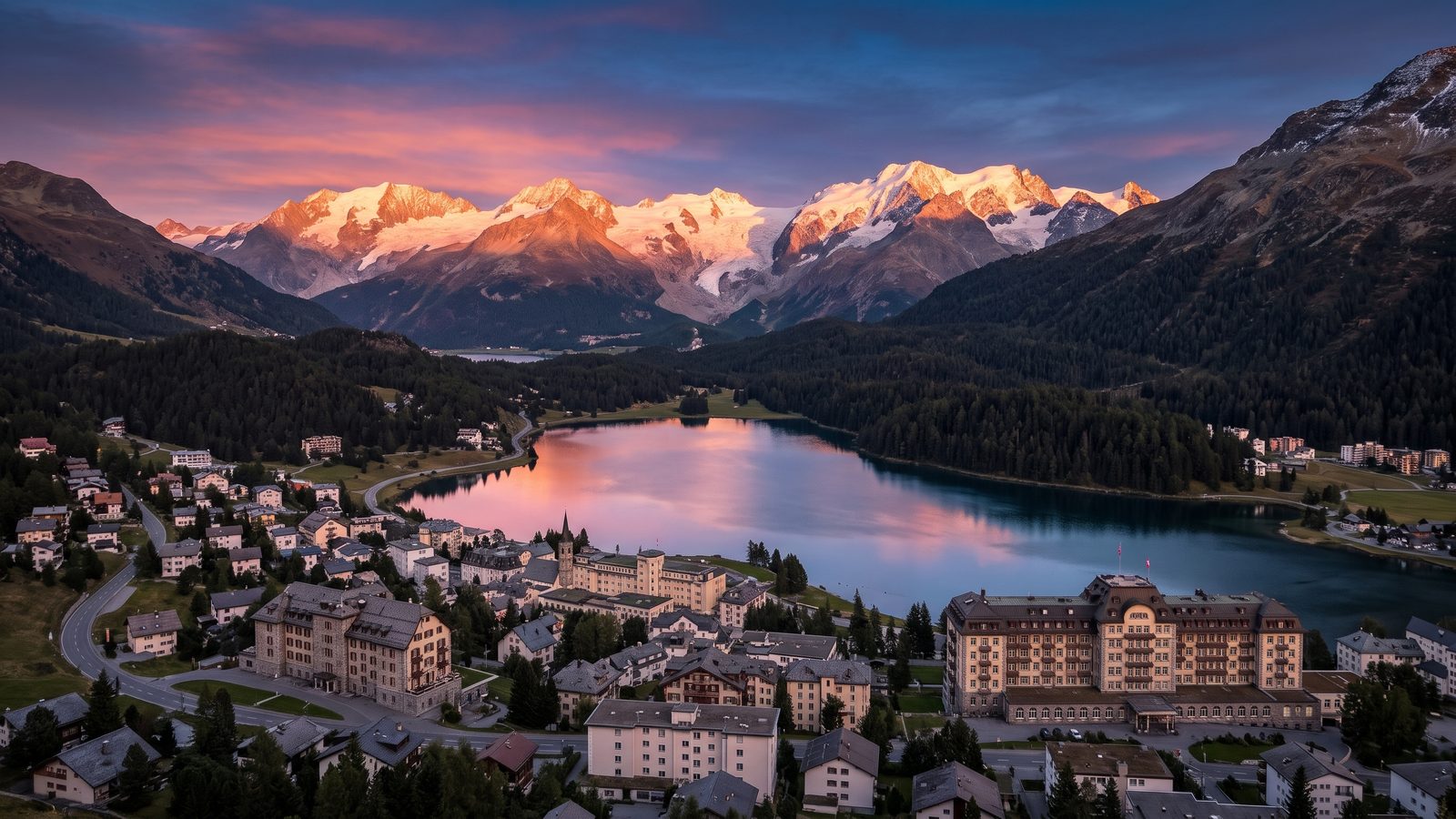
Welcome to St. Moritz, the sparkling jewel of the Swiss Alps nestled in the Upper Engadin valley. Long before it became a playground for royalty and the jet set, this high-altitude haven drew visitors to its ancient, mineral-rich iron springs. Today, you stand in the legendary birthplace of winter tourism, surrounded by dramatic peaks, crystalline lakes, and an extraordinary sun-drenched climate that has captivated travelers for centuries.
As you follow this self-guided audio tour through the village and along its scenic shores, you discover how a daring 19th-century wager transformed a sleepy summer retreat into a global capital of luxury, extreme winter sports, and culinary excellence.
What you'll hear on this tour
Stop 1. The Wager That Changed Winter
You trace St. Moritz's story back over 3,000 years to Celtic mineral springs, later documented by the physician Paracelsus in 1535. However, the modern transformation begins in 1864 with hotelier Johannes Badrutt's legendary wager. He convinces British summer guests to return in winter, offering free accommodations if they do not enjoy the sun-drenched days. His gamble pays off, birthing alpine winter tourism. Soon, frozen lakes become arenas for ice skating, curling, and the first bobsled run in 1889. The village eventually achieves global sports renown by hosting the Winter Olympic Games twice, in 1928 and 1948, forever cementing its status as an iconic alpine pioneer.
Stop 2. Pioneering the Grand Alpine Escape
You walk among the legendary Grand Hotels that pioneered modern alpine luxury. You see grand facades like Badrutt's Palace, where generations of European royalty, celebrities, and international jet-setters enjoy discreet opulence and bespoke service. Along Via Serlas, you explore exclusive boutiques showcasing world-class fashion brands. The valley boasts an astounding density of Michelin-starred dining options where global master chefs elevate local products. Combined with the invigorating, dry air known as the 'champagne climate,' every detail around you reflects a refined tradition of hospitality designed for the most discerning travelers seeking an unforgettable high-altitude retreat.
Stop 3. Adrenaline on Natural Ice Chutes
You feel the palpable thrill of extreme winter sports that put St. Moritz on the map for daring adventurers. Here lies the world-famous Cresta Run, a natural-ice toboggan chute hand-carved every winter, where riders hurl themselves headfirst while braving forces up to 4.5 G around terrifying turns like Shuttlecock. Nearby, teams hurtle down the Olympia Bob Run, a sculpted frozen concrete track, reaching blistering speeds over 130 kilometers per hour. Standing near these historic tracks, you sense the intense courage and precision required to master these icy courses, celebrating a heritage of athletic daring that continues to push boundaries.
Stop 4. Panoramas Across the Upper Engadin
You gaze out across the dramatic scenery of the Upper Engadin valley. Ascending Corviglia, you take in the shimmering expanse of Lake St. Moritz below and the sharp silhouette of Piz Nair dominating the horizon. In the distance, the glaciated summit of Piz Bernina—the highest peak in the Eastern Alps—glitters against the vibrant blue sky. The exceptionally clear mountain air lets you spot individual larch trees miles away. As evening approaches, sunset from Muottas Muragl coats the snow-drenched peaks in a spectacular rose and gold alpenglow, reflected perfectly in the quiet, mirror-like alpine waters beneath you.
Stop 5. Deciduous Larches and Glacier Lakes
You step into the unique ecosystems of the Engadin, famous for its dry 'champagne climate' and over 300 days of annual sunshine. Looking around, you admire the distinctive sapphire blue lakes, fed directly by glacial meltwater. Daily Maloja winds sweep down the valley, drawing windsurfers across Lake Silvaplana's surface. High above, dense forests of golden Engadin larches line the slopes. Unlike typical evergreens, these deciduous conifers drop their needles each autumn, painting the mountains in fiery hues. Quietly traversing these high slopes, wildlife such as red deer and chamois thrive within this extraordinary alpine landscape.
Stop 6. Rustic Flavors and Haute Cuisine
You immerse yourself in a culinary landscape that balances rustic Engadine traditions with world-class haute cuisine. You sample hearty regional comfort foods like Capuns—spaetzle wrapped in chard leaves and topped with melted mountain cheese—and Pizokel, a traditional buckwheat pasta dish served with onions and bacon. You also savor the famous Engadine Nusstorte, a sweet walnut shortbread tart filled with caramel. Alongside these historic dishes, Michelin-starred chefs transform local game, wild mushrooms, Bündnerfleisch, and alpine dairy products into contemporary gourmet masterpieces, offering an incredible farm-to-table dining experience high in the Swiss Alps.
Planning your visit
- Best time to go
- Winter (December to March) for snow sports and frozen lake events, or mid-autumn (October) to see the larch forests turn golden.
- Approximate duration
- About 2 to 3 hours
- Where to start
- Kulm Hotel area or the lakefront promenade along Lake St. Moritz.
Access and conditions change seasonally — check the official site before you go.
Frequently asked questions
Is St. Moritz worth visiting?
Yes, St. Moritz is worth visiting for its unique combination of pioneering winter sports history, luxury heritage, stunning glacial lakes, and over 300 days of annual sunshine.
How long do you need at St. Moritz?
A stay of 1 to 3 days allows enough time to explore the village center, walk along Lake St. Moritz, take mountain railways up to Corviglia or Muottas Muragl, and sample regional cuisine.
How did St. Moritz become a famous winter resort?
St. Moritz became a winter resort in 1864 when hotelier Johannes Badrutt wagered four British summer guests that they would enjoy winter sunshine, promising to cover their travel if they disliked it. They stayed all winter, launching alpine winter tourism.
Keep exploring
Header image is an AI-generated illustration of St. Moritz. AllTours.ai is an AI audio tour guide — point your camera at any landmark and hear its story.