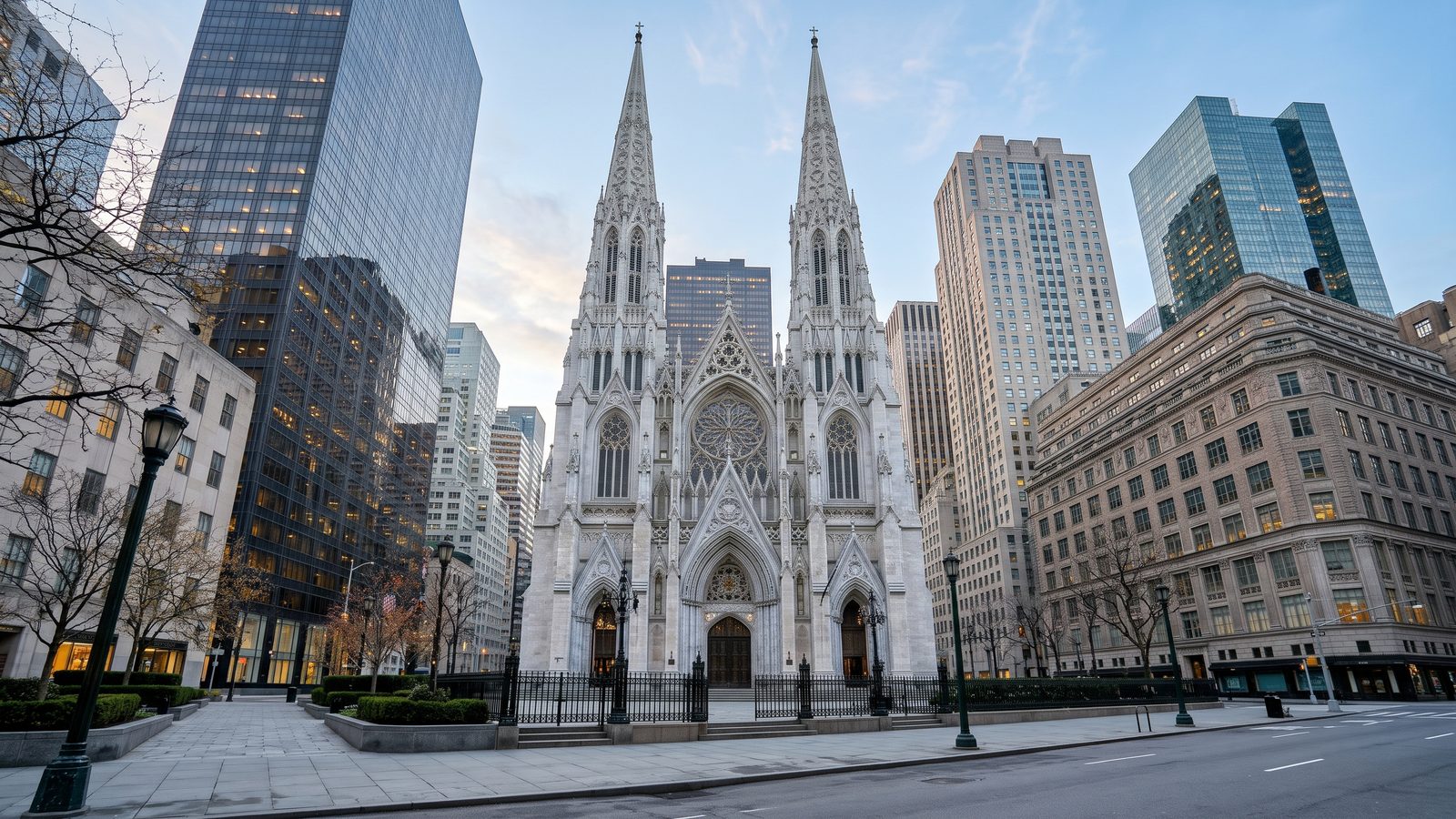
Step off busy Fifth Avenue into the serene splendor of St. Patrick's Cathedral, New York's iconic Neo-Gothic landmark. Built in the nineteenth century under Archbishop John Hughes, this soaring marble sanctuary stands as a powerful testament to faith, immigrant resilience, and architectural vision. As you explore its cavernous nave, radiant stained glass, and detailed marble sculptures, you trace a rich history dramatically framed by Midtown's modern skyscrapers.
This self-guided audio tour reveals the cathedral's deep spiritual heritage, artistic treasures, and unique place in New York City's cultural landscape. Discover how immigrant hands carved this sacred anchor, uniting centuries of tradition with the dynamic energy of one of the world's grandest urban avenues.
What you'll hear on this tour
Stop 1. Soaring Spires and Luminous Marble
As you stand before St. Patrick's Cathedral, you take in the impressive scale of its Neo-Gothic design, crafted by architect James Renwick Jr. as an homage to medieval European cathedrals. You gaze up at the soaring twin spires reaching 330 feet into the Manhattan sky. The façade gleams with white marble quarried in Pleasantville and Massachusetts, shifting dramatically with the city's changing light. You admire the colossal bronze doors weighing 20,000 pounds each, adorned with sculpted reliefs of St. Patrick and St. Joseph. Inside, ribbed vaults and delicate flying buttresses create an illusion of weightless height while grand stained-glass windows flood the interior with kaleidoscopic colors.
Stop 2. Masterpieces of Glass and Marble
You step into the nave to admire a world-class collection of sacred art. Above the Fifth Avenue entrance, you see the Great Rose Window, a brilliant symphony of color depicting the life of Christ, crafted by artists from Chartres and Birmingham. As you wander past the devotional Stations of the Cross, you observe exquisite marble bas-reliefs detailing spiritual journeys. You pause before the Pietà, sculpted by William Ordway Partridge in Carrara marble, offering a moving American perspective on Mary's grief. Approaching the High Altar, you gaze upon European craftsmanship capped by a bronze baldachin that soars toward the vaulted ceilings, surrounded by carved angels and saints.
Stop 3. A Bold Vision Built on Faith
You trace the origins of this cathedral back to 1853, when Archbishop John Hughes, nicknamed 'Dagger John', boldly purchased land far uptown for New York's growing Catholic population. Architect James Renwick Jr. designed the structure, with construction beginning in 1858. However, you discover how the outbreak of the American Civil War in 1861 halted progress for years. Work resumed after the conflict, leading to the cathedral's dedication in 1879. You learn that the twin spires were completed in 1888, while the intimate Lady Chapel was added between 1901 and 1906, finishing a historical journey built upon community resolve and long-term vision.
Stop 4. Neo-Gothic Majesty Among Modern Skyscrapers
You look beyond the marble portals to see how this sacred landmark engages with Midtown Manhattan. The cathedral rises directly from Fifth Avenue, standing as a serene white marble anchor amidst towering glass and steel skyscrapers. You notice how the 330-foot spires create a striking visual dialogue with neighboring modern structures, framing a dramatic tension between past and present. Though surrounded by high-rises, the cathedral never feels dwarfed. Instead, its luminous facade catches the urban sunlight, offering a humbling reminder of enduring faith and architectural grandeur right in the heart of New York City's busiest commercial district.
Stop 5. A Beacon for New York Immigrants
You discover how St. Patrick's Cathedral served as a vital cultural anchor for generations of Catholic immigrants, including Irish, Italian, and Polish newcomers. Its prominent presence on Fifth Avenue proudly asserted their contribution to New York's evolving identity. Beyond daily worship, you reflect on how the cathedral remains woven into the city's civic fabric, host to national moments, state funerals like Robert F. Kennedy's, and annual holiday traditions like Christmas Eve Mass. As you look around, you recognize an iconic landmark seen across art and film, symbolizing the resilient, diverse spirit that defines New York City across generations.
Stop 6. The Living Heart of the Archdiocese
You step into the active spiritual seat of the Archdiocese of New York, where daily faith unfolds around you. At the High Altar, you witness the central celebration of the Catholic Eucharist and priestly ordinations. Behind the altar, you enter the quiet sanctuary of the Lady Chapel, a space dedicated to Marian devotion where visitors pause for personal prayer. You reflect on the cathedral's dedication to St. Patrick, which offered Irish immigrants a spiritual home in the New World. From the solemn confessionals to the detailed bas-reliefs, every corner invites you to contemplate centuries of living Catholic tradition.
Planning your visit
- Best time to go
- Weekday mornings offer a tranquil atmosphere and optimal light through the stained glass.
- Approximate duration
- about 45 minutes
- Where to start
- Outside the main Fifth Avenue entrance, facing the 20,000-pound bronze doors.
Access and conditions change seasonally — check the official site before you go.
Frequently asked questions
Is St. Patrick's Cathedral worth visiting?
Yes, St. Patrick's Cathedral is an iconic Neo-Gothic landmark featuring 330-foot spires, white marble craftsmanship, vibrant stained-glass windows, and rich immigrant history directly on Fifth Avenue.
How long do you need at St. Patrick's Cathedral?
Most visitors spend between 30 and 60 minutes exploring the cathedral's nave, high altar, Lady Chapel, and sacred art collection.
When was St. Patrick's Cathedral built?
Land was purchased in 1853, construction began in 1858 under architect James Renwick Jr., and the cathedral was dedicated in 1879, with spires completed in 1888.
Keep exploring
Header image is an AI-generated illustration of St. Patrick's Cathedral. AllTours.ai is an AI audio tour guide — point your camera at any landmark and hear its story.