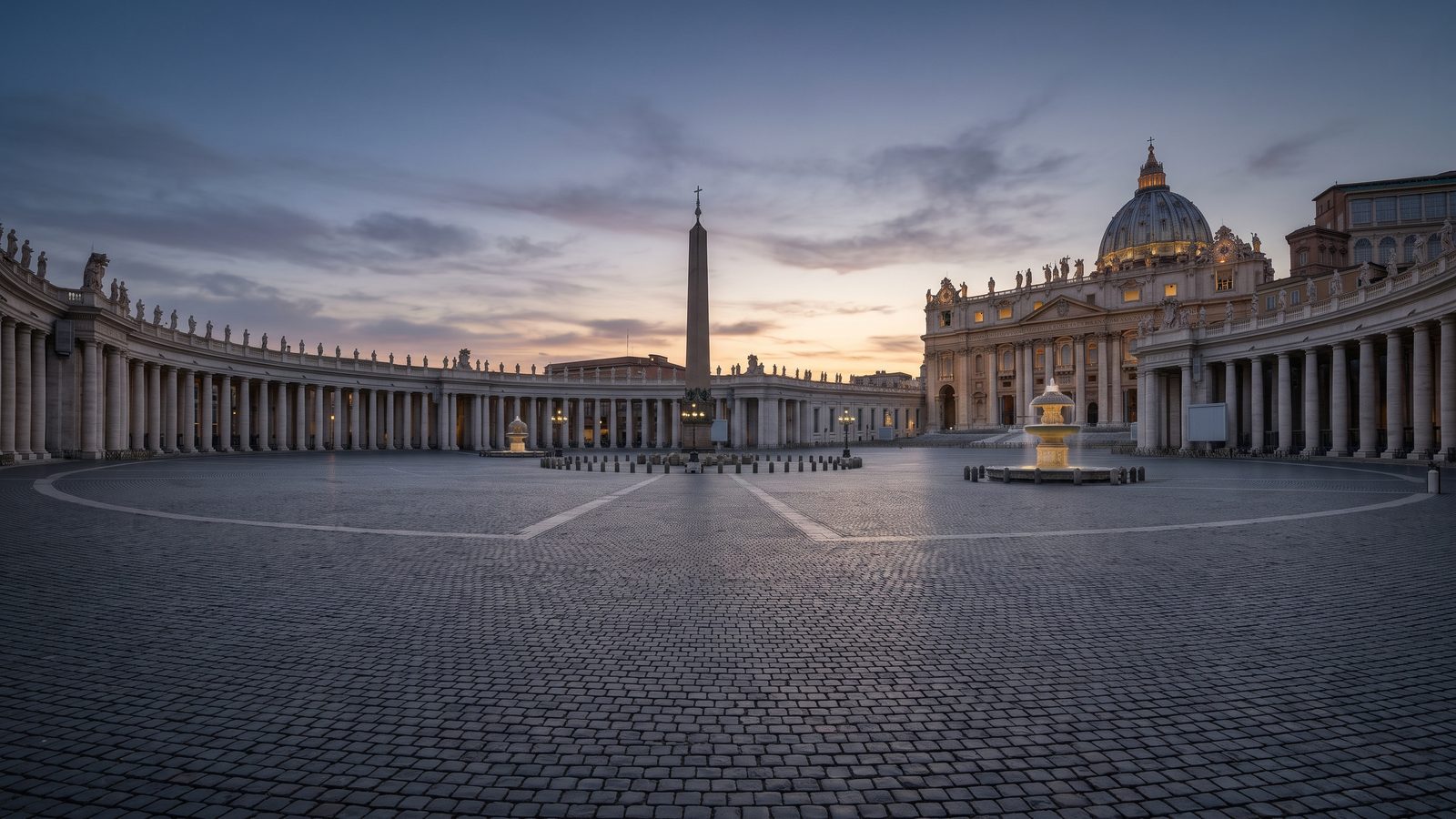
Step into St. Peter's Square, the magnificent spiritual heart of Vatican City designed by Gian Lorenzo Bernini in the 17th century. As you stand beneath the towering colonnades, you are surrounded by millennia of history, from ancient Egyptian obelisks to the solemn site of Saint Peter's martyrdom. This self-guided audio tour leads you through the square's breathtaking optical illusions, sacred monuments, and masterly urban planning.
Experience the grandeur of the papal forecourt at your own pace. Discover how subtle design choices transform stone columns into a welcoming embrace, while dramatic stories of Renaissance engineering and early Christian history bring every corner of this iconic piazza vividly to life.
Listen to a sample
The opening of this tour, exactly as AllTours narrates it on site.
What you'll hear on this tour
Stop 1. Fountains, Saints, and Ropes on Fire
Look up at the ancient Egyptian Obelisk standing silently in the square's center. Moved here in 1586 by Domenico Fontana, this massive sentinel once stood in Nero's Circus. During its tense relocation, strict silence was ordered under pain of death. Yet as the lowering ropes began to fray from friction, a brave sailor shouted, "Water to the ropes!", saving the monument and winning his family the right to supply Vatican palms. Cast your eyes upward to see 140 saint statues crowning Bernini's colonnades, while twin splashing fountains draw water from Lake Bracciano to symbolize living grace flowing continuously through this sacred space.
Stop 2. Bernini's Masterful Optical Illusions
Sweep your gaze across the breathtaking Doric colonnades enclosing you. Gian Lorenzo Bernini crafted 284 massive columns arranged in four deep rows, framing the square like the outstretched arms of Mother Church. Notice how these curved colonnades resolve the tricky trapezoidal space before the basilica's main façade, making the building appear remarkably wider and more grand. Stand in the center and admire the perfect symmetry between Maderno’s northern fountain and Bernini’s southern twin. At the heart of it all, the ancient obelisk acts as a colossal sundial, casting its shadow across the paving while maintaining an imposing architectural anchor for the entire sanctuary.
Stop 3. From Nero's Circus to Sacred Ground
You stand on ground steeped in millennia of faith and conflict. Before Bernini shaped this grand plaza, the infamous Circus of Nero occupied this very site. Imagine the thunder of chariot wheels and the cries of early Christian martyrs, including Saint Peter himself. In the fourth century, Emperor Constantine built the original basilica directly over Peter's tomb. By the sixteenth century, that ancient structure was decaying, prompting the construction of the new basilica. To organize the chaotic space outside, Pope Alexander VII commissioned Bernini in 1656, who spent over a decade crafting the magnificent colonnades you see today.
Stop 4. The Focal Points and the Sundial
Walk across the expansive paving toward the center of the piazza. Locate one of the circular porphyry markers set into the stones between the central obelisk and the fountains. Stand directly on this spot and look outward toward the colonnades. Through a brilliant optical trick conceived by Bernini, the four deep rows of columns suddenly line up perfectly behind one another, creating the illusion of a single, solid row of pillars. As you take in this sight, remember that the towering Egyptian obelisk behind you acts as a giant gnomon, casting a long shadow that marks time across the plaza day after day.
Stop 5. Architectural Staging of the Sacred Journey
Feel the deliberate transition as you leave the winding streets of Rome and enter this vast open space. Bernini designed this area not just as a static plaza, but as a dynamic theatrical stage for pilgrims. The trapezoidal forecourt subtly narrows as it approaches the basilica, manipulating your spatial perspective to draw your eyes directly toward the grand entrance. Beyond it, the sweeping ellipse of colonnades opens up around you, offering an immediate sense of belonging and protection. The splashing fountains provide a soothing backdrop of sound, insulating your spiritual experience from the noisy city outside.
Stop 6. The Modern Pilgrim's Path
Look back toward the outer boundaries of the square where modern Rome meets ancient faith. While no transit tracks cross this sacred paving directly, lines like Tram 19 have long carried visitors and pilgrims right to the Vatican's doorstep at Piazza Risorgimento. Imagine early twentieth-century electric trams clattering along Roman streets, bringing faithful travelers from distant neighborhoods to seek papal blessings. Riding the tram skirts the heavy Vatican walls, providing a serene transition from the bustling secular city to this quiet sanctuary, continuing a centuries-old tradition of accessibility for everyone arriving in Rome.
Planning your visit
- Best time to go
- Early morning or late afternoon to avoid peak crowds and enjoy ideal light for photographs.
- Approximate duration
- About 45 to 60 minutes
- Where to start
- In the center of St. Peter's Square near the central obelisk.
Access and conditions change seasonally — check the official site before you go.
Frequently asked questions
Is St. Peter's Square worth visiting?
Yes, St. Peter's Square is one of the world's most famous public spaces, featuring Bernini's spectacular 17th-century Baroque colonnades, an ancient Egyptian obelisk, twin fountains, and views of St. Peter's Basilica.
How long do you need at St. Peter's Square?
A dedicated tour of St. Peter's Square takes about 45 to 60 minutes to explore the colonnades, obelisk, optical focal points, and fountains. Extra time is required if you plan to queue and enter St. Peter's Basilica.
Who designed St. Peter's Square and when was it built?
Gian Lorenzo Bernini designed St. Peter's Square between 1656 and 1667 under Pope Alexander VII to create a grand forecourt capable of holding large crowds and symbolically embracing pilgrims.
Keep exploring
Header image is an AI-generated illustration of St. Peter's Square. AllTours.ai is an AI audio tour guide — point your camera at any landmark and hear its story.