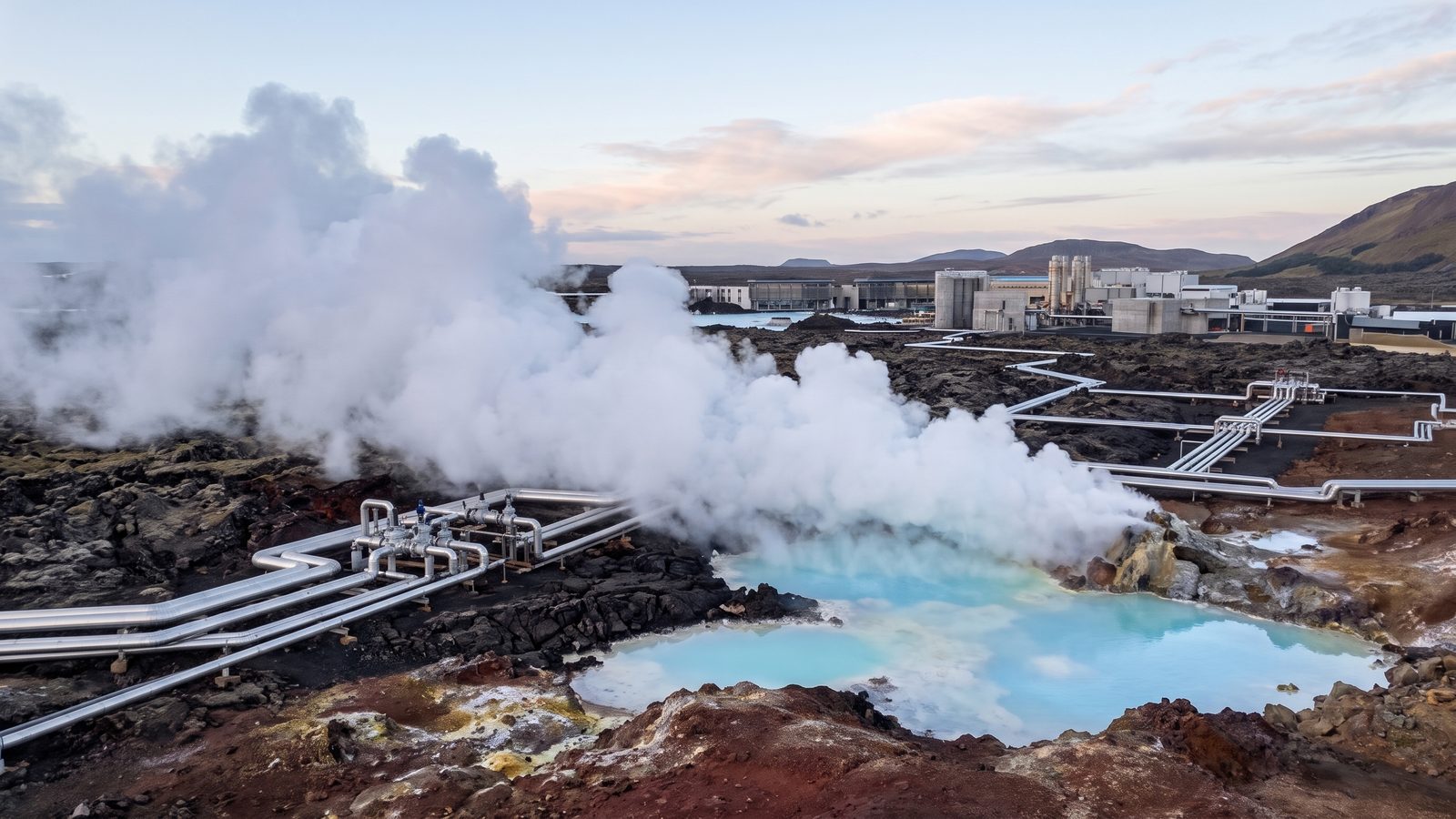
Welcome to Svartsengi Geothermal Area on Iceland's Reykjanes peninsula, where the earth's internal power rises dramatically to the surface. As steam plumes billow against dark, volcanic rock, you stand right above active tectonic forces that heat an entire region. This self-guided audio tour reveals how deep subterranean reservoirs power homes, shape vibrant mineral terraces, and supply the world-famous thermal waters of the nearby Blue Lagoon.
As you walk among silver pipes and rising thermal vapors, you will discover the intricate geology behind divergent plate boundaries and clean energy innovation. Experience the sights, sounds, and sulfur-scented atmosphere of a hyperactive hydrothermal landscape, witnessing raw planetary heat converted into sustainable power directly beneath your feet.
Listen to a sample
The opening of this tour, exactly as AllTours narrates it on site.
What you'll hear on this tour
Stop 1. Harvesting the Power of Deep Magma
You stand above geothermal wells plunging nearly two kilometers into the earth, tapping reservoirs of superheated brine exceeding 240 degrees Celsius. High-pressure steam flashes from this deep fluid to drive massive turbines, generating 76.5 megawatts of electricity for thousands of homes and industries across the Reykjanes peninsula. Beyond electricity, the facility produces 150 megawatts of thermal energy, circulating hot water through district heating pipes directly to local communities. Pioneered in 1976 as a world-first co-generation model on this scale, Svartsengi operates as a sustainable closed-loop system. Cooled water returns deep underground to maintain reservoir pressure, creating a global blueprint for renewable energy extracted from a single volcanic borefield.
Stop 2. Silica Waters and Elemental Terraces
You observe vivid hues painting the ground where deep geothermal waters cool and release dissolved minerals from basaltic bedrock. Supersaturated amorphous silica precipitates into a smooth, opalescent suspension, forming the signature bluish-white deposits that coat the terrain and pools. As you look closer, rusty orange and red streaks reveal iron oxides formed when dissolved iron reacts with atmospheric oxygen. Vibrant yellow crystals of pure sulfur glisten around warmth-scented vents, created as underground hydrogen sulfide gas interacts with air. These dynamic chemical reactions continuously reshape the landscape, creating distinct clay textures and giving the local thermal waters their world-renowned, skin-soothing qualities.
Stop 3. Life on the Diverging Tectonic Ridge
You stand directly on the Mid-Atlantic Ridge, where the North American and Eurasian tectonic plates slowly tear apart. Cold seawater percolates deep into fractured basaltic crust, meeting shallow magma to create superheated geothermal fluids. As these fluids rise, dissolved silica forms delicate terraced deposits in shades of iridescent blue and white along the pool edges. A faint scent of hydrogen sulfide fills the air, signaling intense subterranean chemical activity. Despite the harsh environment, persistent thermophilic mosses and lichens cling tightly to warm mineral vents, thriving on rising vapors. You witness a remarkable ecosystem where resilient micro-flora flourishes against the primal warmth of Earth's internal furnace.
Stop 4. A Raw Canvas of Fire and Steam
You sweep your eyes across a stark volcanic terrain forged by cooling magma. Pathways lead you through dark basaltic flows where twisted, smooth pahoehoe lava lies beside jagged, chaotic a'a formations. These dark rocks absorb sunlight, creating dramatic shadows beneath dynamic Icelandic skies, while the absence of tall trees emphasizes the immense scale of the plain. In the distance, the horizon shimmers through heat and vapor, blurring earth and sky in an otherworldly landscape. Silver industrial pipes stretch across the barren lava like shiny veins, transforming human engineering into part of the geological scenery as you feel the steady subterranean pulse underfoot.
Stop 5. The Visible Breath of Earth's Core
You gaze through dense white clouds of superheated geothermal steam rising from deep subterranean fissures. Deep underground, groundwater encounters magma at temperatures above 200 degrees Celsius, held liquid under intense pressure until it flashes violently into vapor at the surface. You feel subtle vibrations in the air and hear a steady, deep hiss as planetary energy escapes into the atmosphere. Plumes of mist carry invisible microscopic minerals brought up from kilometers below, shifting in density with changing air pressure and wind. Watching these majestic vapors billow across the rugged terrain, you experience Earth exhaling its deep internal heat right before your eyes.
Stop 6. Standing Atop the Continental Divide
You walk along a giant rift where tectonic plates actively pull apart, marking a divergent boundary that stretches across the globe. Underground magma sits remarkably close to the surface, establishing an intense geothermal gradient that heats circulating groundwater. Cold seawater enters through a vast network of faults and cracks in the basaltic bedrock, traveling deep into the crust before heating well beyond 200 degrees Celsius. As this superheated liquid surges back upward, it creates a hyperactive hydrothermal system. You witness a continuous geological exchange where raw planetary energy transforms the surface, constantly reshaping the fractured landscape right beneath your feet.
Planning your visit
- Best time to go
- Year-round; early morning or late afternoon provides soft light and dramatic steam visibility.
- Approximate duration
- about 45 minutes to 1 hour
- Where to start
- Begin at the viewing area near the Svartsengi Geothermal Power Plant, adjacent to the Blue Lagoon access road.
Access and conditions change seasonally — check the official site before you go.
Frequently asked questions
Is Svartsengi Geothermal Area worth visiting?
Yes, Svartsengi offers a rare opportunity to see Iceland's volcanic power in action, featuring steaming vents, colorful mineral deposits, and the world-pioneering geothermal power plant that feeds the Blue Lagoon.
How long do you need at Svartsengi Geothermal Area?
Most visitors spend 45 minutes to 1 hour exploring the viewing areas, taking photos of the landscape, and listening to the self-guided audio tour.
When was the Svartsengi geothermal power plant built?
The Svartsengi plant began its pioneering combined heat and power operations in 1976, making it a world-first co-generation model on this scale.
Keep exploring
Header image is an AI-generated illustration of Svartsengi Geothermal Area. AllTours.ai is an AI audio tour guide — point your camera at any landmark and hear its story.